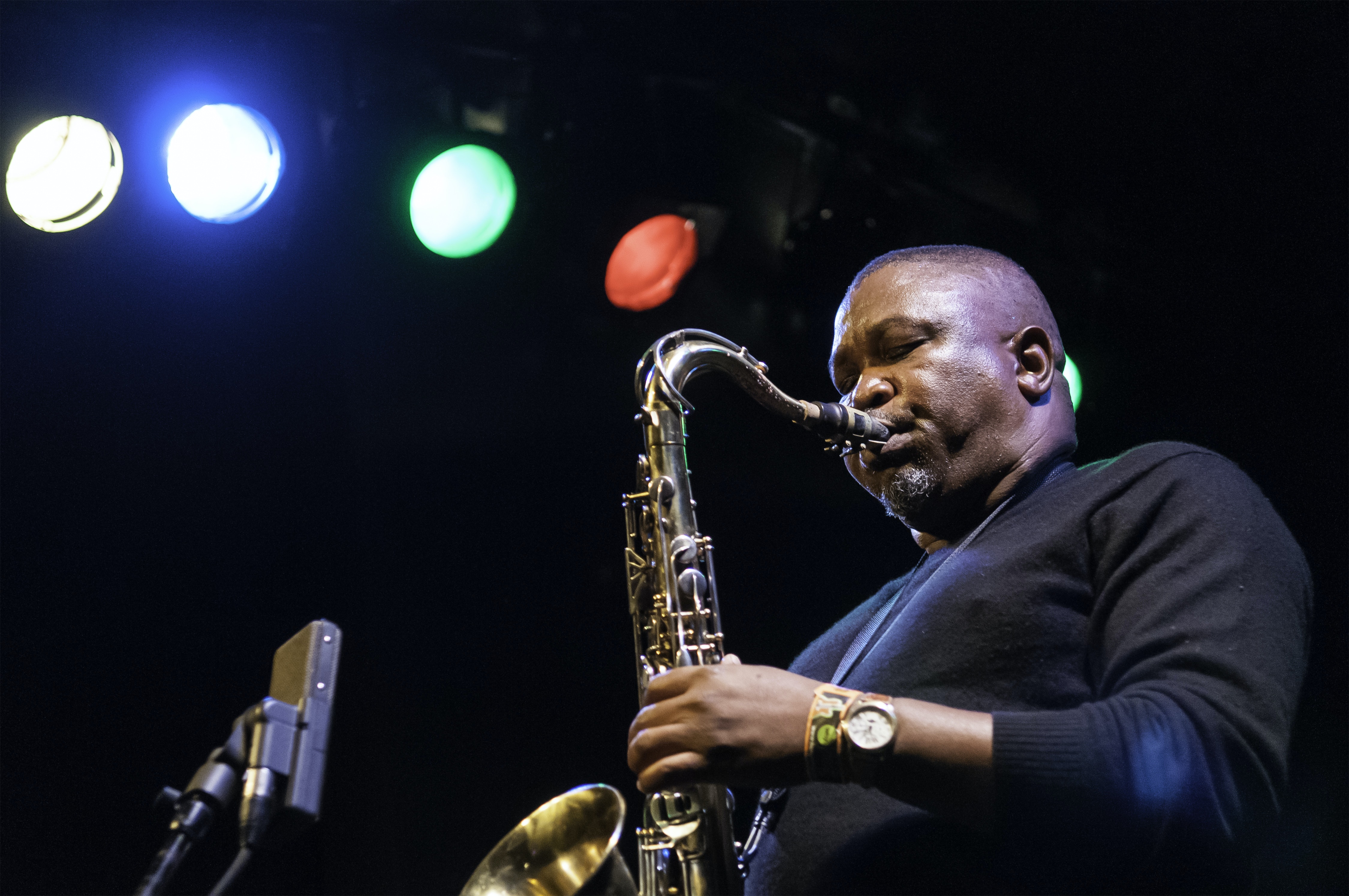
Zimasile ‘Zim’ Ngqawana, died unexpectedly and too soon – on 10 May 2011 at the age of 51 – leaving bereft a family and a musical community that spanned the globe.
A flautist and saxophonist, composer and teacher, Ngqawana was born in New Brighton township in then Port Elizabeth, South Africa. After a university music education he became known on the jazz and dance theatre scenes. It was Ngqawana who was chosen to present music – a 100-piece ensemble – at the inauguration of president Nelson Mandela in 1994. He released his debut studio album, San Song, in 1996. He would tour the world with his band Ingoma and work with the likes of Wynton Marsalis, Abdullah Ibrahim and Hugh Masekela, in turn mentoring a new generation of South African musicians. He later established a school, the Zimology Institute.
Ngqawana’s biography and his achievements are well known.
Recalling him on the 10th anniversary of his death is to remember how a South African jazz musician’s life and death, in a country that generally treats the arts – and especially jazz – as an inconvenience outside of Heritage Day, could resonate so widely.
Ngqawana’s sound – indebted to Xhosa traditional musical, western art music and jazz – fills the silence that destruction leaves. Committed to creativity as healing, Ngqawana’s legacy continues long after his death.
A long line of saxophonists
In the mid-1800s, Belgium’s Adolphe Saxe invented a strange instrument made of brass but which, because of how it produces sound, is classified as a woodwind instrument: the saxophone.
The hybrid instrument was adopted by jazz, a genre that has always embraced hybridity. For jazz scholar Chris Merz, the saxophone in South African jazz became prominent from the 1930s, part of the American Swing craze.
The 1950s saw the global decline of big bands and rise of smaller jazz combos. So began the reign of the alto saxophone in South African jazz, despite some growling intrusions from tenor saxophonists like Winston Mankunku. This is why South African jazz can speak of Ntemi Piliso, Kippie Moeketsi, Gwigwi Mrwebi, Barney Rachabane, Duke Makasi, Robbie Jansen and Dudu Pukwana to name but a few.
It is also why it can speak of Zim Ngqawana.
A self-made brand
We may consider Ngqawana as a ‘self-made’ brand. Through his creations like Zimphonic Suites, Vadzimu, Zimology, Aphorizims, Zimphony Orchestra and the Zimology Institute, he crafted his own public persona in such a way that the culture industry had to follow rather than shape it for him.
Ngqawana’s making of the self was playful, but not superficial. He also resisted the label “jazz”, which he considered at once “too limiting and too all-encompassing”. Confronting the controversial view that there is no word for “music” in African languages, he correctly grasped that this is because, historically, music in Africa was part of life’s sacred and profane rituals. It was ingoma (the drums). In his sleeve notes for the 1999 album Ingoma he wrote:
Ingoma is a tour de force of committed conscious kultur warriors, blowing a national clarion to draw the concerned listener’s attention to the fire that is engulfing our house as a nation in a state of emergency.
Antiquity and modernity
The call for commitment of the artist as cultural worker and warrior, and for the recognition that people’s lives could and must improve, suggests why Ngqawana is important for those who insist on the transformation of our society and refuse to relegate African cultural knowledge systems to the dustbin of the past.
He wrote in 2001’s Zimphonic Suites, that it’s all about “harmony between antiquity and modernity”.
For Ngqawana, this clarion should be heard and acknowledged by all. This explains his visibility on South African TV in the 1990s (especially with the hit Qula Kwedini) and his ubiquity on the airwaves and the live scene and, most importantly, as a teacher.
Meeting Zim
I (Lindelwa Dalamba) first met Ngqawana when was invited to Rhodes University, where he had studied. As a student I was privy to a jazz workshop he held. It was an odd, discomforting jam session.
Ngqawana made us play endless rounds of the standard Stella by Starlight, pushing us to the limits of our tolerance of its melody, chord changes and prior interpretations. That’s the point: to push through the given script until you find yourself on the other side. That used to be the point of jazz.
But my most important encounter was when I ran into him at the University of KwaZulu-Natal as a postgraduate student. Avuncular as ever, he declared his pleasure that those he had known as youngsters were continuing to blow the clarion.
When I said I was no longer blowing the saxophone, now determined to be a jazz musicologist, he promptly went to his office and returned with a copy of every single one of his albums, along with a copy of Amiri Baraka’s Blues People: Negro Music in White America. This generosity was an assertion of community, possibly the only impulse that has assured jazz’s endurance in this country. The gift is my memento mori: Ngqawana’s mortality, beyond death and vandalism, continues to inspire and to teach.
The moment of annihilation
Indeed, in 2010 Ngqawana’s studio was vandalised by scrap metal thieves. To gouge the metal from the grand piano’s legs, it was turned on its side. Windows, the toilet and light fittings were broken. A saxophone was smashed.
At the moment of annihilation, perhaps, our true voice is heard – we scream, sing, respond. In improvising its hesitant future, the artist’s voice is born; informed by all it has ever been and seen. The sound bears witness, exhaled into the impassive air.
“This vandalism,” says Ngqawana in The Exhibition of Vandalizim, a documentary created by African Noise Foundation, “shows the extent of what has happened to them … A vandalism of the soul, vandalism of the heart, vandalism of the mind.”
Committed to creativity as healing, Ngqawana left an extensive archive of published and unpublished music. It is important, therefore, that 10 May 2021 also marks the resurrection of the Zimology Institute, the project he initiated as a holding space for his philosophy and music.
Principles of poetics
His legacy is also one of poetics, the principles – conscious or intuitive and understood in retrospect – by which the artist articulates their style. In the film, a stubbornly resilient Ngqawana sits in the rubble left by the vandals and plays a percussive solo on the broken cistern. “We are condemned … to move into the unknown,” he says. Moving beyond the palpable pain in seeing his instruments and studio destroyed, he insists that the vandals are victims of the barbarism of colonisation. He makes art of the carnage. In filmmaker and writer Aryan Kaganof’s film Legacy he stresses Ngqawana’s interest in the conscience.
Conscience and consciousness formed themselves through artistic discourse in the 1970s and 1980s, where culture was an inextricable aspect of, and outlet for, the political in music. Ngqawana always went beyond the political postures and personalities of the day, cutting through to the meaning of human events and their impact on the experience of freedom.
For us, Ngqawana’s enduring lesson is how art is able to contain, in its creation, its negation:
The true purpose of great music should lead us to silence … from sound to silence.
Qula Kwedini.


