Repatriating migrants misses the point. Systemic issues need to be tackled:
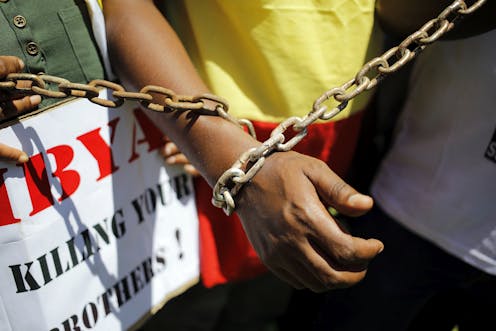
The 2017 European Union-African Union Summit held in Abidjan in December drew up an emergency plan to repatriate scores of African migrants held captive in Libya, and to crack down on the people smugglers.
Since the adoption of the plan, over 3,000 migrants have been repatriated to Gambia, Cameroon, Nigeria, Ivory Coast. The number falls short of the targeted 20,000 the AU wished to return within six weeks of adopting the plan.
About 400,000 to 700,000 migrants remain in precarious conditions in Libya. In a separate programme the UN High Commissioner for Refugees (UNHCR) has evacuated hundreds to Niger and Italy since November 2017.
On the face of it, the decision to repatriate the migrants is a welcome pragmatic intervention. But, at best, it’s cosmetic because it fails to consider the fundamental causes of human flight from Africa. The EU and the AU should rather first address policy and governance issues that create conditions that compel young Africans to seek a better life elsewhere.
Before drawing up the emergency plan, the European and African leaders should have asked themselves whether, given an option, the migrants would willingly have chosen to return home?
I argue that they wouldn’t have for two main reasons. Firstly, they face adverse living conditions at home some of which are partly due to destructive EU policies in Africa. Secondly, some of the AU or member states’ leaders rule over countries that make life difficult for their citizens.
Bad EU policies
The economic circumstances that compel Africans to migrate are aggravated by the negative impact of EU policies. Two cases in point are the EU Common Fisheries Policy and the Common Agricultural Policy.
The fisheries policy has had a negative impact on the fisheries industries in West Africa. For example, most of the agreements the EU has with African countries that have sizeable fishing industries on Africa’s central and western coasts are stacked against African countries.
Also problematic are the subsidies paid to EU commercial fishermen, including those guilty of illegal fishing. Not only are small-time and subsistence fishermen in West Africa unable to compete. Their fishing stocks are depleted for European consumers. Livelihoods are destroyed, food security and marine ecosystems are eroded.
And subsidies paid to EU farmers under its agricultural policy hurt African farmers. They distort markets, undercut farmers, reduce their productive or competitive capabilities affecting entire livelihoods and lifestyles.
Violation of UN protocols
According to the AU and EU, the repatriation of migrants is voluntary. But the voluntary nature of these repatriations has been questioned. Though the final text in the joint declaration pledged voluntary repatriation, the leaders reportedly clashed over differences in the interpretation of the blurred distinction between voluntary and the forced return of migrants.
In addition, the reality is that some migrants were forced to go back home. For example, several Ivorian migrants who were repatriated by their government claimed that they had been forced to return home.
Repatriation should be voluntary as set out by the UNHCR. The physical, legal and material safety of migrants should be central to repatriation.
All this is besides the fact that conditions back home remain the same as they had left when they embarked on the perilous journey. The environment in the communities to which the migrants are returning should be stable enough to enable them to rebuild their lives and maintain sustainable livelihoods. They should also have access to basic services in the communities to which they are returning, for them to be fully reintegrated.
Some of the migrants come from countries where there is fully-fledged conflict such as South Sudan. Others come from countries that have been destabilised and where violence is part of people’s everyday reality. In many, people face persecution on the grounds of their ethnicity, political and social orientations or religion. This includes countries such as Egypt, Somalia, Central African Republic, the Democratic Republic of the Congo, Mali, (northern) Nigeria, Cameroon and, until recently, the Gambia and Zimbabwe.
These conditions generate well-founded fears of unstable environments in which the migrants’ safety, dignity and ability to live decent lives are not guaranteed.
Bad economic conditions, like joblessness, are also a factor that drive migration.
The UNHCR’s requirements are that such conditions should no longer exist before anyone is repatriated. African leaders should have attended to these issues before deciding to repatriate the migrants.
Towards a solution
The UNHCR estimates that there are 277,000 refugees in need of resettlement in 15 priority asylum and transit countries on the Central Mediterranean route.
Relocation can only ever be part of the solution. Europe and Africa should each urgently address the fundamental causes of human flight from Africa, which are rooted in social and political issues. In the meantime they should provide legal avenues through which reasonable criteria are set and against which migrants can be assessed and qualify for migration. The fact that the European labour market requires skilled, semi- and unskilled migrants is beyond debate.

Chris Changwe Nshimbi does not work for, consult, own shares in or receive funding from any company or organisation that would benefit from this article, and has disclosed no relevant affiliations beyond their academic appointment.
Source: The Conversation – Articles (AFRICA)
Read more on The Conversation.
Join the fun: Add Your event | Submit a Press Release | Add your listing.


