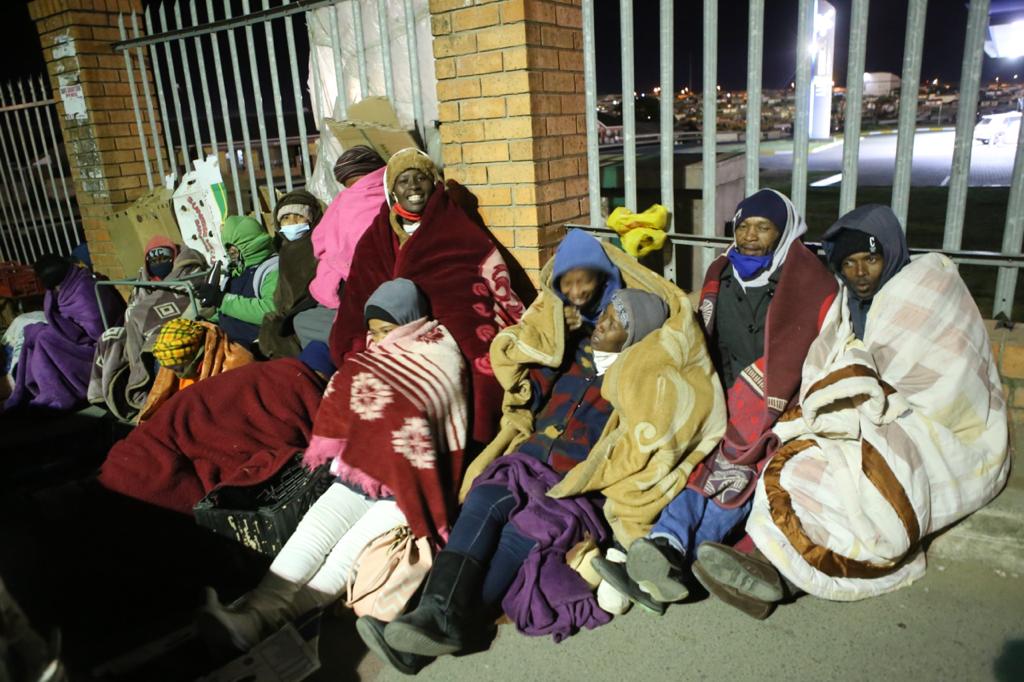
People wait overnight to apply for social grants. Archive photo: Johnnie Isaac
- Research by the Black Sash and the London School of Economics and Political Science has found that lenders who target social grant beneficiaries charge high interest rates though the loans are low risk.
- Children’s grants are widely used as collateral for debt, though this is illegal.
- The report recommends that all lending by those who are contracted by SASSA to assist in the payment of social grants should be banned.
Lenders are making low-risk loans to social grant beneficiaries and charging them high-risk interest rates, a new research report has found.
The report, Challenging Reckless Lending in South Africa, by researchers at human rights organisation Black Sash and the London School of Economics and Political Science examines loans targetting recipients of social grants.
At the online launch hosted by Black Sash National Director Lynette Maart, the report’s research team of Professor Deborah James, David Neves and Dr Erin Torkelson presented findings drawn from nine towns and suburbs across six provinces. Over 18 million people rely on social grants to survive, and with employment opportunities scarce and grant disbursements insufficient to cover living expenses, borrowing has become a lifeline for grant beneficiaries.
The report found that systems set up by Net1/CPS while the company was administering South African Social Security Agency (SASSA) grants created an environment in which lenders lend at high rates of interest. That environment persists, the report finds, with lenders of all types using the built-in reliability of social grants to make low-risk loans, while charging high-risk rates.
Though it is illegal, children’s grants and temporary grants are widely used as collateral for debt.
The report diagnoses three kinds of lending targeted at beneficiaries.
- The EFT/debit model works within the formal banking system, with loans sent to bank accounts, and repayments automatically deducted from those accounts. Since the Post Office took over the SASSA grants system from Net1/CPS, the number of beneficiaries taking out loans within the Net1 system has dropped significantly. But almost one million people still have their grants paid into EasyPay accounts, which allow for automatic debit orders, particularly through Net1 subsidiary Moneyline.
- The hybrid cash/debit model offers beneficiaries cash loans, with repayments automatically deducted from their accounts. The report found that lenders using this model most often engage in illegal practices, even when registered with the National Credit Regulator (NCR). Maps produced for the report show how these lenders have sprung up in the areas around SASSA paypoints.
- The cash/cash model covers much of the informal sector, or mashonisas, where cash loans are repaid with cash. The report finds that many borrowers prefer this, even when higher rates of interest are charged, as repayment terms are more easily negotiated. But the system is open to abuse with borrowers reporting that their Sassa cards are confiscated, with the lender extracting repayment from the borrower at an ATM.
In the formal sector, Net1’s Moneyline offers “no-interest” loans to grantees. However, the report argues that the service and initiation fees attached to these loans are “effective interest”, and these amounts range from 54% to 112% of the loan. Beneficiaries borrowing from Moneyline need only their EasyPay card and biometrics. Under current legislation this form of short-term credit is lawful due to the prevailing interpretation of interest – if these charges were seen as interest, the rates would often exceed the current permitted maximum of 60%.
The report argues that though debt administered through EFTs and repaid by debit order is considered unsecured and subject to high effective rates of interest, in reality, these loans are extremely low-risk, as repayment is guaranteed by the government grants system. A 2017 GroundUp op-ed presented a similar conclusion.
While the report concedes that loans are a lifeline for many social grant beneficiaries, the problems faced by those who fall into debt traps suggest that there is not enough support from government, and little opportunity for recourse for beneficiaries confronted by illegal and unfair practices. This points to a need for changes to debt regulation, advice and relief, as well as enforcement of current regulation.
The report recommends policy changes that would align provisions in the Social Assistance Act, SASSA Act and National Credit Act to ensure that grants are not depleted; that all lending by those who are contracted by SASSA to assist in the payment of social grants should be banned; and that “social grant-based credit ought not to be treated as ‘unsecured’ credit with high interest rates”. The researchers also propose stricter enforcement of legislation, and financial education to help borrowers.
GroundUp contacted Net1 on Friday morning for comment in response to the report. In response, Alex Smith, Chief Financial Officer of Net1, said that the company had not had sight of the report before it was issued to the media. “At no point have the authors of this report been in touch with Net1 for input or comment on the report content. We are not in a position to comment until we have reviewed the document in more detail and will respond as appropriate once we have done so.”
GroundUp will publish Net1’s response as it arrives.
© 2020 GroundUp. This article is licensed under a Creative Commons Attribution-NoDerivatives 4.0 International License.
You may republish this article, so long as you credit the authors and GroundUp, and do not change the text. Please include a link back to the original article.


