A new exhibition in Johannesburg titled !ke e: xarra ke – People who are Different: Come Together celebrates the rock art of the San people, the first inhabitants of southern Africa. Presented by the University of the Witwatersrand’s Rock Art Research Institute and the Origins Centre, the exhibition includes an ultra-high-resolution facsimile of a San rock art panel called the Linton Panel. The panel contains the image chosen for South Africa’s national coat of arms. The exhibition also features a new artwork by descendants of the San people, as well as a book launch. We asked the head of the institute, Sam Challis, to tell us how the painting rose to such national prominence.
Who are the San and what’s their rock art about?
The names San and Bushman refer to the indigenous hunter-gatherers of southern Africa, and their descendants, whose ancestors lived here for many thousands of years. Both names have been used pejoratively – as demeaning terms – for centuries. But now both have been reclaimed as identities to be worn with pride. Some groups prefer either one term or the other, depending on the historical use in their region. South Africans prefer the word San while those in the Kalahari Desert region – and the artists from Nieu Bethesda in South Africa whose work we commissioned for the new exhibition – prefer Bushman.
The rock art is an indigenous archive of San religion: their beliefs about how to transcend realms to heal the sick, influence the movements of animals and control the weather. It is not a “menu” of animals they liked to eat, and these are no idle doodles or simple “records” of events.
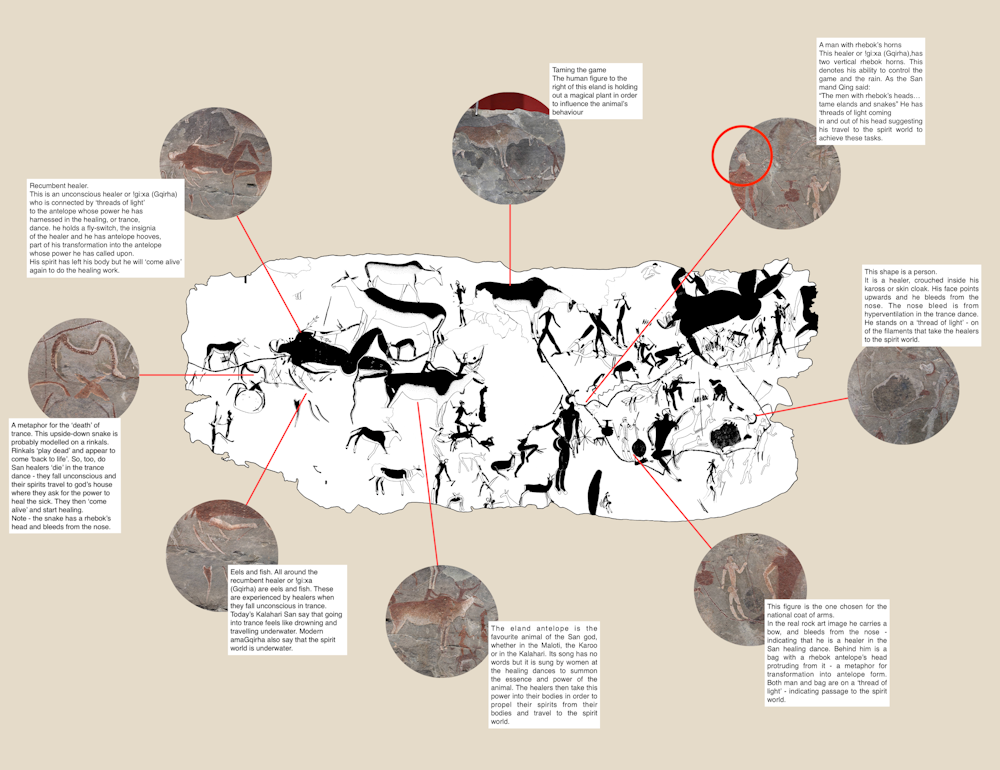
In the 1860s and 1870s, two linguists, Bleek and Lloyd, recorded the language of San Bushmen prisoners being held in Cape Town. Later, scholars realised that these |Xam (San/pronounced “Kgamm”) testimonies produced a “fit” with rock art images, which until then had been poorly understood. Dorothea Bleek’s 1932 study Customs and Beliefs of the |Xam Bushmen proved an almost inexhaustible resource for understanding this religious art from the perspective of the artists. Especially when these beliefs intersected with those of the Maloti Mountain San and Kalahari Bushmen, and other communities who inherited them.
What San painting was used in the coat of arms?
In 2000, President Thabo Mbeki’s office approached the Rock Art Research Institute because they wanted an indigenous rock art image to grace the coat of arms of the new South Africa. (The old shield had contained ox wagons and other colonial images.) The institute’s scholars offered several appropriate options, and the government chose the human figures from the famous Linton Panel, which is displayed at Iziko South African Museum in Cape Town.

With various partners we have reproduced the panel digitally. The art can now be viewed on an interactive zoom console in which visitors can highlight various motifs with explanations.
The two human figures come from one painting of a male figure. In the original, he most likely represents a San healer and game control specialist. He’s been mirrored and stylised to form a gesture of greeting.
How did a San phrase become a national motto?
Mbeki’s office also asked the institute to deliver a new national motto using the |Xam San language. Our professor, David Lewis-Williams, chose the |Xam words “!ke e: |xarra ||ke” from the phrases “people who are different” and “come together”. It can be translated as “diverse people, unite”. The language is no longer spoken (and so does not favour any of the country’s 11 official languages) but it is important to recognise that the people survive. There will be 16 individuals of |Xam descent at the opening, from the Bushman Heritage Museum. Three of these are the artists whose work forms part of the exhibit, in a modern |Xam take on the imagery in the national coat of arms.
There’s also a book being launched?
It is very fortunate timing that the institute’s honorary research fellow, Jeremy Hollmann, is launching a revised edition of his book Customs and Beliefs of the |Xam with Wits University Press at this time. Based on Dorothea Bleek’s 1932 Customs and Beliefs of the |Xam Bushmen, it brings the testimony of the |Xam to a wider audience, making San beliefs more accessible.
Why is this exhibition important?
As part of Wits University’s centenary celebrations, the new exhibit takes a fresh look at the symbols of what it means to be South African while also reflecting on what it means to be colonised and marginalised, as the San were and are. We celebrate the efforts to illuminate the indigenous archive, and to decolonise the images of these and other African ancestors. The Rock Art Research Institute is the first and foremost centre of its kind in the world.

From the 1980s, its scholars, with David Lewis-Williams, joined the academic fight to bring to light the religious, and serious, nature of indigenous images and history. From the 1990s, its teachings have spanned the globe and influenced hunter-gatherer studies from Spain to Siberia and from Cape Town to Canada.
From the late 1990s, under Ben Smith, it strengthened connections across Africa (hosting the digital collections of several other nations) and in the 2000s created the Origins Centre (which then became a separate entity).
The exhibition opens at Origins Centre in Johannesburg on 28 November 2022


