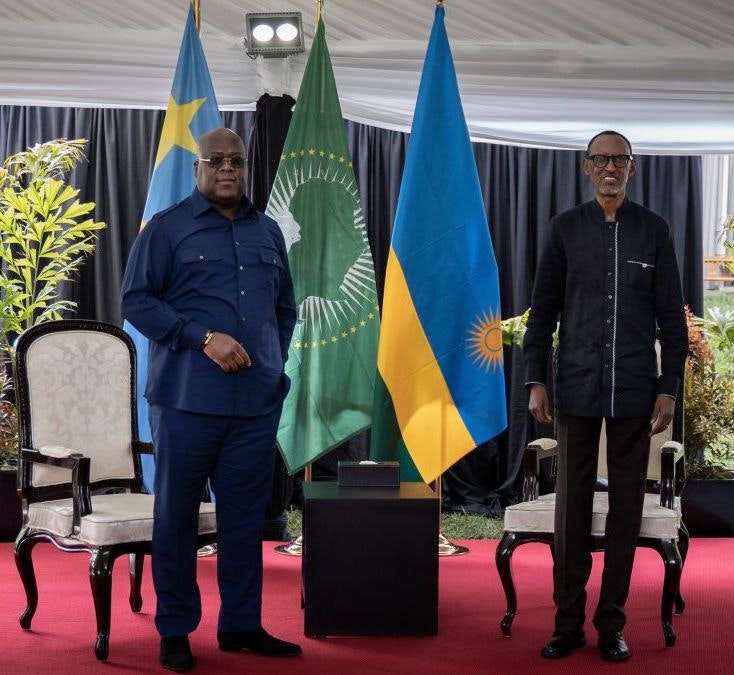
Rwanda and the Democratic Republic of Congo (DRC) make for very unhappy neighbours. Both sides claim the other is set on bringing down their government, and violating past agreements and international norms.
Rwanda accuses the DRC of working with the Forces Démocratiques de Libération du Rwanda (Democratic Forces for the Liberation of Rwanda) or FDLR. The rebel group’s stated aim is to overthrow the Rwandan government.
For its part, the DRC accuses Rwanda of violating its sovereignty by supporting the Mouvement du 23 Mars (March 23 Movement, M23). The rebel group, along with multiple others, is active in the DRC.
A recent United Nations report supports Kinshasa’s contention. The group of experts on the Democratic Republic of Congo detailed its accusations in a 131-page report. Kigali, however, dismissed the findings as “false allegations”.
Rwanda is a country of 13 million people and occupies 26,000 square kilometres. DRC, on the other hand, has 90 million people and covers a territory of 2.3 million square kilometres. The DRC lies to the west of Rwanda. The two countries share a border of about 217 kilometres.
Tensions between the two nations date back to the 1994 genocide in Rwanda when an estimated one million Tutsis and moderate Hutus were killed. Many of the perpetrators of the violence fled to the DRC, at the time called Zaire. The post-genocide Rwandan government launched military operations in a bid to force the perpetrators back home to face justice.
Rwanda believes the DRC continues to provide refuge for those behind the 1994 attack.
The two countries have gone through two major wars and multiple skirmishes. They have also had periods of stability and trade growth. The latest tensions, however, are cause for concern. They risk destabilising the Eastern Africa region, disrupting trade routes and allowing for the establishment of opportunistic militia groups.
Read more: The UN is under attack in eastern Congo. But DRC elites are also to blame for the violence
The issue is on US Secretary of State Antony Blinken’s agenda as he tours three African nations in August 2022. He will meet with Congolese and Rwandan leaders to negotiate for a peaceful resolution to the current conflict.
But, based on a decade of research into relations between the two countries, I do not believe Blinken’s visit will to lead to any significant reduction in tensions. The most recent events are not new. Both nations hold old suspicions of each other.
How it started
Since the 1994 genocide, the Rwandan government has kept a close eye on DRC. While 4 July is marked in Rwanda as the day the genocide ended, it was a temporary pause.
After two years of inaction from the then Zaire president Mobutu Sese Seko, Rwanda went after those it believed were behind the attacks and were hiding in Zaire. It carried out military operations that triggered the First Congo War (1996-1997).
This war had two objectives. The first was to disband the refugee camps that were hosting the remnants of the genocide perpetrators. An estimated two million refugees were forced back into Rwanda.
The second objective was the removal of Mobutu on the grounds that he was providing a haven for genocide actors. The Zairian dictator was removed from power in May 1997.
Within nine months, the war was over. With Rwanda’s support, Laurent Kabila and his Alliance des Forces Démocratiques pour la Libération du Congo-Zaïre (Alliance of Democratic Forces for the Liberation of Congo, AFDL) took over power.
Read more: What M23’s on-and-off insurgency tells us about DRC’s precarious search for peace
But a much bloodier Second Congo War (1998-2003) soon followed. This was catalysed by two events. First, the dismissal of the Congolese defence minister James Kabarebe, who was Rwandan and largely responsible for conducting the First Congo War. Second, Congo’s support for the remnant genocide forces, Armée pour la Libération du Rwanda (Army for the Liberation of Rwanda, ALiR).
The Second Congo War dragged on for five years. It led to the deaths of millions of people. This was as a result of the actual fighting, and the increase in disease and malnutrition.
The lack of a quick resolution to the war resulted in various parts of the DRC being run by either militia groups, or the governments of neighbouring countries. Even allies during the start of the war, such as Uganda and Rwanda, fought against each other.
Eventually, the 2002 Pretoria agreement led to the withdrawal of the Rwandan military from Congolese territory.
Nevertheless, Rwanda continues to contend that Congo supports genocide remnants, now operating as the FDLR.
For its part, DRC accuses Rwanda of supporting Congolese rebel groups, such as the Congrès National pour la Défense du People (National Congress for the Defence of the People, CNDP) and the M23.
Divisions in Kigali
The Rwandan government is divided on the future of relations with its giant neighbour.
One group of policy leaders perceives the DRC as a continual threat to Rwandan security. They view the Congolese military as being ineffective in combating forces stationed in the DRC that are expressly against the Rwandan government, such as the FDLR.
This group often dominates public policy decisions in Rwanda’s foreign relations with the DRC.
But there’s a second group that focuses on the economic opportunities of closer Rwandan-Congolese relations. They believe that Rwandan development should focus on the export of domestically produced goods to the Congolese market of 90 million potential customers. Many within this group believe that the economic benefits outweigh the security concerns, which they argue have decreased in recent years.
Following the 2018 election, which saw Félix Tshisekedi become Congolese president, relations between Rwanda and the DRC improved. This included increased trade activity between the two nations.
Read more: Tshisekedi’s victory in the DRC is historic — but controversial
It seemed for a while that the beliefs of Rwandans who wanted rapprochement with Kinshasa had the upper hand, hinting at a positive future for the two nations.
But in recent months, these hopes have been dashed. Once more, the dominant narratives involve allegations of DRC collaborating with the FDLR, and Rwanda with M23.
The two countries are likely to continue experiencing periods of stability and tension. Another major conflict, like the Congo wars, is unlikely, but the continual tensions prevent trade integration that would boost development and peace between the two nations.


