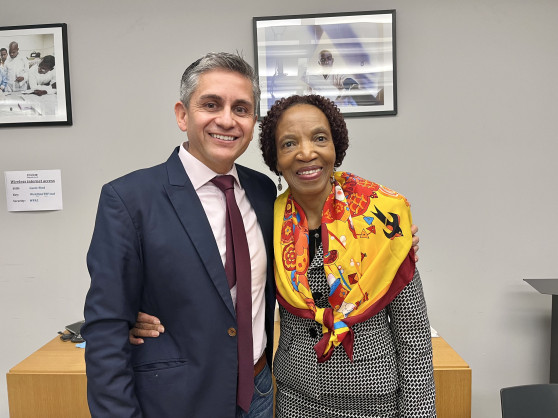
By Dr Sergio Carmona, Chief Medical Officer of FIND (https://www.FINDdx.org), the global alliance for diagnostics and Dr Princess Nono Simelela, Special Advisor to the World Health Organization's DG on Strategic Priorities, including Cervical Cancer Elimination.
Women and girls in sub-Saharan Africa accounted for two out of every three (https://bit.ly/2xN4hOv) new HIV infections in 2021. Women living with HIV are six times more likely (https://bit.ly/3Fjcbms) to develop cervical cancer than those living without.
These are powerful, distressing statistics, showing very clearly that to meet the 2030 targets of ending the AIDS epidemic as well as the World Health Organization (WHO) ambition to eliminate cervical cancer as a public health problem, we must urgently prioritize women’s health across our continent.
Why are these two diseases so closely linked? Weakened immune systems mean women with HIV are less likely to be able to clear infections of HPV, which is the virus that causes cervical cancer. Indeed, HIV infection halves the time (https://bit.ly/3isvyjY) it takes for pre-cancerous cells to develop into cervical cancer.
Cervical cancer is both preventable and curable (https://bit.ly/3it5RQq) if detected early, through highly effective HPV vaccines and high-performing tests or screening tools, leading WHO to suggest that it could be the first cancer ever in the world to be eliminated.
But while awareness of the impact of vaccination and value of screening has improved, disruption to health services due to the COVID-19 pandemic pushed aside many women’s health programmes, including HPV vaccination campaigns and screening initiatives. Today, cervical cancer remains the deadliest cancer (https://bit.ly/3XLsgsh) among women in low-income countries – because women in these countries simply do not have access to these life-saving measures.
Increasingly, communities and organizations are identifying opportunities to address both cervical cancer and HIV/AIDS together. Last year WHO updated their guidelines (https://bit.ly/3VtiuJN) on cervical cancer screening and treatment to include recommendations that are specific for women living with HIV. As Winnie Byanyima, Executive Director of UNAIDS, recently acknowledged (https://bit.ly/3isCCNJ), “It is unacceptable to claim that we have saved a woman’s life by enabling access to antiretroviral therapy for HIV alone, if we then leave her to die from cervical cancer… [we are] building bridges between HIV and cervical cancer programmes, and bringing the two communities together because we know that linkages save lives.”
Such linkages include integrated control strategies, research and access programmes, joint case management and awareness raising, and cooperation between the two disease communities to make the most of the resources we have available.
In HIV, the introduction of self-testing has been a major step in the fight against the disease. Lessons from that experience, coupled with an explosion in diagnostic technology prompted by the COVID-19 pandemic, mean that for cervical cancer we are now much closer to new approaches for early detection and cervical screening services, including self-sampling (https://bit.ly/3FdTVtF) that can be conducted more privately and conveniently (at home, for example). Through monitoring the testing landscape for COVID-19, FIND has identified at least 27 molecular point-of-care tests with potential for HPV testing – many of which are already in use for HIV diagnosis.
Indeed, to meet the WHO goal of screening over 70% of all eligible women for cervical cancer in LMICs at least twice in their lifetime, there are significant opportunities for collaborations with HIV programmes. Scaling up this “twice-lifetime” screening alongside HPV vaccination could enable 100% of countries to reach elimination (https://bit.ly/3uhhgpe) – reducing cervical cancer cases by 97%, saving countless lives as well as health system costs.
First, we need to integrate cervical cancer into community-led approaches to advocacy, and education, to break down barriers around stigma for both diseases and increase demand for screening and testing. Second, we need to prioritize and accelerate the adoption of new, women-centric technologies that are coming through the pipeline, especially those that can enable self-sampling. And third, we need to increase access to affordable diagnostics so that everyone who needs a test can get one – for both HIV and cervical cancer.
To be successful, these measures require committed leadership from heads of Governments, who must prioritize the control and elimination of cervical cancer alongside HIV, seeing this not as a cost but an investment in the future of their nations.
In addition, community leaders, policy makers, donors, civil society and the private sector must provide solid support to scale up cervical cancer programmes and integrate them into health systems alongside HIV services.
On World AIDS Day this year we were called on to ‘equalize’ (https://bit.ly/3B0eKYe) to address the inequalities that are holding back progress in ending AIDS. We must heed that call and come together with urgency to free women from the burden of both diseases.
Distributed by APO Group on behalf of FIND.


