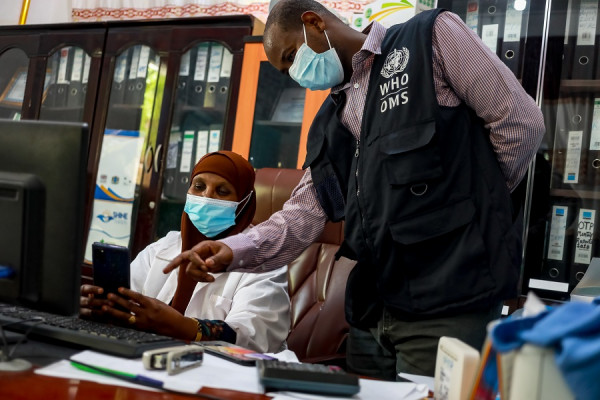
Hawa Ibrahim Ali recalls being taken aback when she first heard about the coronavirus disease (COVID-19) in 2020. As a district medical officer for the Federal Ministry of Health and Human Services, and a hospital manager whose job it is to oversee 13 health facilities in 3 of Benadir’s districts, Hawa was worried about how Somalia, her country, would cope with a disease that was defeating the world’s best developed health systems one by one.
However, she was pleased to see the support that poured in for Somalis to take on this contagious virus. One key donor was the Foreign, Commonwealth and Development Office (FCDO). Early in the COVID-19 outbreak, the World Health Organization (WHO) invited Hawa, along with many others, to participate in training supported by the FCDO on the Early Warning and Response Network (EWARN), a surveillance system that collects information on epidemic-prone diseases with the aim of triggering prompt public health intervention. This sort of capacity-building was definitely something health personnel needed, she thought at the time.
COVID-19 added into the EWARN system
During her training, Hawa noted that in immediate steps to collect information on COVID-19, WHO had integrated a module on COVID-19 into the EWARN system that Somalia uses. This meant that from then on, health facilities were required to report details of anyone who presented with COVID-19 symptoms.
At the training session, participants representing local health facilities were given the COVID-19 case definition and a hotline to call in the event that an emergency case arrived at any of the health facilities.
Concurrently, in an effort to expand the geographical coverage and outreach of EWARN, with FCDO support, WHO added 31 new health facilities to the EWARN network in the Benadir region. Within the first year of this addition, from May 2020 to May 2021, Somalia’s EWARN system had received more than 113 alerts and reported COVID-19 cases to the EWARN system. By early 2021, 85 health facilities were actively searching for COVID-19 symptoms in Benadir.
“None of this would have happened without the support of the donors and WHO,” said Hawa. “We are very grateful for the support Somalia has received during these tough times, and hope our partnerships get stronger to help more Somalis in the field of health.”
EWARN reporting rate and case detection has dramatically increased
The 3-day training conducted for health workers focused on 3 pillars – detecting, verifying and responding to diseases. As a result of the routine EWARN training that was conducted, and the expansion of the EWARN network, with FCDO support, the EWARN reporting rate and case detection of COVID-19 cases dramatically increased from 57% to 79% from April 2020 to May 2021.
To address the COVID-19 outbreak in Somalia, a chain of activities was being conducted concurrently. While the COVID-19 alerts were being detected and verified, samples were being shipped from all districts to laboratories for testing. Additionally, health personnel were being empowered to search for diseases and in contact tracing and management. Overall, 48 nongovernmental organizations running 83 health facilities were trained in Benadir.
Rapid response teams collect and facilitate testing of COVID-19 samples
Of the 113 alerts made, Somalia worked on a verification process for samples from 47 suspected cases as they did not meet the COVID-19 case definition. With the support of WHO, the FCDO and Federal Ministry of Health, through well-trained district polio officers and district medical officers, district rapid response and district medical personnel collected samples from patients and shipped them to the National Public Health Referral Laboratory, where 15 of the 47 samples (32%) turned out to be positive.
Meanwhile, with support from WHO, district polio and medical officers and community surveillance teams began to roll out extensive training for health workers in health facilities and hospitals on contact tracing and monitoring and following up on positive cases of COVID-19. Additionally, WHO conducted training for health care workers on the case definition of COVID-19, and how to fill in case investigation forms.
Training rapid response teams
During 2 training sessions in March and April 2020, 97 members of rapid response teams were further equipped and trained in the use of various electronic means of data collection, including the open data kit data collection method. Almost one third of these trainees were women.
“This training enabled us to reach more than 176 households with 880 individuals in 2 months, to collect information,” said Hawa.
“We detected – with the support of WHO and the FCDO – 131 contacts of COVID-19 cases,” adds Hawa. “Of this total, 43 turned out to be positive and 88 completed the 14-day follow-up period, a process that helps to monitor patients and their contacts.”
Describing the process, district polio officer Ruqiya Mohamud Hirape from Benadir’s Waberi district adds, “We have rapid response teams at community, district and state levels. They connect us all to communities.”
Helping communities overcome COVID-19
Forty-five-year-old Amina Hassan visited Hawa Ali one day, along with her 6 children and the rest of the family.
“I was so surprised – one day, a lady named Amina came with her husband, children and the grandparents to thank us and everyone who provided any support to this project. She was just so happy to have her husband safe and well at home after he fell ill, and to be able to start her life again with the family united,” said Hawa.
With the training that supported Hawa and her colleagues to identify quickly and address serious COVID-19 symptoms, communities have been receiving timely attention to avert severe effects of COVID-19.
“I am 45 years old and my main role is to stay at home and look after my babies and my husband, Ahmed Hassan. Ahmed is the only breadwinner for us all. When he was confirmed as positive for COVID-19, I was shocked and afraid, and thought of death. The district medical officer and polio officer helped us understand why and how Ahmed needed to isolate and how I could look after him. Also, I cannot forget the way you reassured me spiritually, Hawa, which gave me confidence at a very difficult moment for me and my family,” said Amina.
“You called me consistently for 2 weeks, every day, to check on Ahmed’s temperature and took down information regularly on phone,” Amina continued. “Thank you all. And continue the good work you are doing for the community and Somalia at large. We will never forget you.”
During the period of support, 35 health facilities were added to the existing EWARN in Benadir, bringing the total to 689 health facilities across Somalia.
As a result of this expansion, 49 additional districts have rapid response teams that are trained, equipped and ready to undertake verification and field investigations.
Distributed by APO Group on behalf of WHO Regional Office for the Eastern Mediterranean.


