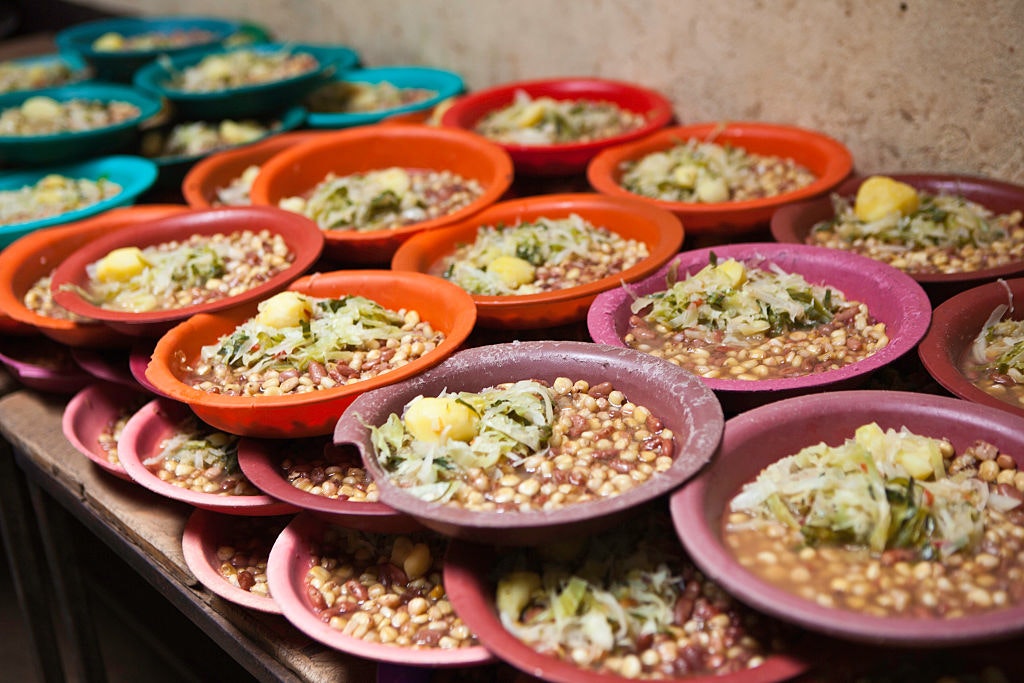
Hundreds of millions of children worldwide attend class every day. With such a wide reach, schools can effectively deliver a vast array of interventions such as immunisations and hygiene education. They can greatly improve the health of the students, who will learn better as a result.
School feeding programmes are among these interventions. They take a variety of forms, either targeting the poorest and most marginalised communities or universally covering all public schools in a given country. They are deployed daily, often within broader school health and nutrition programmes, and reach hundreds of millions of children every day.
The COVID-19 pandemic showed how important school feeding programmes are in achieving equality in health and education. School closures pushed millions of children away from learning – numerous students dropped out. This means they were also excluded from the health, nutritional and developmental benefits of receiving a daily meal, as well as the social protection it affords.
The African Union, the European Union, the Organisation for Economic Co-operation and Development (OECD), and more than 65 countries have now gathered behind the School Meals Coalition, which aims to expand national school feeding programmes worldwide. The coalition set up the Research Consortium for School Health and Nutrition, of which I am part.
The Research Consortium is charged with generating scientific evidence to guide the roll-out of effective national school health and school feeding programmes. One of its focus areas is quantifying the returns of these programmes across multiple sectors, including health, education, social protection and agriculture. To quantify the returns, it’s necessary to assess the programmes’ value for money, equity and gender impact.
Value for money of school feeding programmes
It’s costly to run school feeding programmes. But there are also potentially very large multi-sectoral returns. In a global value-for-money study, we developed a benefit-cost analysis framework that drew from secondary data on school feeding programmes in 14 countries, at various economic levels. Latin America, South Asia and sub-Saharan Africa were included.
We looked at the impact and return on investment in four sectors: health and nutrition, education, social protection, and the local agricultural economy.
-
School feeding programmes are beneficial for health and nutrition. For instance, they can reduce anaemia and worm burdens, which are highly prevalent among poor children. These diseases pose long-term health and education challenges. Their reduction shows the possible magnitude of the health and nutrition benefits of school feeding programmes.
-
School feeding programmes yield gains for the education sector. For example, they can increase school attendance and academic performance. This would permit major wage gains into the future adult working lives of students. A review found that one additional year of education could result in up to around 9% increased lifetime earnings.
-
School feeding programmes, in giving a free meal, confer social protection to households and families, especially to the poorest. To translate this into a social protection impact, we can estimate the monetary value of the meals which families would not have to pay for.
-
School feeding programmes can help develop local agricultural economies by boosting local farming activities. For this impact, one can compute the number of smallholder farmers who would produce food to sustain local school feeding programmes.
All these multi-sectoral returns can be either expressed as or converted into monetary values.
Return on investment
Our analysis showed that school feeding programmes present high value for money, and can lead to very large multi-sectoral returns. There could be considerable variations between countries depending on local contexts like burden of disease, wages, the costs of feeding a child, and the extent of farming and inequalities. Yet the benefits of having school feeding programmes far exceed the costs.
The overall benefit-cost ratio of school feeding programmes would vary between $7 and $35 from each $1 of investment. The benefit is much greater across several sectors than for just one standalone sector.
Going forward
National school health and school feeding programmes are critically important for the human capital accumulation of children and adolescents. They urgently need to be scaled up worldwide.
Increased attention needs to be devoted to how to decentralise and foster long-term, home-grown school feeding initiatives to ensure local sustainability.


