Scientists design a novel formula that repels and kills mosquitoes:
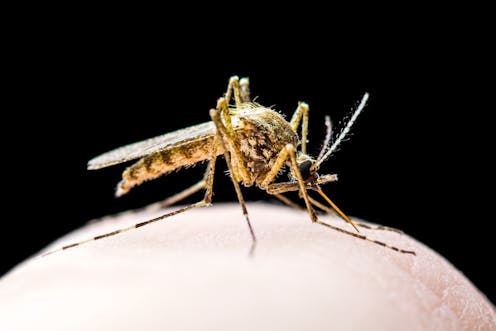
Long-lasting insecticide treated nets and indoor spraying are the main malaria vector control interventions recommended by the World Health Organisation. Both target mosquitoes that feed indoors.
The challenge is that a significant portion of malaria infections in Africa may be due to people being exposed to mosquito vectors outdoors. This means that current control methods need to be updated to include methods or strategies that protect people all the time and not only when they are inside their homes.
Topical mosquito repellents that prevent or at least reduce contact between the blood seeking female mosquitoes and humans have been touted as the best way to reduce the possibility of the disease spreading.
There are several options on the market but N,N-diethyl-meta-toluamide – more commonly known as DEET – is the gold standard. All other mosquito repellents are measured against it. But DEET has several challenges.
Mosquitoes have started developing resistance to it and consumers have been complaining about its odour, high adsorption rate, oily feel and the skin irritation it causes.
These problems have led to calls for a replacement. But finding new active compounds to commercialise into repellents is time consuming and expensive because it involves the lengthy process of establishing their safety.
As a result scientists have started looking into the viability of combining mixtures of approved repellents. This is exactly what we did. In our study we evaluated a compound that’s used in a repellent along with another compound that has no link to repellents, to test how effective they would be together. This had never been done before.
The result was a novel repellent that has a longer lifespan than commercially available repellents. It has the added benefit of not only repelling mosquitoes but killing them too if they make contact with it.
Our findings set us up with a compound that can be developed into a commercially viable repellent that can protect people when they are outside.
How repellents are formed
Most repellents are made up of compounds that are mixed with carrier oils. But they evaporate quickly and need to be reapplied often.
We wanted to solve this problem and believed that a mixture that was a negative pseudo-azeotrope which are used in perfumes would do the trick. A pseudo-azeotrope is a mixture of substances that retains the same composition in vapour and liquid states. In particular, a negative pseudo-azeotrope evaporates slower and this makes it last longer.
We took nonanoic acid – a compound which is used as an additive in the food industry – and added it to a compound used in most repellants: ethyl butylacetylaminopropionate, more commonly known as IR3535.
We tested the formula by applying it to someone’s forearm and then placing a cup with 20 hungry, female Anopheles arabiensis mosquitoes against it. A cup with mosquitoes in it was also placed against a person’s arm that didn’t have repellent on it.
After three minutes we tested how many times the mosquitoes had bitten the respective arms.
Our results showed that our formula was better at repelling the mosquito throughout the three minutes and that the effect lasted for up to six hours on the skin. The result also showed that most mosquitoes that came into contact with our formula died.
A multidisciplinary approach
The spread of malaria is dependent on a number of factors. These include how many mosquito vectors there are in a particular area, how susceptible they are to the malaria parasite, what hosts the mosquitoes are feeding off, and the survival period of the mosquito.
Two big challenges have developed that are making the elimination of malaria difficult. The first is that the vectors have started developing resistance against the main control method: insecticides. The second is that the parasite that spreads malaria Plasmodium falciparum has developed resistance to anti-malarials.
What this means is that malaria won’t be eliminated with the use of one type of control method. An integrated multi and trans-disciplinary approach is needed.
New, innovative, safe and sustainable methods need to be researched and developed to overcome current resistance trends and prevent transmission of malaria from all angles.
Our research opens the door to a new mosquito repellent formulation that improves the armoury against malaria.

Walter Focke receives funding from Faculty Research Team, the DFG and SA MRC.
Mthokozisi Sibanda works for the University of Pretoria. He receives funding from the National Research Foundation.
Taneshka Kruger does not work for, consult, own shares in or receive funding from any company or organisation that would benefit from this article, and has disclosed no relevant affiliations beyond their academic appointment.
Source: The Conversation – Articles (AFRICA)
Read more on The Conversation.
Join the fun: Add Your event | Submit a Press Release | Add your listing.


