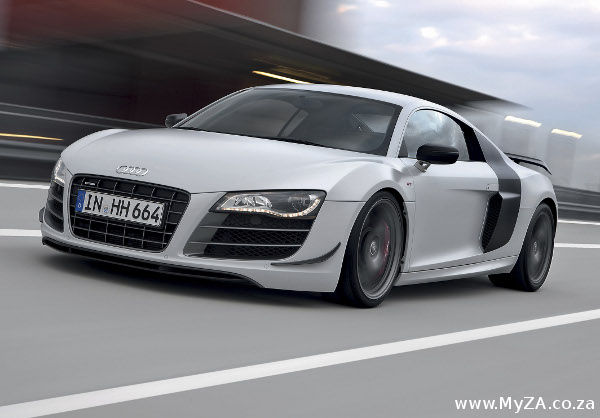
Audi South Africa will feature the Limited Edition R8 GT as one of the centrepieces of its display at the Johannesburg Motor Show, which takes place at Expo Centre, Nasrec, from October 6-16, with the first two days being reserved for the media and VIP guests.
The global production of this model has been limited to 333 units and only seven of these cars have been allocated to South Africa. All have been pre-sold at a price of R2 620 000.
This new member of the R8 family is a limited production version of Audi’s high-performance sports car. The GT is more dynamic, lighter, more powerful and faster than any of the other models in the range.
The output of its 5.2-litre V10 engine has been increased to 412 kW while vehicle mass has been reduced by 100kg. The R8 GT accelerates from 0-100km/h in 3.6 sec. and is capable of reaching a top speed of 320 km/h. The R8 GT Coupe shows an improvement in performance over the standard, 386 kW R8 V10 Coupe which launches from 0-100km/h in 3.9 sec. and runs on to a top speed of 316 km/h. The average fuel consumption of the GT’s direct-injection engine is 13.9 l/100 km litres.
Audi engineers have reduced the mass of the Audi R8 GT significantly when compared to the R8 5.2-litre FSI Quattro. A number of new components made of carbon fibre composite contribute to the reduction in the car’s mass.
The high performance Audi sports car, which has permanent Quattro four-wheel drive, tips the scales at just 1 525 kg, for a power-to-weight ratio of 3,7 kg per kw..
The Audi R8 GT is fitted with the 6-speed R-tronic transmission, which can be controlled via gear shift paddles on the steering wheel. The automated manual transmission offers the advantage of a manual gearbox with high efficiency, compact dimensions and low weight. The R-tronic features a Launch Control programme, which enables the R8 GT to accelerate in spectacular fashion.
With its longitudinally mounted mid-engine, the Audi R8 GT has a front:rear weight distribution of 43:57. The Quattro powertrain accordingly sends the majority of the engine’s power to the rear wheels.