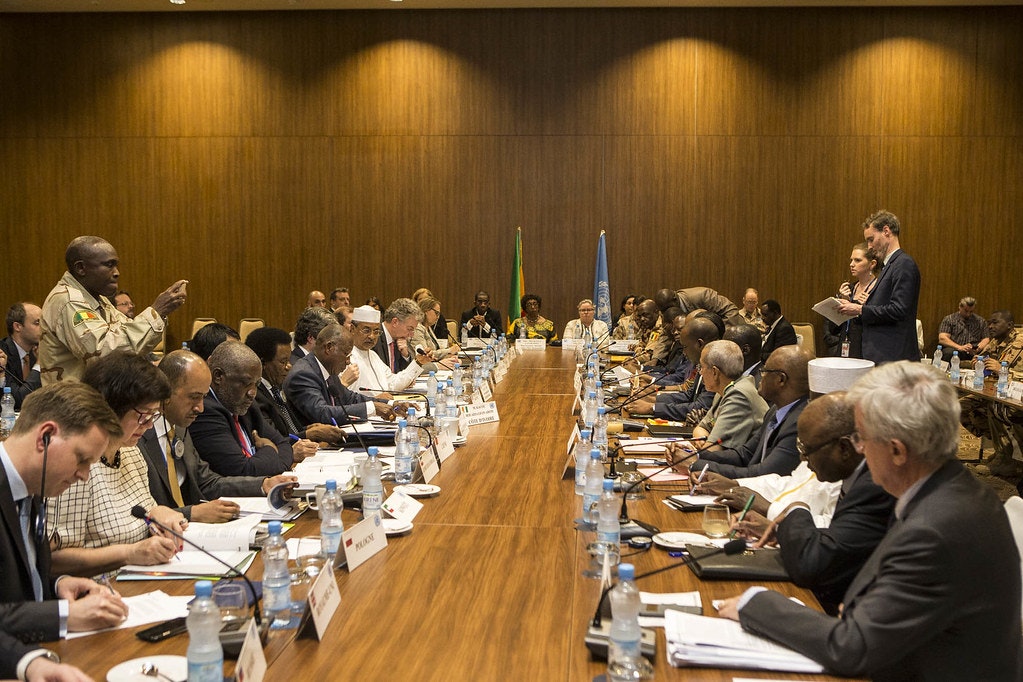
At first glance, the creation in 2014 of the G5 Sahel, an international organisation set up to deal with conflict management in the Sahel, seemed unlikely. Some analysts were already describing a “security traffic jam” in the region. This was in reference to the fact that there were a range of actors involved in conflict management in the Sahel.
Indeed, there were already structures in place, notably the African Peace and Security Architecture. As I showed in my earlier research, African and non-African governments promoted this architecture vigorously – at least on paper. With that institutional framework as a backbone – combined with widespread international support – the African Union (AU) and the Economic Community of West African States (ECOWAS) sought to play an active role in conflict management in the Sahel.
There were, however, several reasons why Burkina Faso, Chad, Mali, Mauritania, and Niger – as well as others, particularly France – considered the establishment of the G5 Sahel (as well as the G5 Sahel Joint Force in 2017) as helpful despite the existing security architecture.
Bypassing the African security architecture
There were early signs of such a move. Once a crisis in Mali deepened throughout 2012, the AU and ECOWAS decided to step up to lead conflict management in the area. In December 2012, the United Nations Security Council authorised the AU’s and ECOWAS’s African-led International Support Mission to Mali, or AFISMA.
Despite this, some regional leaders searched for alternatives. Niger’s President Mahamadou Issoufou, for example, asked France to intervene. Other leaders like Macky Sall of Senegal and Alpha Condé of Guinea likewise supported a French intervention. This was effectively a snub of the AU and ECOWAS.
The French military – and eventually President François Hollande – considered the AU and ECOWAS as incapable as I elaborated elsewhere. In early 2013, Hollande decided to deploy Opération Serval, a French military operation to fight Islamic militants who were gaining ground in Mali. Benin’s president Boni Yayi applauded France. He described the decision as something that
we should have done a long time ago to defend a member country.
With regional states themselves indicating a limited trust in the AU and ECOWAS to solve the conflict in Mali – and with the conflict spilling over into the wider Sahel – the idea arose that a new collective defence mechanism should be tried out.
Against the odds?
Despite the regional “security traffic jam” and the existence of the African security architecture, there were many reasons for the G5 to create a new organisation.
First and foremost, it meant that the governments of Burkina Faso, Chad, Mali, Mauritania, and Niger would have more control over actions on the ground. Unlike traditional peacekeeping operations, the G5 Sahel blurs the line between troop contributing and mission host country. G5 Sahel troops are deployed within their own countries. This gives the governments notable control over their actions.
Second, the new organisation served the interests of the G5 Sahel leaders – it helped protecting their regimes. Setting up the G5 Sahel Joint Force meant that they had a vehicle to further their own interests. The force’s mandate includes fighting both terrorism and organised cross-border crime.
The G5 states also receive substantial military and financial aid. France initially spent Euro 8 million, the European Union donated Euro 50 million, Saudi Arabia pledged Euro 85 million and the US allocated US$51 million.
Leaders benefited from these funds as it allowed them to build stronger and better equipped security forces that helped them to cling to power.
Finally, the G5 states saw the situation as offering them an opportunity to push back against Algeria and Nigeria, the main regional powers. Algeria had been the dominant player in the Sahel region and Nigeria had played a key role within the ECOWAS. Their dominance in regional affairs meant that the G5 states had less control over conflict management.
Overlap
Yet the establishment of the G5 Sahel caused an institutional overlap. It meant that the United Nations, the AU, the ECOWAS, and the G5 Sahel had a mandate to deal with conflicts in the region. One consequence was friction between the organisations as well as competition over financial support, human resource expertise and technical assistance.
This was, however, not perceived as problematic. Particularly France wanted to see the creation of the organisation. The French government was involved in the discussions among G5 Sahel leaders from the beginning. It engaged in substantial diplomatic efforts to drum up international support for the new organisation, playing a key role in organising funding for the entity, and participating in the G5 Sahel Operational Coordination Committee.
France’s assistance in forming the G5 Sahel is hardly surprising given that the organisation effectively serves its interests and that of its Western partners. It enables Paris to subcontract security and control migration without shouldering too much risk.
France was aware of the many shortcomings of the G5 Sahel. Yet having received little active support from its European partners for its counter-terrorism efforts in Mali and beyond and being itself financially overstretched, France was in need for relief.
As no other major actor – besides the AU – indicated its willingness to engage with the crisis in the Sahel, the options for France narrowed. As Michael Shurkin has expressed it: The spirit was
not letting the perfect be the enemy of the good.
These reasons led to a situation in which the creation of the G5 Sahel was a logical step. Another actor was born and added to the “security traffic jam”.
Despite its many flaws, question marks behind its effectiveness, and the problems caused by the institutional overlap, the G5 Sahel is likely to stay. This is because it serves the interests of regional governments, France and its Western partners.


