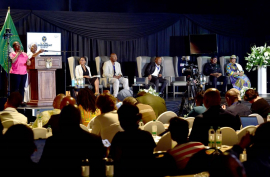
The densification of the country’s settlement patterns and where economic activity happens, especially in rural areas, is vital, says economist Ayabonga Cawe.
Cawe made the remarks on Tuesday on the first day of the 2022 Local Government Summit. He addressed the delegates on behalf of Trade, Industry and Competition Minister Ebrahim Patel, for whom he is an advisor.
He said a paper written in the 1990s argued that that the legacy of pre-capitalist forms of indirect rule and delegated authority had led to what had been inherited in the land use framework. Here, he said, a sparse population or settlement patterns make the delivery of services very difficult.
“I think, for our purposes that makes the clustering and agglomeration of economic activity even more difficult, if we look at it this way, then industrial development, especially in the rural areas, remains constrained by scale, lack of agglomeration effects.
“If you look at the border decentralisation areas where some of our industrial paths can be found, we find that a lot of the challenges arise because of the history of many of these areas which serve the political rather than an industrial or economic end,” he said.
A lot of the work that the Department of Trade, Industry and Competition (DTIC) was doing and in spatial industrial development was aiming to respond to these challenges.
These were about answering how catalytic projects like the N2 Wild Coastal in the OR Tambo District could crowd in investment, greater densification of economic activity and settlement patterns.
“What we’ve already seen is that many of the people in the populations in that particular district, or IGR impact zones, are moving closer and closer to transit nodes into areas of economic opportunity. Our task is to make sure in complementary fashion that waste such economic activity, happens that we create significant opportunities for value addition,” he said.
Increasingly, the DTIC’s task, in line with its joint performance areas and creating an ethical capable development state, is focused on ensuring that functional intergovernmental relations become a critical part of how it does its work.
“Historically, how we have historically undertaken the development of SEZs [Special Economic Zones], the financing of top infrastructure and so on, has had limited managerial and project management input from national departments, national and provincial sector departments. We need coherent implementation frameworks and protocols that create relationships between different sector departments that coordinate how it is that we work, and also ensures that implementation happens in synchronous fashion.”
In this regard, he said there were many examples.
One of these was some ongoing work in an agreement which draws in provincial, district and local municipalities on the funding of infrastructure for the proposed Fetakgomo/Tubatse SEZ.
“Some of our work in the Tshwane SEZ has ensured now that the national government is involved not only in the governance alongside private sector actors of this, but also in enabling strong project management capability and working with original equipment manufacturers, who are anchor tenants in some of these logistics infrastructure.
He said that the department realised that all these efforts would never really have an impact in communities if vertical synergies are not unlocked.
“Also horizontal synergies between areas that have wall-to-wall boundaries, so that those municipal boundaries do not become hard boundaries that determine and influence how these are achievable.
With the vulnerabilities of the economy exposed over the past year by natural and societal events, the department’s work was now focused on encourage many districts to develop export plans related to the African Continental Free Trade Area.
This should be done in a way that identifies key products and services, with a focus on areas of latent and existing comparative advantage that can be linked to tradable value chains.
“We are not wanting to encourage competition between different districts, but rather we want complementary interventions. We don’t want a situation where all our municipalities want to produce textile, clothing and footwear and leather products. – SAnews.gov.za


