Ghana has about six million social media users out of a population of 31 million. WhatsApp, Facebook and YouTube are the three dominant social media platforms, while Instagram and Twitter are gradually gaining popularity.
Most users are young, educated and in the middle class or above. Men outnumber women online.
Ghanaian political parties have used social media largely to complement their traditional communication channels. This was particularly true in the 2012, 2016 and 2020 general elections.
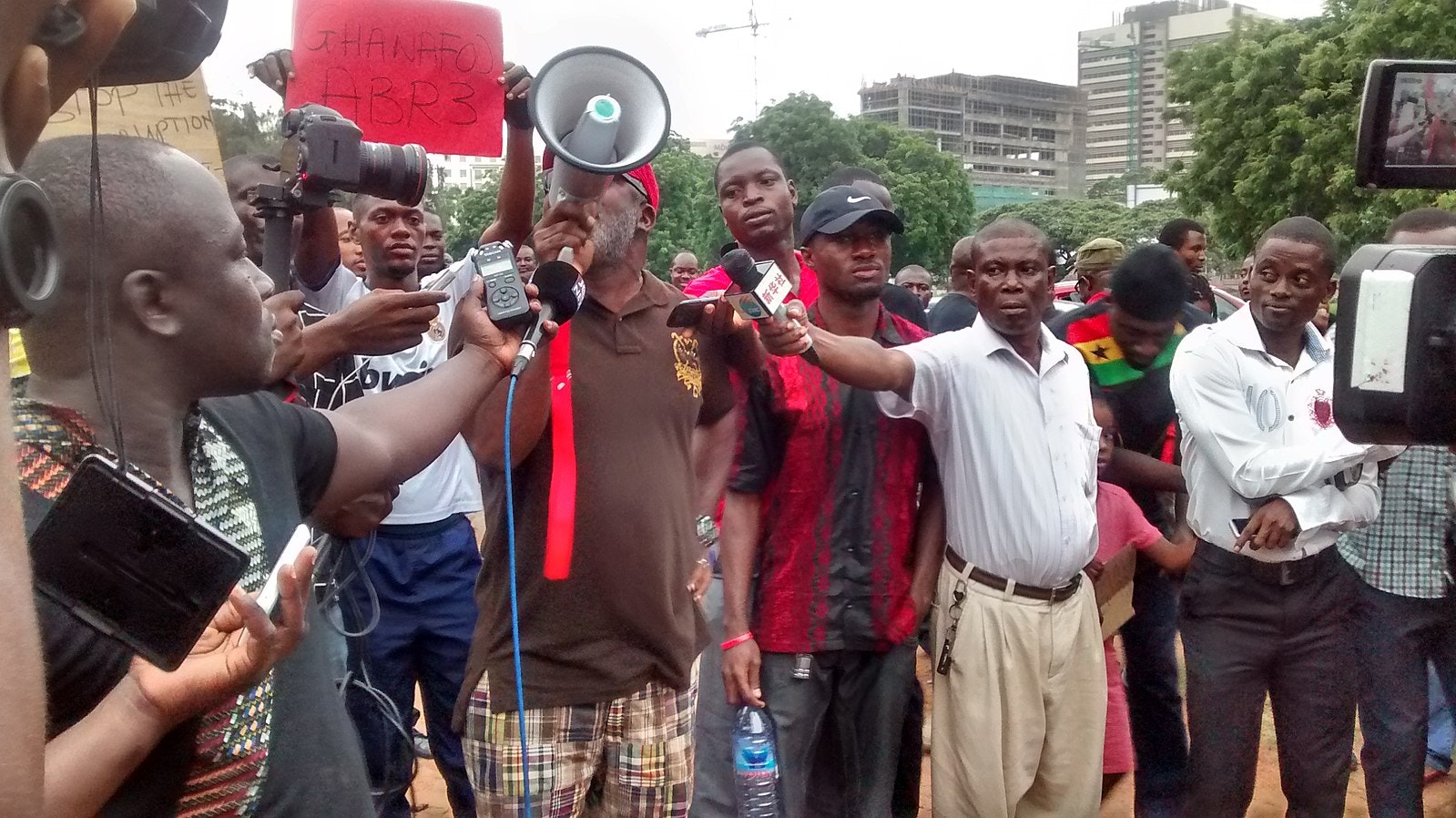
But a new trend is emerging – the use of social media for online activism. This was evident in the #OccupyFlagstaffHouse and #RedFriday 2014 campaigns.
The #OccupyFlagstaffHouse campaign was the first to be launched on Facebook and Twitter, on 28 June 2014. It was started by regular citizens engaging online. Within four days, it led to a demonstration at the Efua Sutherland Children’s Park in Ghana’s capital and picketing at Flagstaff House, Ghana’s presidential palace and seat of government.
Ten days after the #OccupyFlagstaffHouse demonstration, the organisers launched “The Red Campaign” (#RedFriday), aimed at compelling the government to address the issues raised in the first demonstration. The campaign encouraged Ghanaians to wear red on Fridays to indicate solidarity with the campaign, and to post photos and videos of themselves on Facebook and Twitter using the hashtags #RedFriday and #OccupyFlagstaffHouse.
In my research paper, I set out to highlight the synergy between social movement theory and social media critical discourse studies.
I conclude from my findings that the leaders of Occupy Ghana did some work in the physical world that enhanced their online campaign. I, therefore, argue that social media campaigns and digital activism can be fruitful if they are followed up by practical offline actions. The absence of action on the streets can result in people supporting a cause by performing simple measures without being truly engaged or devoted to making a change. This has been termed “slacktivism” in the literature.
A digital warpath
I based the study on social movement theory, which delineates how and why people mobilise themselves for sociopolitical action, as well as the effect of such action.
The data for this study comprised tweets produced by and interactions involving the OccupyGhana Official Twitter account before, during, and after the #OccupyFlagstaffHouse and #RedFriday campaigns.
The name of the Twitter handle is @occupyGh. The sample spanned 12 months of activity, from 28 June 2014 to 30 June 2015.
The analysis showed three mechanisms used in the tweets to promote the objectives of the protesters and put pressure on the government to tackle the issues responsible for the debilitating economic situation.
Specifically, the tweets performed a dual function of social activism in the form of promoting critical awareness and preparing the ground for an offline demonstration.
Constructing the Ghanaian government as insensitive. The tweeters represented the Ghanaian government as an uncaring administration that showed little-to-no concern for the plight of Ghanaians. Tweets that expressed this constituted about 37% of the entire dataset:
TWT 31. The government has been slow to respond to our #OccupyFlagstaffHouse petition. The cedi hasn’t fared better. The economy isn’t better.
TWT 36. The reason this government is not getting citizen support is that they deny what the real effects of their lack of ideas is on the masses.
In these tweets, the protesters, via a referential strategy realised by noun phrases such as “the government”, “this government”, “our government” and “they”, explicitly identify the entity they consider to be responsible for their predicament.
Representing Ghanaians as the suffering masses. Positioning themselves as the voice of the people, the protesters construct Ghanaians as a people suffering due to poor leadership, bad governance and mismanagement of the economy. These constituted approximately 39% of the tweets analysed.
TWT 247. #RedFriday because we are all living under increasingly harsh conditions and with IMF, we are likely to have worsened living conditions.
TWT 248. #RedFriday because workers face rapidly declining real wages due to the depreciation of the currency and increasing inflation.
Using expressions such as “dire economic conditions”, “worsened living conditions”, “increasingly harsh conditions” and “declining wages”, the tweeters frame the people of Ghana as victims of an irresponsible government; hence the need to “remind our president that he promised us a better Ghana”.
Exploiting stance for sociopolitical objectives. Stance is a term that refers to “the lexical and grammatical expression of attitudes, feelings, judgements or commitment concerning the propositional content of a message”. It gives an indication of how writers present themselves and communicate their opinions and commitment. Stance enables writers to position themselves in relation to others and to “stamp their personal authority onto their arguments or step back and disguise their involvement”.
TWT 73. #RedFriday demands @JDMahama should make prudent economic and social
policies that would make the standard of living better for Ghanaians.
TWT 74. #RedFriday demands Government should manage the exchange rate and save the #Ghana Cedi from the current free fall to prevent price hikes.
TWT 117. What do we want from all this? That we will hand to our children a Ghana better than we inherited from our fathers. #redFriday
The use of stance in the form of “evidentiality”, “affect” and “presence”
helped the protesters project their positions and underline their advocacy and civic engagement commitments to persuade the masses to support the goals of the protest.
Proof
The Occupy Ghana pressure group was founded in 2014 as a result of the #OccupyFlagstaffHouse and #RedFriday campaigns. It continues to play a pivotal role in national discussions. Its leaders and members make regular media appearances, and it has built alliances and partnerships with other civil society organisations, think tanks and political pressure groups to analyse and review public policies and initiatives.
The movement is an example of how social media campaigns and digital activism can be fruitful if they are followed up by practical and strategic offline actions.


