While the impact of the COVID-19 pandemic has been well documented in high-income countries, much less is known about its impact on low-income and conflict-affected countries where there are significant challenges in information generation and dissemination.
Somalia is one of these countries. It has been battered by a series of large-scale humanitarian emergencies, epidemics and population displacements. These crises were exacerbated, in large part, by three decades of protracted conflict.
But knowing the scale of the impact of COVID-19 is virtually impossible.
Along with other colleagues from the London School of Hygiene and Tropical Medicine, the Somali Disaster Resilience Institute and Satellite Applications Catapult, we conducted a study to understand the impact of the COVID-19 pandemic on Somalia.
The official figure stood at just over 1,100 deaths as of October this year. But media reports and investigative enquiries of NGOS point to larger numbers of potential COVID-19 deaths. This suggests that the official data may not capture the full picture of the true burden of COVID-19.
Collecting data
The challenge is getting data in a fragile, crisis-affected context.
We overcame this by using commercially available high-resolution satellite data, obtained from Maxar, to count the number of burials in Mogadishu, Banadir region between January 2017 and September 2020. The Banadir region is on the edge of the city and is home to about 2 million residents.
We compared the number of burials we could count prior to COVID-19 with those in the pandemic period, between January and September 2020.
We also surveyed key informants to verify what the satellites were showing – in terms of burials – and understand community perceptions of COVID-19 mortality and the challenges associated with controlling the pandemic.
Based on the number of burials we could identify, our analysis found a substantial increase in the burial rate during the COVID-19 period.
Applying this rate to the population of Banadir allowed us to produce a death toll. We repeated this process for burials identified by satellite imagery in the pre-COVID-19 time period, which allowed us to calculate a baseline death toll. The difference between these two figures – which we called the excess death toll – suggested there had been a massive under-reporting of deaths.
Using satellite imagery like this is a novel way to identify how many deaths could be attributable to the pandemic. It’s a promising tool that can be used in resource-constrained settings, where on-the-ground research is a challenge, and where people remain vulnerable to renewed waves and new variants.
Excess death
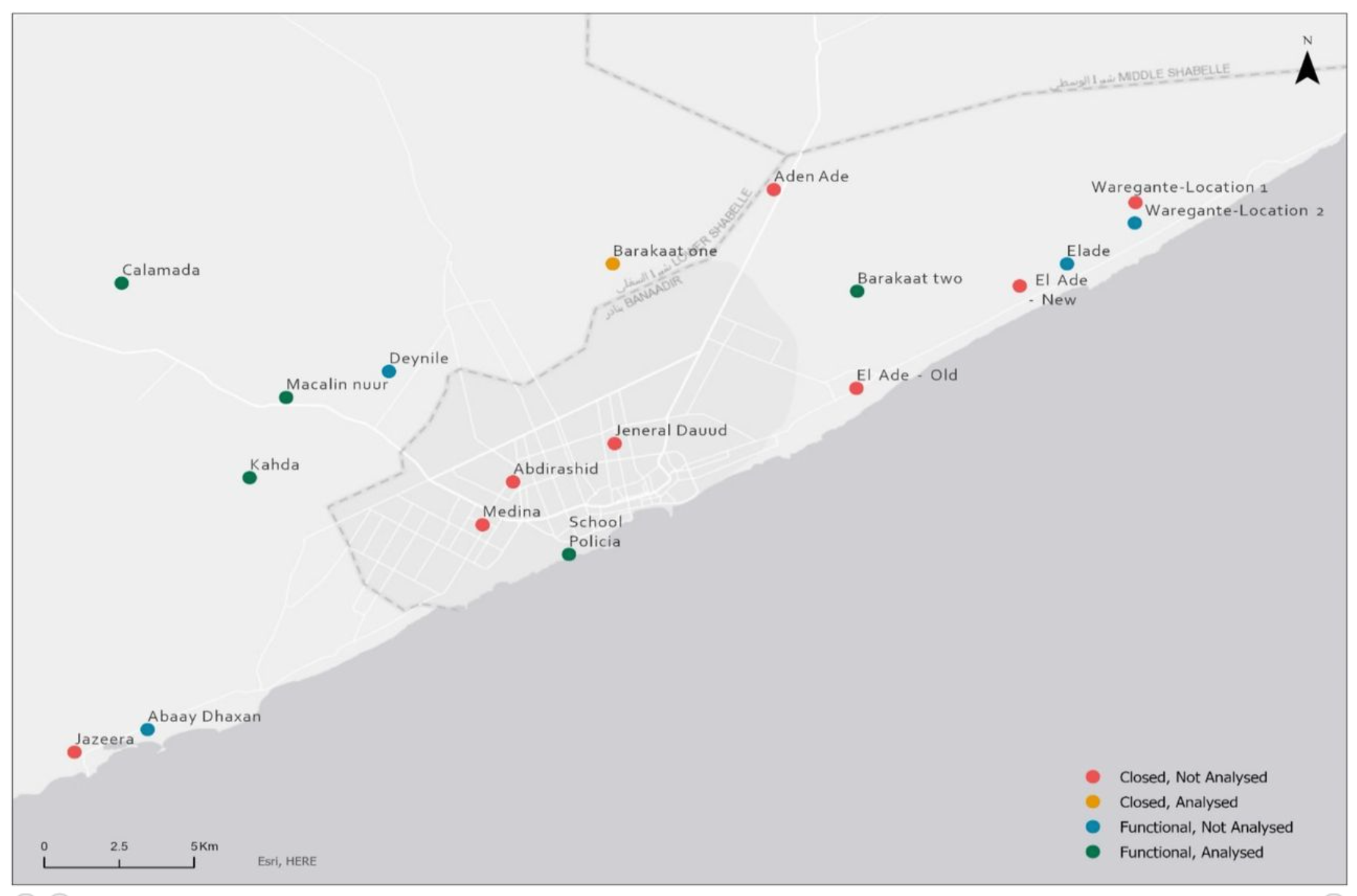
For the satellite data we worked on the assumption that all decedents in Banadir are buried in recognised cemeteries. We then sought to identify and collect data on every cemetery that was “active” (receiving new burials) at any point during the analysis period.
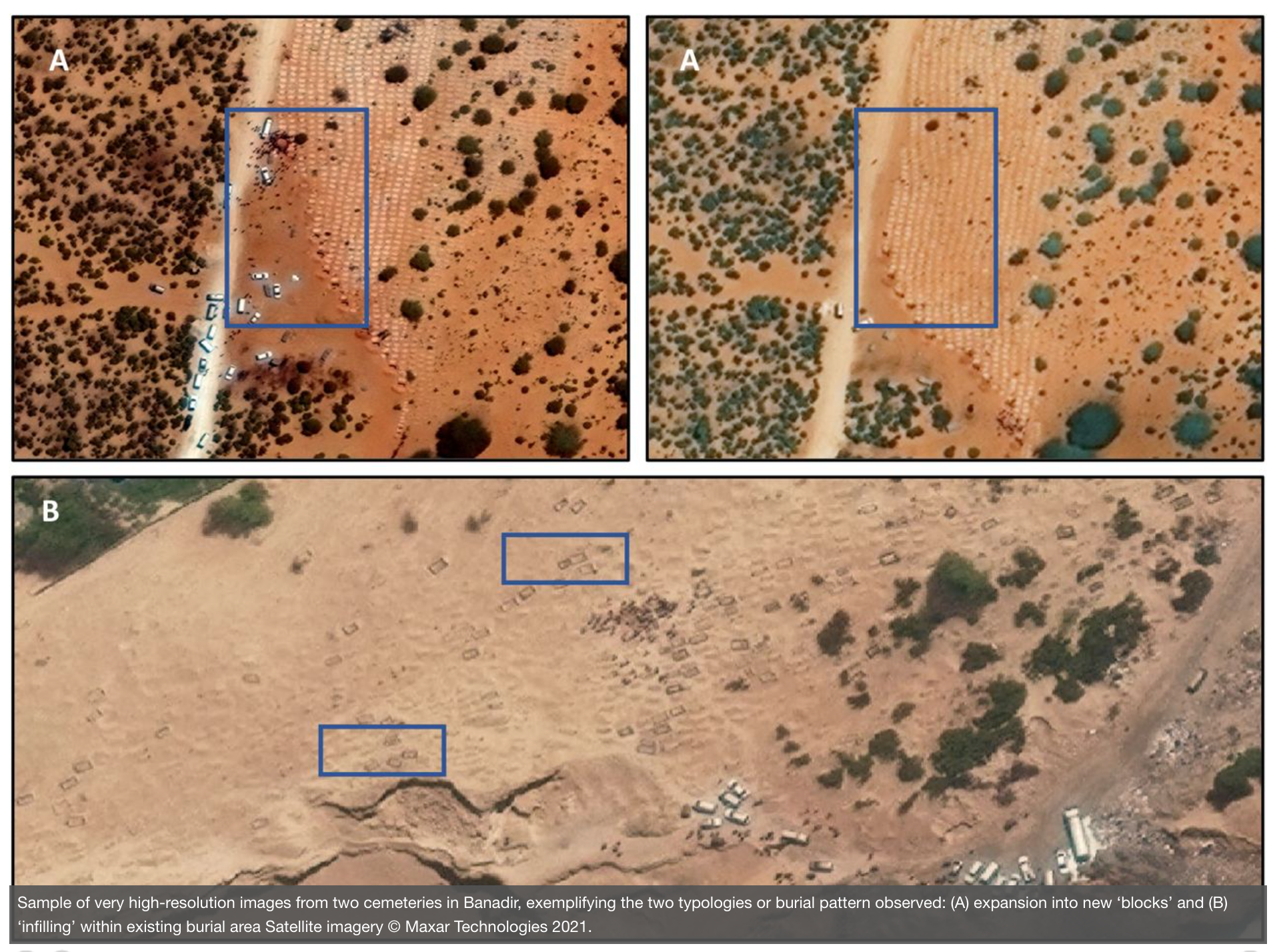
Overall, 68 sequential satellite images were available across the six analysed cemeteries, an average of 11 images per cemetery. We were able to perform an exhaustive grave count for 58.8% (40/68) of images. This was mostly because some images weren’t clear enough to identify graves, or because the view was obstructed by vegetation. We had to rely on satellite data retrospectively collected by Maxar, thus limiting the number of usable data points.
For eight images (11.7%) we analysed only the visible area and created a model to predict the missing grave observations.
During the pre-COVID-19 baseline period (between 2017 and 2019), daily burials across the six cemeteries averaged between 10 and 12. From January 2020, an increase in burials – peaking at more than 20 daily in June 2020 – was evident.
Official figures in October 2020 stood at 3,864 cases and 99 deaths across all of Somalia. In contrast, from January to September 2020 we estimated an excess death toll between 3,200 and 11,800 in Banadir region alone. This suggests that the death toll nationwide may be considerably higher.
Drivers of deaths
We used interviews with informants to better understand what was driving the high number of deaths in Somalia. We interviewed a range of people, including health authorities, gravediggers and religious leaders.
At the onset of the pandemic in March 2020 the government imposed a lockdown as well as restrictions on public movements and meetings. This included the closure of schools, government offices and restriction of international travel.
But the people we spoke to told us that there was a lot of scepticism about the existence of COVID-19. This meant that, in reality, compliance was low, therefore community interactions and public gatherings continued to function as normal. Hotels, teashops, mosques, and other public places remained open.
Our informants painted a picture of a healthcare system ill prepared to cope with the magnitude of the epidemic. Several of our key informants mentioned a shortage of key equipment and treatment facilities. The people we spoke to also mentioned elevated prices of face masks and antiseptics which put them out of the reach of ordinary people.
While most of these deaths are likely to be due to COVID-19, we also heard that some were attributable to the indirect effects of the pandemic, such as socio-economic disruptions or reduced access to health services.
Knowing the toll
Our study suggests a considerably higher COVID-19 death toll. It also sheds light on some of the drivers of this high death toll.
We believe that our methods – using satellites and geospatial analysis – can be key to monitoring COVID-19 death rates in other countries, such as South Sudan and Ethiopia, where reporting is challenging due to difficulties in access or conflict.
Death tolls serve as one of the clearest indicators of the impact of the pandemics and can be used by policymakers to make more effective decisions.


