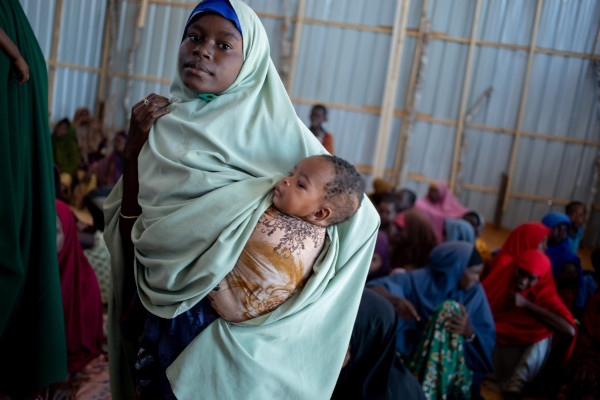
A rapidly evolving drought and famine-like situation in Somalia continue to affect 7.8 million people and has already resulted in displacing 1.4 million,while putting the lives of more than 1.8 million under 5 children at risk of severe malnutrition and related health complications.
The WHO Country Office, with the funding from Central Emergency Response Fund (CERF), has scrambled all its ground resources to halt a catastrophe from happening by providing hope and resilience to distressed populations through provision of essential lifesaving primary health care services in 31 hard-hit districts across the country. However, experts believe that situation is getting worse and that the international community should pay greater attention by extending their support to avoid a calamity and repeat of the 2011–2012 famine in which more than 260 000 lives were lost due to prolonged drought and a famine – the worst in its history.
“CERF funding has certainly helped us keep morbidity and mortality to a minimum, but with rapid and increased displacement of populations and liberation of previously inaccessible districts, the situation may spiral out of hand in the coming weeks and months. Our planned intervention targets are becoming bigger by the day because of the increased demand both at health facilities and outreach sites across the country. It’s time that the world should open up their coffers to help Somali populations cope with one of the worst droughts in more than a decade,” commented the WHO's acting Incident Manager, Khalid El-Tahir who is leading drought response activities in Somalia.
Since July 2022, WHO, has used the CERF funding as a catalyst to spearhead health interventions reaching 724 525 vulnerable people with emergency health care services by procuring and distributing essential medical lifesaving equipment, medicines, and supplies to 57 health facilities in target areas, including support to 7 laboratories with essential laboratory items for timely detection of diseases with epidemic potential and response activities.
The Central Emergency Response Fund is a humanitarian fund established by the United Nations General Assembly on 15 December 2005 and launched in March 2006. CERF’s objectives include promoting early action and response to reduce loss of life, enhance response to time-critical requirements and strengthen core elements of the humanitarian response in underfunded crises. CERF seeks to enable timelier and more reliable humanitarian assistance to those affected by natural disasters and armed conflicts. The fund is replenished annually through contributions from 125 Member States and more than 30 private and regional donors.
Currently, Somalia is experiencing multiple emergencies at the same time with rising incidence of diseases that are preventable. To meet the growing demand from the target districts, WHO has scaled up its emergency drought response operations massively, yet the need is outstripping the supplies.
CERF-enabled drought response
There is a continued sharp increase in the number of people requiring urgent support, it is estimated that approximately 1.8 million children under 5 might face acute malnutrition until June this year, which represent 54.5% of the total children population in the country. Of whom, 513 550 are estimated to be severely malnourished. The median prevalence of severe acute malnutrition has also worsened from 1.5% in 2021 Gu and 2.1% in 2021 Deyr to 3.1% in 2022 Gu. Humanitarian cluster partners in Somalia are reporting that almost half of Somalia’s 15.7 million population has been affected by the current drought and over 1.9 million people have left their homes in search for food, water, and livelihoods.
WHO supported public health interventions provided through both the fixed health facilities and through outreach teams in the communities has managed to consult, treat, immunize and refer. Since the beginning of last year, WHO has reached close to 7.7 million people (including women and people with disabilities) in the 31 drought-affected districts with health care. Acute food insecurity has continued to worsen across Somalia, with an estimated 7.8 million people across Somalia experiencing high levels of acute food insecurity (IPC Phase 3 or above), including 4.7 million facing crisis (IPC Phase 3), 2.1 million people facing emergency (IPC Phase 4) and more than 213 000 facing catastrophe (IPC Phase 5). Rates of stunting are also higher than the last decade by 28%.
“If the situation is not addressed the future of Somali children is jeopardized as stunting in children is associated with an increased risk of mortality, reduced cognitive development, reduced adult income earning capacity,” warned WHO Somalia’s Health Operation Manager, Simon Kaddu Ssentamu.
Under the ongoing CERF-funded interventions, WHO has deployed 372 vaccinators, 2137 community health workers and mobilizers across 31 drought-affected districts and have reached over 7 million at-risk population with preventive and promotive health interventions, vaccinating 905 229 children (6 months to 5 years of age), administering vitamin A supplementation and/or micronutrient supplements to 152 202 children (6 months to 5 years), deworming 133 703 children (12-59 months) and generating 2350 health-related alerts for investigations during the last 3 months and supporting 281 health facilities across affected districts. WHO teams have surpassed the initial targets of interventions by almost 50% due to continued surge of populations from recently liberated areas towards settled districts.
The community health workers besides referring critical patients to health facilities also delivering key messages for reproductive health services, including family planning and child spacing, screened and referred children to the OTP/stabilization centre and providing supplementation with micronutrients to pregnant women. The community health workers were also trained on identification and referral of cases of gender-based violence for additional support.
Distributed by APO Group on behalf of World Health Organization Regional Office for the Eastern Mediterranean.


