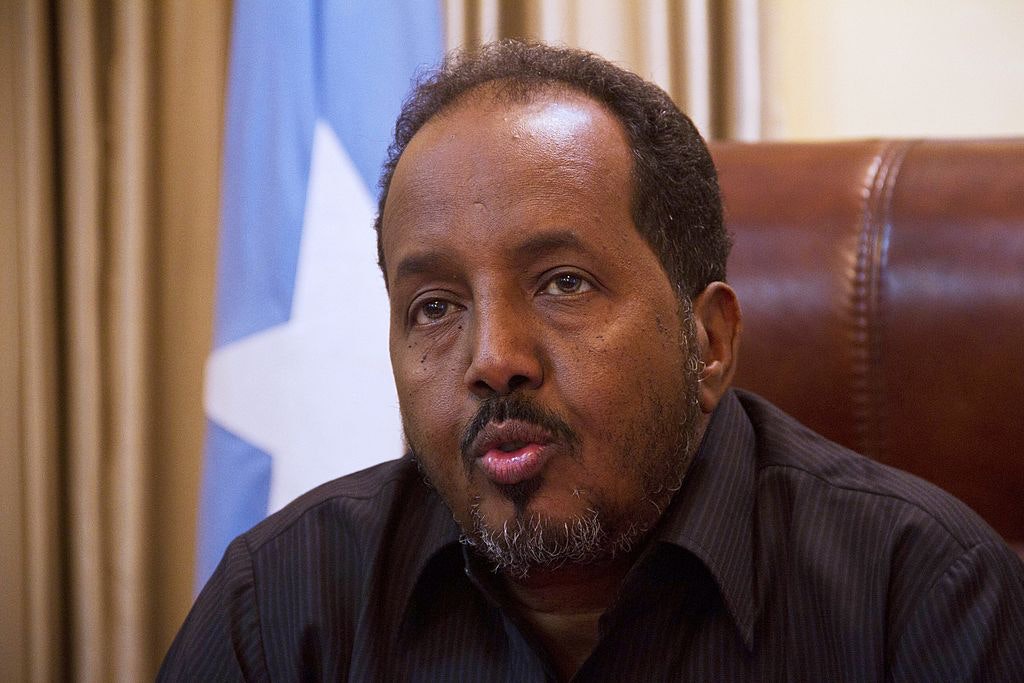
Somalia has a new president. Hassan Sheikh Mohamud beat the incumbent Mohamed Abdullahi Farmaajo in a long-delayed election. It’s not Hassan Sheikh Mohamud’s first stint as leader, the 66-year-old served as Somalia’s president between 2012 and 2017. He is the leader of the Union for Peace and Development party, which unexpectedly won an overwhelming majority of seats in both legislative chambers in the second and third round of the election. Somali scholar Mohamed Haji Ingiriis examines the president’s leadership abilities (both strengths and weaknesses), and the precarious challenges he faces.
What role did nationalism play in the elections?
Nationalism didn’t play a role. The only regional or global ideology at work in Somalia at the moment is Islamism. One of the challenges of the new government is to find an all-embracing ideology to provide original solutions to the myriad acute problems facing Somalia and to guide the war-torn country towards peace and progress.
The only group offering strong locally-based ideology is Al-Shabaab, which sticks to Islamism based – as it is – on the notion of militant fundamentalism.
What are the new president’s strengths and weaknesses?
Hassan Sheikh is a man of many things. I have known him for more than 20 years. When I first met him, he was working on both educational and business sectors in Mogadishu. When I left the country in 2002, he was working on a research organisation called Centre for Research and Dialogue which used to collect data mainly on peace and reconciliation.
His strengths are his oratory skills, persuasive arguments and incisive criticism of his predecessor.
The fact that he could mobilise a strong segment of the political class in Mogadishu and beyond is another. However, this political class depends entirely on the benefits and privileges of political positions. They now expect him to provide them with unaccounted power to enrich themselves with their positions.
Over the last five years, the political class was heavily polarised between pro- and anti-government elements. Hassan Sheikh succeeded in tapping into the support of those who were opposed to the outgoing government, the largest of the two opposing political classes. This is very different from the unexpected way in which he won presidency in 2012. At that time, he was a rather mediocre figure in Mogadishu’s polarised political spectrum. But he took advantage of the failures of the then government authorities, who were hamstrung by internal disputes and lack of a clear vision for the country.
His weaknesses are that he was previously blemished by regular reliable reports of chronic corruption during his first tenure as president between 2012 and 2017, and his innate inability to control his close inner circle of men. These allies were bent on abusing their power and enriching themselves from the state coffers. He could not easily control them as he had relied on them for consultations and other day-to-day necessary political activities.
Due to their maladministration and mismanagement, the opposing political class as well as ordinary people started to be outspoken about the fact that the country had become one of the most corrupt in the world.
It will be important to watch whether his former detested inner circle of men will be active or inactive at this time around. If he returns them to the helm – (and he seems to be doing this with the appointment of his intelligence chief) – he will definitely lose the course. But if he chooses a new cadre of fresh technocrats, he may succeed in winning the hearts and minds of the Somali public.
What is the context in which he takes charge?
The situation is extremely tense and volatile. The elections were delayed for nearly 18 months because of disagreements among the political class.
On one side (that of former president Farmaajo), the main argument was to hold an election based on the formula of one person one vote. On the other (the opposing group of which the incoming president Hassan Sheikh was part), the main argument was to hold an election based on indirect selection.
This approach inadvertently gave a great deal of power to federal member state presidents in the periphery. Giving excessive powers to these over-ambitious men will negatively impact the authority of Hassan Sheikh and his incoming administration. The federal member state presidents will want the ultimate say in the operations of the federal government, something that Somalia’s provincial constitution does not stipulate.
The economic context is dominated by inflation due to rising food prices in the wake of the Ukraine-Russia crisis as well as current droughts affecting millions of poor people in the rural areas. This is further exacerbated by a very high unemployment rate among young people
The social context is also quite different from the one in 2017, when Hassan Sheikh lost the presidency. Mogadishu, the capital, is booming in terms of social development. Much – if not most – of the ongoing construction is a direct contribution from the society, not from the state.
What chances does he have against Al-Shabaab this time?
In his first tenure, Hassan Sheikh failed to curb the explosive attacks on Mogadishu by Harakat Al-Shabaab Al-Mujaahiduun. The consequences of their weekly (and almost daily) assaults hindered any peace-building and state-building progress.
He now has a better chance of dealing with the question of Al-Shabaab by way of negotiating with them. Former high-profile defectors of Al-Shabaab, such as Sheikh Hassan Daher Aweys and Sheikh Mukhtar Roobow Mansuur, whom I met in Mogadishu, are willingly waiting this time around to help the new government talk to Al-Shabaab. Hassan Sheikh can therefore shift from the previous failed course of dealing with Al-Shabaab militarily into a new peaceable approach of negotiation.
But he’s unlikely to face Al-Shabaab without the involvement of the US. US authorities in the Horn of Africa prefer their chosen military approach. This involves fighting Al-Shabaab from the sky, while sending US-trained Somali forces to fight on the ground.
This failed hardline militaristic approach has badly affected the local Somali population which bear the brunt of American drone airstrikes. Most recently, on the same day of Hassan Sheikh’s election, the Biden White House announced it was resending close to 500 US forces back to Somalia. Many Somalis would rather see the US help the new government rebuild the national army and reform the whole security sector.
What are the other main challenges?
Hassan Sheikh’s main challenge is how to restore peace in the capital city of Mogadishu Mogadishu.
His other challenges are how to build a trust between his supporters and those of the former president Farmaajo as well as the need to create political stability between the political class.
To succeed, he must form a government of national unity comprising of both adversaries and admirers. The numerous camps of the political elite should feel represented. The failed Somali political drama of winner-takes-all should be discarded.
Hassan Sheikh said during his campaigning that he saw his role as driving a large and long train that could accommodate everyone. Thus, no-one should be left in the scathing sun while waving to board the train.
Will this kind of train ever exist in Somali politics? I have my own doubts.


