Some softer solutions to Nairobi’s traffic pollution problem:
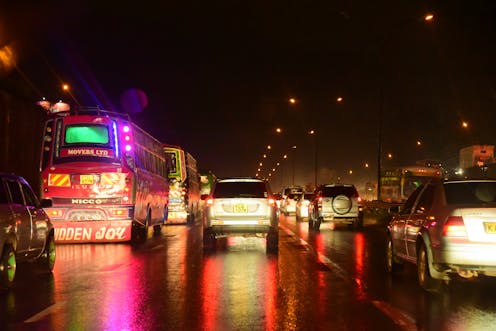
Rapid urbanisation in Nairobi, Kenya’s capital city, has meant there’s been huge growth in the number of vehicles on roads. Today, Nairobi is one of the world’s most congested cities.
Between 2013 and 2017, the number of registered vehicles rose from about 2 million to just under 3 million – an increase of 49% over just four years. Part of this rise can be attributed to “boda bodas” – motorbike taxis – whose numbers have soared. Last year, the number of newly registered bikes doubled in just 10 months.
With poor urban infrastructure, a neglect of non-motorised transport (like walking and cycling) and a lack of services – like mass transport systems – the city has become congested and polluted. Nairobi loses about US$ 500,000 in productivity every day because of traffic jams.
This undermines urban productivity and health as people spend long periods of time in traffic or walking through congested areas, breathing polluted air.
The amount of pollution particles in the air often exceeds the daily guidelines set out by the World Health Organisation. In 2016 for instance, Kenya’s air contained double the recommended volume of particulate matter for outdoor air pollution. Around 40% of CO₂ emissions were attributed to the transport sector.
Reflecting on previous research and experience, we examined potential solutions to Nairobi’s traffic pollution problem.
Attempts by the government to address the pollution problem are still at an early stage. We suggest a combination of infrastructure, policy, regulatory and softer measures – focused more on the city’s residents’ lived experience and environment – that can provide an effective way to address traffic congestion, and therefore, pollution.
Nairobi
The Kenyan government has recognised the congestion problem, and is taking some steps to address it.
It formed the Transport and Urban Decongestion Committee in 2014 and, one year later, it announced that 20% of all funds allocated to the roads budget would be committed to building non-motorised transport and public transport infrastructure. The idea was to create safe networks of footpaths, cycling lanes and tracks and green areas.
In a bid to further reduce car pollution, a ban on the importation of cars which are more than eight years old is set to begin in July. Older cars tend to be high polluters and are often imported from places – like Japan and Europe – where they no longer meet current emissions guidelines.
All of these actions are happening against the back drop of the Metro 2030 strategy – a national strategy which seeks to develop an efficient transport system. A key component of this is the Bus Rapid Transit which could significantly reduce emissions of carbon dioxide in Nairobi.
But these infrastructure projects have been hard to get off the ground. As the Kenya Roads Board stated:
the transport sector in Kenya combines international quality operators and services, a somewhat run down infrastructure and some inefficient and ineffective institutions.
Solutions
But there are other easier, shorter term solutions which could also make a contribution to decreasing congestion and traffic pollution in Nairobi.
Temporary and/or permanent vehicle access restrictions could be adopted, in various ways. For example, large goods vehicles and vans could be re-routed away from the city centre during peak hours or the most polluting vehicles be charged for going into certain central zones.
Traffic “calming” measures could be introduced – like 20mph zones or curves in roads – accompanied by behavioural and public education initiatives. This will help to lower emissions associated with erratic revving, speeding and associated brake pad and tyre wear.
Junction improvements – like the introduction of “green waves” which allow slower moving vehicles to pass through traffic signals unhindered at lower speeds – can lessen the need for stopping and starting and reduce emissions that are released with heavy braking. Pedestrian and cycle priority at junctions are also essential to balance the demands of motorised and non-motorised traffic.
For pedestrians and cyclists, covered walkways, segregated on- and off-road lanes and continuous pavements could enhance their experience and encourage new adopters of these modes.
There is a need for infrastructure investment to be complemented by policy, legislation and active regulation. Planning would benefit from being less focused on facilitating vehicle access and travel through the city. Instead, it should be people-focused and aimed at improving the social and environmental aspects of sustainability. Political will, private sector commitment and public engagement are all necessary to achieve this goal for Nairobi.
Professor Miles Tight and Professor Francis Pope, University of Birmingham, contributed to the research on which this article is based.

University of Birmingham received funding from the EPSRC via grant Global Challenges Research Fund IS2016 and IS2017. DFID is also acknowledged for contribution via the East Africa Research Fund (EARF) grant 'A systems approach to Air Pollution (ASAP)'. Fiona Raje received funding through these schemes.
Source: The Conversation – Articles (AFRICA)
Read more on The Conversation.
Join the fun: Add Your event | Submit a Press Release | Add your listing.


