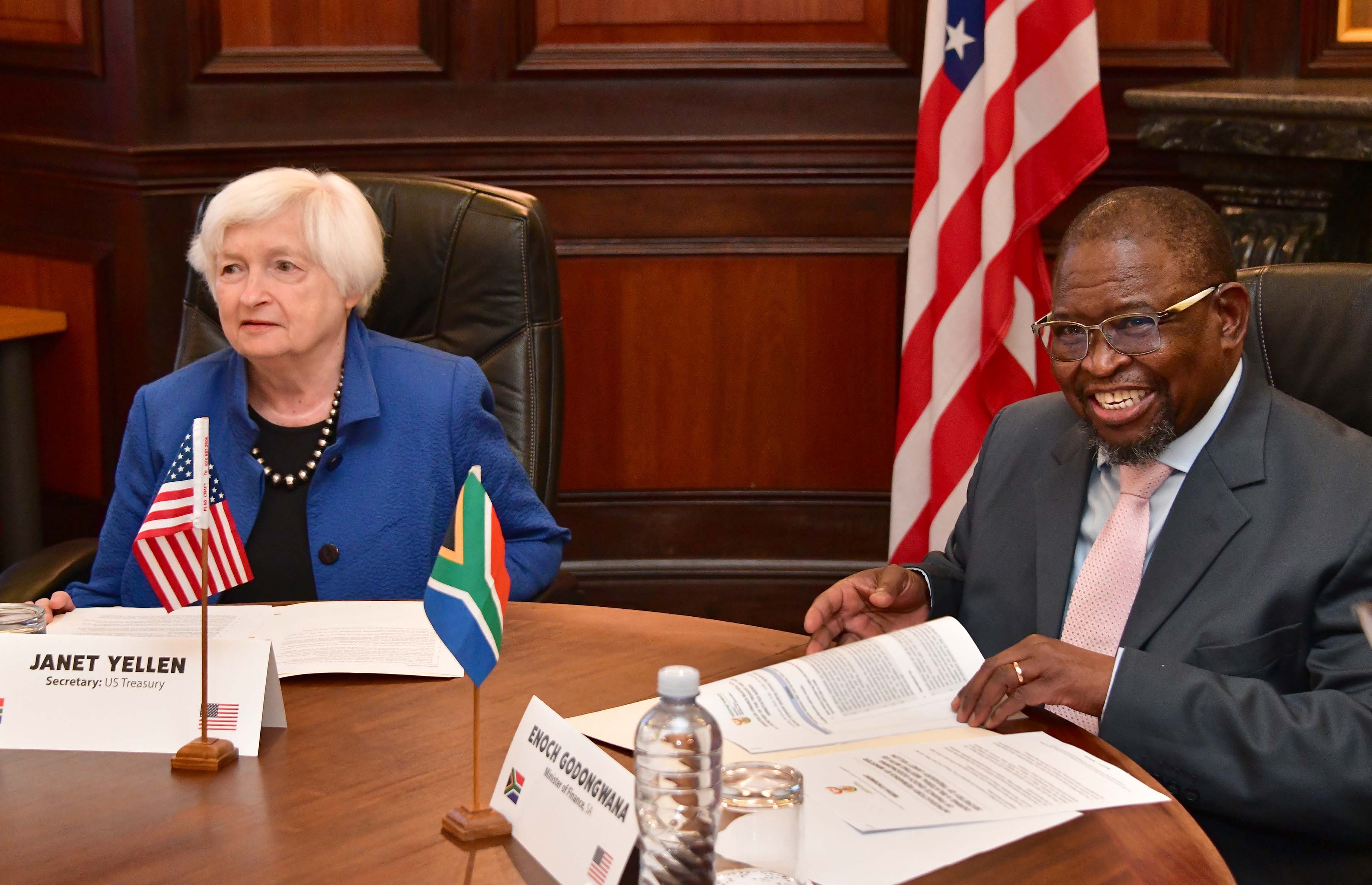
January was a busy diplomatic month for South Africa. The country hosted Russian foreign minister Sergei Lavrov and US treasury secretary Janet Yellen. Josep Borrell, vice-president of the European Commission, was also in town.
The biggest talking point, though, has been Lavrov’s visit, which met with criticism in the west. Similarly, the South African-Russian-Chinese joint maritime exercise, Operation Mosi, scheduled for February off the South African Indian Ocean coast. Critics have slammed South Africa’s hosting of the war games in the light of Russia’s invasion of Ukraine in February 2022.
South Africa has been reticent to criticise Russia openly for invading Ukraine. The country abstained during each vote criticising Russia at the United Nations. Some have read this as tacit support of Russia.
The visits and South Africa’s position on Russia’s invasion of Ukraine have put the spotlight on the country’s foreign policy.
I follow, study and have published extensively on South Africa’s foreign policy. In a recent publication, Ramaphosa and a New Dawn for South African Foreign Policy, my co-editors and I point out that South Africa’s voting pattern in these instances should be read in the context of its declared foreign policy under the stewardship of President Cyril Ramaphosa.
Like his predecessors, Ramaphosa’s policy encompasses at least five principles:
-
pan-Africanism
-
South-South solidarity
-
non-alignment
-
independence
-
progressive internationalism. The governing ANC defines this as
an approach to global relations anchored in the pursuit of global solidarity, social justice, common development and human security, etc.
Evolution of South Africa’s foreign policy
In the era of Nelson Mandela, the first president of democratic South Africa, the country, once a pariah state, returned to the international community. Under him, the country saw a significant increase in its bilateral and multilateral relations.
Read more: History may explain South Africa’s refusal to condemn Russia’s invasion of Ukraine
It enjoyed global goodwill and Mandela was recognised for his outspoken views on international human rights abuses. His involvement in conflict resolution efforts in, for example, Timor Leste (East Timor) and Africa also received international acclaim. The UN declared 18 July Nelson Mandela International Day.
Mandela’s tenure was followed by the aspirational era of President Thabo Mbeki’s African renaissance. Mbeki’s foreign policy aspired to reposition Africa as a global force as well as to rekindle pan-Africanism and African unity.

His successor Jacob Zuma’s era could be described as indigenisation of South Africa’s foreign policy, driven by the values of ubuntu (humanness). In giving effect to ubuntu – equality, peace and cooperation – as a foreign policy principle, South Africa gravitated towards the global south, rather than just Africa. Yet the continent remained a focus of South Africa’s foreign policy.
Ramaphosa’s foreign policy
South Africa’s foreign policy under President Cyril Ramaphosa has shifted to a strong emphasis on economic diplomacy. This is joined by a commitment to “progressive internationalism”.
Progressive internationalism formed the basis for South Africa’s vocal position on UN reform, global equity and ending the dominance of the global north. The global north could view this as challenging to its hegemonic power and dominance in the UN.
This has challenged South Africa’s declared foreign policy principles. It maintains strong economic and political relations with the global north. But it also maintains strong relations with the global south (including Cuba, Venezuela and Russia). For this, it has been criticised by the west.
South Africa’s quest for global status in line with its declared foreign policy principles continues under Ramaphosa. It has adopted several roles to achieve this: balancer, spoiler and good international citizenship.
As a balancer, it has attempted to rationalise its relations with both the north and south in accordance with the principles of non-alignment and independence. As a spoiler, it has failed to condemn, for example, China for its poor human rights record, claiming it is an internal Chinese matter. This could be read as an expression of its south-south solidarity with China. Its role as a good international citizen has made it an approachable international actor. It has promoted the rule of international law and upholding international norms. This speaks to its progressive internationalism principle.
At home and abroad
The Ramaphosa era set off in 2018 with less emphasis on foreign policy. But by the time the COVID pandemic broke out in December 2019, his foreign policy really came to the fore as he led both the South African and African pandemic responses.
South Africa has been attempting to capitalise on the geostrategic changes in the balance of forces on the world stage. Blatant realpolitik has returned. During the past year, for example, the country has conducted joint multilateral military exercises with several states, most notably with France (Operation Oxide), a permanent member of the UN Security Council.
South Africa’s soft diplomacy has made some inroads at UN agencies and through its cultural diplomacy. But this has not necessarily resulted in material gains – such as more leadership in multilateral organisations.
Moreover, its gravitation towards strong non-western military powers such as Russia, China and India has met with western disappointment. Its foreign policy position of solidarity, independence, non-alignment and progressive internationalism has not translated into material foreign policy benefits either, such as increased foreign direct investment as envisaged by Ramaphosa’s economic diplomacy.
Trade with states such as China, Turkey, Russia and India has increased. But it is not enough as the country requires massive investment to update infrastructure and start new development projects in line with Ramaphosa’s vision of a “new dawn” for South Africa.
The post-pandemic international political economy has also adversely affected the country. This has been amplified by the economic impact of the Ukraine crisis . Massive Western financial commitments are directed towards Ukraine. This leaves South Africa in a vulnerable economic position as it needs foreign development assistance.
Looking forward
As our South African Foreign Policy Review volume 4 has shown, Ramaphosa’s “new dawn” has been deferred. This as his party and government jump from crisis to crisis. This kind of instability often seeps into the diplomatic landscape. Investors are aware of the investment risks posed by state capture and power crises.
Globally, the age of soft power has somewhat waned since the Russian invasion of Ukraine in 2022. South Africa needs to be proactive – not only reactive – to emerging international geostrategic conditions.
Read more: Russia in Africa: can it offer an alternative to the US and China?
Besides its current leadership of the BRICS bloc (Brazil, Russia, India, China, South Africa), the country needs to be bolder. It should, for example, campaign for a fourth term on the UN Security Council, and for leadership in multilateral organisations. In these, it can actively achieve its foreign policy objectives in support of the country’s national interests.


