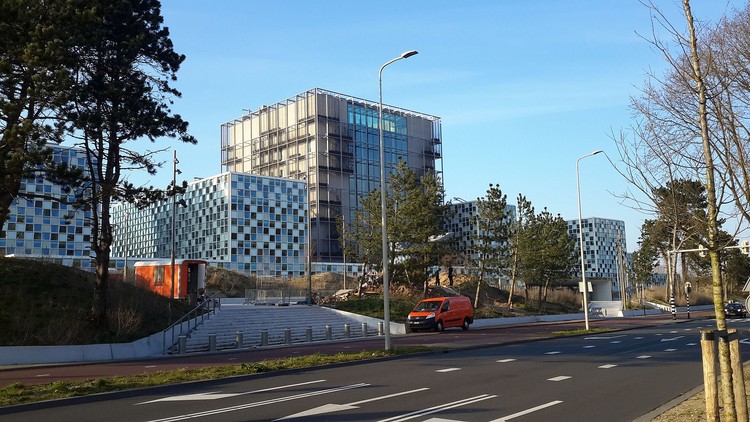
International Criminal Court in The Hague, Netherlands. Photo: Wikimedia user Hypergio (CC BY-SA 4.0)
The International Criminal Court (ICC) arrest warrant for President Vladimir Putin of Russia for alleged war crimes, and his possible participation in the Brazil, China, India, Russia (BRICS) summit later this year, has put South Africa’s relationship with the ICC in the international spotlight.
South Africa, as a member of the ICC, has a legal duty to fully co-operate with the ICC, and this includes the execution of arrest warrants. South Africa has also incorporated the Rome Statute (a multilateral treaty which established the ICC) into domestic law in accordance with the Constitution which prescribes the process in terms of which treaties become law in South Africa.
After South Africa’s failure to arrest Omar Al-Bashir — the former president of Sudan — during his visit to participate in an AU summit in 2015, the Supreme Court of Appeal found that the government was in breach of international and domestic law as well as the Constitution.
The Putin and Al-Bashir situations are comparable in that Al-Bashir was also a sitting head of state at the time of his visit to South Africa and he was also the subject of an ICC arrest warrant for various atrocity crimes.
At the time, South Africa claimed that visiting heads of state were protected from arrest because of immunities, but this claim was rejected by both the Supreme Court of Appeal and the ICC.
The key reason for this is that the Rome Statute, the multilateral treaty which South Africa signed, ratified, and incorporated into domestic law, provides that head of state immunity shall not apply for cases before the ICC.
South Africa’s own domestic law, which incorporates the Rome Statute, provides for the procedures that apply when South Africa is asked by the ICC for co-operation, including the execution of arrest warrants. And on this, the Supreme Court of Appeal held in the Al-Bashir matter that there is a duty on South Africa to disregard head of state immunity and co-operate fully with the ICC.
After the Al-Bashir debacle, the South African government decided to withdraw from the ICC. The Rome Statute provides for withdrawal procedures, including a one year waiting period before the withdrawal becomes effective. But South Africa’s attempt to withdraw from the ICC encountered domestic legal and constitutional obstacles. In a case brought by the Democratic Alliance, the government was ordered to follow the correct constitutional procedures to withdraw from the Rome Statute. This means the government cannot simply decide to withdraw from international treaties (like the Rome Statute) without debate in Parliament.
South Africa’s attempt to withdraw from the ICC in 2016 was therefore declared to be invalid under the Constitution.
It is important to keep in mind that the court did not say the Constitution requires South Africa to be a member of the ICC; that decision is ultimately a policy matter to be debated in Parliament. But there is a certain process to be followed to withdraw from the ICC and on that, the Constitution is clear.
After this decision by the court and South Africa’s failed attempt to withdraw from the ICC, the International Crimes Bill of 2017 was published by the government. This bill was not considered by Parliament and was in fact withdrawn earlier this year in light of the ANC’s decision in 2022 that South Africa will remain a member of the ICC.
But the International Crimes Bill gives us insight into government’s thinking in terms of a possible scenario where South Africa might withdraw from the ICC. This scenario came to the fore last week after a confusing statement by President Cyril Ramaphosa indicating that South Africa will withdraw from the ICC. This was later clarified by both the presidency and the ANC and it seems that South Africa will remain a member of the ICC (for now).
To be clear, even if South Africa were to withdraw from the ICC, this would not affect South Africa’s current duties under the Rome Statute to execute the Putin arrest warrant and it would take a year before the withdrawal takes effect.
Where do we stand now? There are three basic scenarios for the way forward:
- The first scenario is the status quo: South Africa remains a member of the ICC and the domestic implementation legislation remains unchanged.
- In the second scenario, South Africa remains a member of the ICC, but with significant amendments to the domestic implementation legislation. This is where the 2017 International Crimes Bill gives us some clues about government thinking. The most important issue is that of immunities. In this scenario, South Africa’s domestic law will be amended to provide for immunities so that a future visit by a head of state or other foreign dignitary will not be complicated by any arrest warrants as we have seen with the Al-Bashir visit and also now with the possible visit by Putin for the BRICS summit in August. Whether such an amendment will be in compliance with the Rome Statute and the Constitution is debatable, but the government seems convinced that this is a legitimate balance between South Africa’s foreign policy interests and the demands of international criminal justice.
- The third scenario is the most drastic: full withdrawal from the Rome Statute of the ICC. This is what was attempted in 2016. The withdrawal failed then for procedural reasons, but it remains a question whether or not South Africa will make another attempt at withdrawal.
South Africa played an important role in the drafting of the Rome Statute of the ICC in 1998 and was one of the first countries in Africa to fully incorporate the Rome Statute into domestic law.
History suggests that South Africa will probably remain a member of the ICC, but with some important changes in the relationship on the cards.
© 2023 GroundUp. This article is licensed under a Creative Commons Attribution-NoDerivatives 4.0 International License.
You may republish this article, so long as you credit the authors and GroundUp, and do not change the text. Please include a link back to the original article.
We put an invisible pixel in the article so that we can count traffic to republishers. All analytics tools are solely on our servers. We do not give our logs to any third party. Logs are deleted after two weeks. We do not use any IP address identifying information except to count regional traffic. We are solely interested in counting hits, not tracking users. If you republish, please do not delete the invisible pixel.