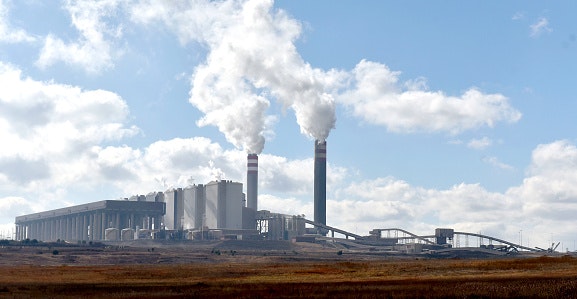
South Africa has experienced power shortages with rolling blackouts on an unprecedented scale in 2022. This state of affairs is largely due to technical failures at its ageing fleet of coal power plants.
The present power generation shortage is due to the power utility Eskom’s failure to add sufficient new electricity generation to the grid. This meant that it had to keep ailing old power stations going beyond their projected life span. The coal plants are prone to frequent renewed breakdown. In addition, their maintenance and parts replacements are becoming prohibitively expensive.
Given the major contribution that the burning of coal makes to greenhouse gas emissions and climate change, electricity generation from coal is in any case globally viewed as extremely problematic, with major pressure and incentives to scale this down.
South Africa is currently ranked eighth in the world in terms of the total amount of coal used for electricity generation. This is based on country-by-country global statistics on coal power generation. The statistics are produced on an annual basis and are widely available. The largest coal user by far is China, followed by India, though these are also the world’s most populous nations.
In terms of energy consumption from coal per capita, South Africa also ranks among the highest in the world with just under 16,500 kWh per person per annum This is in line with other highly coal dependent countries. It is roughly on par with China, South Korea and Australia and slightly lower than the top three – Estonia, Kazakhstan and Taiwan.
When it comes to dependency on coal power plants, South Africa is in a class of its own – 85% of its electricity is produced in coal power plants. This is way higher than all countries – bar two. Only Mongolia and Kosovo have a higher dependency. They have tiny populations – Mongolia has just over 3 million people, Kosovo just under 2 million. South Africa’s population is over 60 million.
South Africa’s percentage of electricity from coal has decreased only marginally – by 9 percentage points – since 1985. This is in contrast to other previously coal dependent countries that have made much more dramatic moves to carbon-free power. For example, the UK got 58% of its electricity from coal in 1985. Today this is down to 2%, partly thanks to massive investments in wind power.
South Africa has climatic conditions suitable for solar and wind power, and should in theory similarly be able to reduce its coal dependence. A drive towards low-carbon electricity generation however requires governmental support, which has mostly not been forthcoming in the last decade.
The history
As it’s a country with rich coal deposits, South Africa’s proliferation of coal plants was to be expected in the 1970s and 1980s. Because it’s also a water scarce country, possibilities for hydropower plants were always limited. And while one nuclear plant was constructed, the increasing isolation of apartheid-era South Africa made it difficult to access international expertise needed for further nuclear developments.
Renewable technologies are relatively new. They only became commercially competitive about 10 years ago, and were not considered a viable alternative to fossil fuels before then.
When the need for more power generation in South Africa became apparent in the first years of the millennium, a time when the electrification of previously unconnected communities was booming, the choice was made to construct two further coal plants, Medupi and Kusile.
These builds have, however, proved technologically flawed, way over budget and badly behind schedule.
When the first series of rolling power cuts had to be implemented in 2007, it became clear that energy security planning and implementation had gone wrong. The subsequent electricity plan from 2010 recommended major developments in nuclear and renewable energy.
In 2015 the government stalled the construction of planned new solar and wind plants in favour of a highly controversial and ultimately blocked nuclear deal with Russia. Since the resumption of the renewables electricity programme in 2018 some wind and solar plants have been built, but at nowhere near the rate needed to dent the dominant role of coal.
A lack of unity of purpose
Despite the electricity crisis having now become urgent and obvious, with several hours of power cuts during as many as half of the days in 2022, there has been no unity in purpose to tackle the issue.
There are loud calls, also supported by influential individuals within the ruling African National Congress party, to maintain South Africa’s coal-intensive trajectory. The proponents argue that the coal power stations can simply be managed better, and that any new power generation should mainly be focused on nuclear and gas.
The opposing view is that South Africa should align with the global trends to massively develop new solar and wind power plants. Its advocates justify this option by pointing to the lower cost of these technologies, short project completion times and environmental considerations.
Despite enjoying weather conditions that are superbly suited for wind and solar farms, South Africa has been extremely slow to kickstart its renewable energy generating infrastructure.
South Africa could have followed the example of China. Although the largest user of coal in the world, it is already making major moves towards a far lower carbon footprint. Over the five year period 2021-2025, China plans to add solar and wind plants producing 570 GW of electricity.
To put this figure into perspective, this is roughly ten times South Africa’s present total power capacity.
Next steps
The office of the South African president, Cyril Ramaphosa, comes across as sympathetic to mass renewable energy developments. It has aligned itself with the recently published Just Energy Transition Investment Plan.
The plan envisages accelerated building of more wind and solar farms to replace decommissioned coal power stations. It also tries to mitigate lowered economic activity and job losses in the coal fields and adjacent coal plants. It goes further in exploring energy exports in the form of green hydrogen, an energy storage medium fed by renewables, and the current global move towards electric vehicles.
If supported and implemented, the plan will result in better power supply in only three to five years from now. This however presupposes that the government will rally behind this initiative and work together rather than sending contradictory messages.
In the interim, power shortages will persist in South Africa.


