South Africa is paying a heavy price for dysfunctional local government:
South Africa’s Minister of Cooperative Governance and Traditional Affairs, Dr Zweli Mkhize, recently painted a bleak picture about the state of local government. It should worry all South Africans, not only those suffering as a consequence of dysfunctional municipalities.
In his budget speech in Parliament in May Mkhize said that 87 municipalities – about a third of South Africa’s total of 257 – “remain dysfunctional or distressed”. He identified two problems. One set is systemic and relates to the size and structure of municipalities. The other is mismanagement due to “political instability or interference, corruption and incompetence”.
Whatever the causes of the dire state some municipalities are in, it is evident that this situation has a huge negative impact on society.
South African municipalities form the third sphere of government after the provinces and national government. In accordance with the Constitution, they must be democratic, accountable institutions that provide a range of basic services to local communities, such as water and electricity.
They are also key institutions for the promotion of social and economic development, given their direct link to local communities. Successful municipalities are essential for the country’s prosperity.
What dysfunctional looks like
A number of characteristics are evident in dysfunctional municipalities. Firstly, there is very poor or no service delivery – in other words rubbish isn’t collected and basic services such as water supplies are patchy or non-existent. Another feature is that they suffer from serious financial problems such as low debt collection and huge overdue creditors’ payments. There is also always evidence of infrastructure, such as roads, deteriorating at a fast pace.
Communities in these areas often experience a range of problems that reflect this state of dysfunctionality. These include potholes; significant water losses due to infrastructure not being maintained; an increasing backlog in new infrastructure; financial mismanagement as well as fraud and corruption.
A second important impact is that service providers are affected. If a municipality doesn’t collect all the revenue due to it, it can’t pay its creditors or takes a very long time to do so.
An example of this is the R16 billion owed by municipalities at the end of 2017 to Eskom, the country’s power utility. Smaller service providers, some of which are small and medium enterprises, could face serious liquidity problems if they don’t get paid. At worst they could go under.
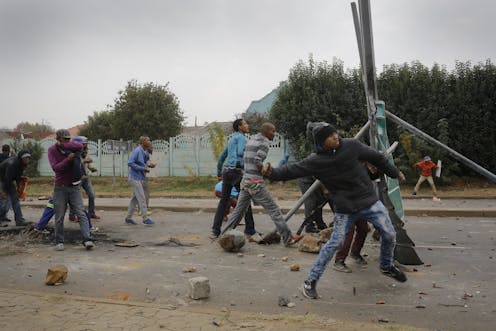
The effect of all this is often civil unrest. In the longer term consequences will be increasing uncertainty or even instability in affected communities and a spiralling financial crisis. And financial problems will have a snowball effect. This is because investors won’t be interested in investing and current businesses might decide to move elsewhere. This will mean that local economic development and much-needed job creation won’t get off the ground.
What needs to be done
In addressing systemic issues, there needs to be a thorough investigation into the structure, size and types of municipality and their governance structures. This should ideally be done by independent experts on behalf of the government.
This should be directed to the overall improvement of the design of local government. And it should also take into account the fast-changing, technology-driven environment in which we live.
In reflecting on the current state of affairs two potential scenarios – which I name after Beatles songs – are presented.
The first is a low road scenario. I have called this “Crying, Waiting, Hoping”. The other is a high road scenario, which I have named “We can work it out”.
In the first scenario, bad governance continues. On the financial side this involves financial mismanagement, tender fraud, corruption, low debt collection and very slow payment of creditors. In this scenario services will deteriorate. Refuse will be collected less frequently and there will be more water losses due to old infrastructure not being maintained. In addition, more potholes will lead to more claims due to accidents. And finally, increasing dissatisfaction among the citizens which lead to more civil unrest.
If this went on for a prolonged period of time it could lead to the total collapse of a municipality. This in turn would require a long time and significant funding to get it into an acceptable functional state again.
The “We Can Work It Out” scenario envisages the successful prosecution of corrupt officials and councillors, cooperation across the political spectrum to create a stable organisational basis and a serious attempt by communities to help solve municipalities’ problems. They can do this by providing expertise and participating constructively in the rebuilding of their society.
In this scenario all available resources from all three spheres of government, the business community, academia and citizens would be used in a spirit of cooperation to work out solutions that can benefit society.

Dirk Brand does not work for, consult, own shares in or receive funding from any company or organisation that would benefit from this article, and has disclosed no relevant affiliations beyond their academic appointment.
Source: The Conversation – Articles (AFRICA)
Read more on The Conversation.
Join the fun: Add Your event | Submit a Press Release | Add your listing.


