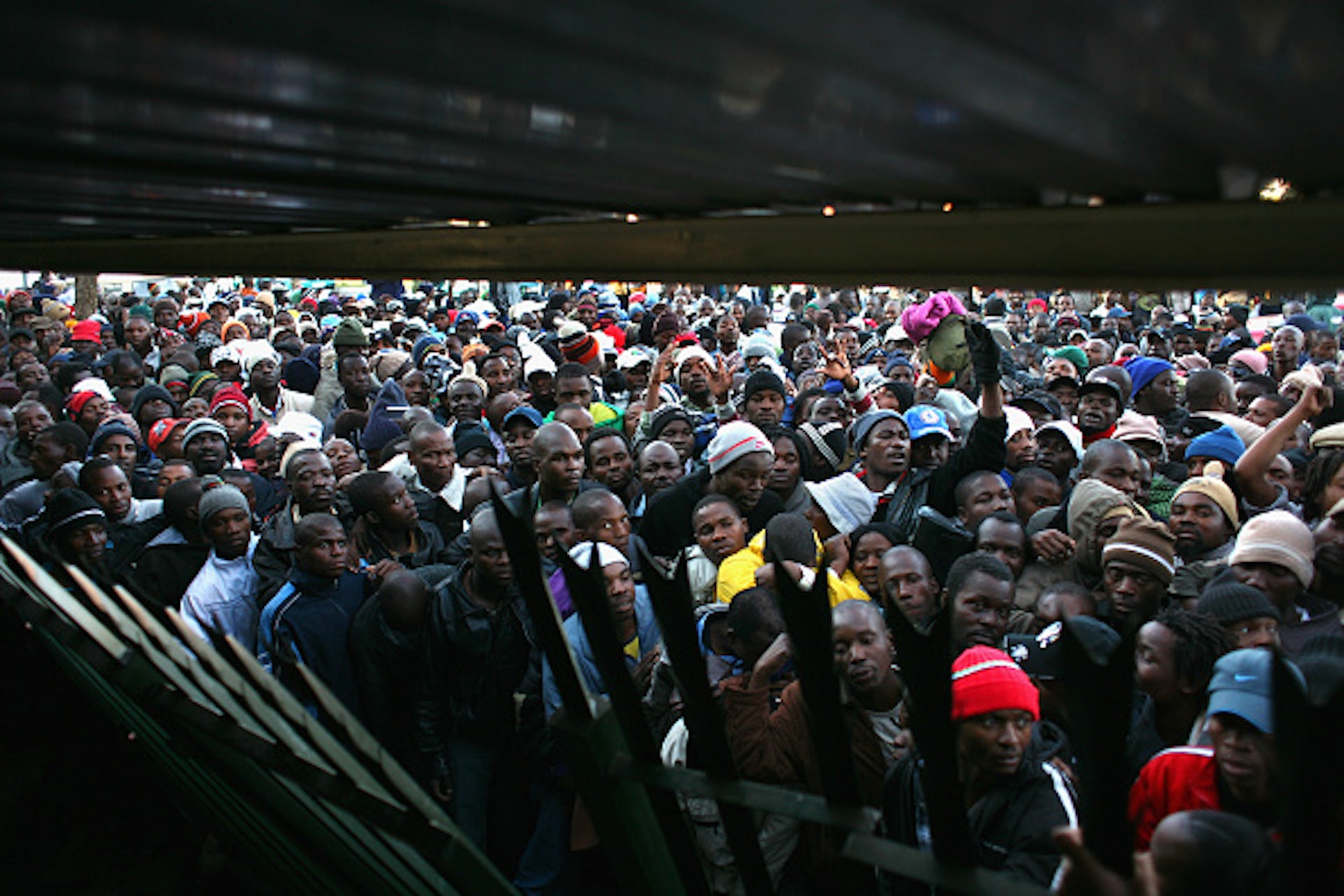
Hundreds of thousands of Zimbabweans have flocked to South Africa to escape economic hardship since the 1990s. The South African government has, since 2010, granted the migrants a special permit to live and work in the country. It’s latest iteration is the Zimbabwe Exemption Permit. Now the government says the permit has run its course and wants to scrap it. This has sparked fears that the move will jeopardise the lives of the permit holders and their dependants. The Conversation Africa’s Thabo Leshilo spoke to Sikanyiso Masuku, an immigration and migration expert, about the issue.
What is the Zimbabwe Exemption Permit?
The South African government recognised that it had a huge Zimbabwean migrant population so, in 2010, it granted an amnesty meant to legalise the status of those who had either illegitimately claimed asylum or fraudulently acquired other South African legal documents in order to stay in the country.
This Dispensation for Zimbabwe Permit was valid until 2014. It was succeeded by the Zimbabwe Special Permit that was, in turn, replaced by the Zimbabwe Exemption Permit, effective from September 2017 to December 2021.
The Zimbabwe Exemption Permit, like the one it replaced
-
entitled the holders to the right to live and work in the country
-
did not grant them the right to permanent residence – irrespective of how long they had been in the country, and
-
would not be renewed or extended.
Holders could not change the conditions of the permit in South Africa. Similar exemptions were previously granted to people from Lesotho and to Angolan refugees.
How many people have the permit?
There are 178,412 Zimbabwe Exemption Permit holders, drawn from three waves of Zimbabwean migration to South Africa since the 1990s. Some entered between 1994 and 1997, just after apartheid ended. There was an influx in 2000 as Zimbabweans fled from an economic and political crisis. This group of forced migrants was only recognised as asylum seekers in 2002. Then, in 2008, even more Zimbabweans arrived, fleeing a heightened economic crisis.
South Africa’s Immigration Act permits employment under certain visas. These visas include the general work visa, critical skills visa and permanent residence permits. The Zimbabweans found that they did not qualify for any of these visas. Most, therefore, pursued the asylum seeker route to live and work in the country legally.
Why is the matter in court and what are the contested issues?
The South African government announced on 25 November 2021 that the Zimbabwe Exemption Permit would be discontinued in December 2021. Permit holders would have to either return to Zimbabwe or apply for visas allowing them to work. This caused an outcry because of the short notice period.
The Helen Suzman Foundation, a think-tank promoting human rights and constitutional democracy, is challenging the November 2021 announcement on behalf of some of the permit holders. Three other entities, the Zimbabwe Immigration Federation, the Zimbabwean Exemption Permit Holders Association and the Consortium for Refugees and Migrants in South Africa, have mounted separate court challenges.
The Helen Suzman Foundation is partly arguing for the court to rule that the Minister of Home Affairs’ decision was unconstitutional. It is also arguing for a fair process in respect to the permit holder’s children’s rights to family unity, stability and schooling.
The other parties are arguing that the decision to terminate the exemption permits is detached from the economic and political realities in Zimbabwe that necessitated the exemption in 2010.
As part of regularising the permit holders’ status, restrictions on their rights to apply for other visas have been lifted. Hence, those who have acquired critical skills can now migrate to other mainstream visas. While this reprieve sounds noble, it only came into effect after the Department of Home Affairs tightened the list of critical skills covered in February 2022. This was just three months after the termination of the Zimbabwean exemption permits.
There were also concerns that, although Home Affairs was not expected to continue the permits in perpetuity, a consultative process taking into account the risks to the lives and livelihoods of the permit holders – was never done. The Promotion of Administrative Justice Act 3 of 2000 12/7/2009 equally demands that the Home Affairs minister must first consult with affected individuals before making any decision.
The department has denied that it failed to consult, citing correspondence to this effect.
It also insists that the decision announced on 25 November 2021 was government policy as it was arrived at with the support of the cabinet. It is thus government policy that a blanket exemption for Zimbabwean citizens should end. They would now have to comply with the provisions of the Immigration Act.
Furthermore, the minister argues that the decision on permits did not take away rights, but rather conferred them. The permit holders can now apply for a general worker’s visa, to be granted at the discretion of the department’s director general.
Through a waiver system, low skilled exemption permit holders have also been allowed by the department to apply for general work visas without first obtaining a certificate from the Department of Labour. However, a pre-existing backlog of nearly 63,000 visa applications has sparked fears that Home Affairs might lack the capacity to process new waiver applications in time. Zimbabwe Exemption Permit holders’ response to the waiver application system has also been poor, with only 4,000 applications received by Home Affairs by September 2022.
What, in your view, is the correct position?
The conditions of the Zimbabwe Exemption Permit have always been clear that the holders are not entitled to permanent residence, irrespective of the period of stay in the country.
More than anything, this debate has exposed the challenges arising from the formulation of temporary policies that operate outside the confines of the Immigration Act. Clearly, the permit was designed as a contingency plan in response to the reality of mass migration. However, it was never envisioned that, more than 13 years after the conditions necessitating this extraordinary exemption, Zimbabweans would still be desperate to remain in South Africa.
The discontinuation of the permits was inevitable. Most of the litigants in the case against Home Affairs aren’t debating the permits’ cancellation as such. Instead they are focusing more on issues of constitutional validity or procedure, rationality, and fairness of government action. This shows that even they accept its impermanence.
How should the issue be resolved?
Although cabinet said on 24 November 2021 that the holders of the exemption permit have to apply for mainstream visas – most of them do not qualify for other visas allowing them to work.
Unless another version of the exemption permit is created (as has been done thrice already), the people concerned will most likely remain ineligible to claim alternative forms of protection under the the Immigration Act. For instance, although the permit was set to expire at the end of 2021, an 18 month grace period was granted. This has not yielded much as 97% of the 178,412 permit holders have still not applied for alternative visas.
A viable solution appears to be a measured discontinuation of the exemption permit. This should include assessing and addressing the resultant social and economic effects of the move. That way, the permit holders might finally be able to pursue more durable and alternative solutions and get some closure.


