South Africa is set on fixing its economy. But will poor people benefit?:
President Cyril Ramaphosa has been working hard to improve South Africa’s economic situation. In October he hosted a jobs summit that’s expected to produce 275 000 new jobs a year. More recently he organised an investment summit at which participants announced commitments worth R290 billion. He also announced initiatives to promote the construction of infrastructure and reform the tax regime.
This all sounds very impressive.
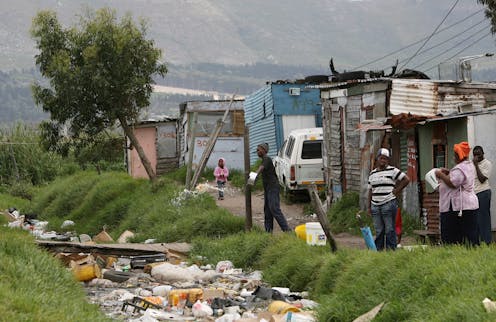
Unfortunately, it’s possible that all these initiatives could simply result in growth that reinforces the structural weaknesses in South Africa’s economy. As a consequence they will not significantly reduce South Africa’s high levels of inequality and poverty – both hallmarks of apartheid’s legacy.
Past experience suggests that there’s a high risk this could happen. The South African economy grew an average of 2.78% a year between 1993 and 2017. Nevertheless, the unemployment rate increased from about 20% in 1994 to about 27% in 2018. And South Africa’s Gini coefficient – a measure of income inequality – indicates that the country is more unequal today than it was in 1994.
In addition, people’s ability to pay for essential services like water and electricity is diminishing as prices increase quicker than incomes and job creation. While access to schools and health care facilities has improved over the past two decades, the quality of the services being offered has deteriorated.
Thus before we applaud the government’s economic initiatives, the country needs to understand what contribution they will make to improving the lives of South Africans. In other words, can these initiatives pass the following test: will they contribute to progressively delivering the economic and social rights to which all South Africans are entitled?
Clarity on what needs to be done
The South African Constitution provides a good framework. It sets out the government’s obligations to its citizens.
Firstly, the Constitution says that the government has an obligation to transform the economy into one that doesn’t discriminate, that protects and respects the dignity of each person and steadily improves standard of living.
It goes further to say that, in addition to their civil and political rights, South Africans have the right to housing, education, sufficient food and water, health care and an environment that isn’t harmful.
In 2015 the state reinforced this commitment by ratifying the International Covenant on Economic Social and Cultural Rights. The rights are very similar to those set out in South Africa’s constitution. Article 2 of the covenant requires states to use the “maximum available resources” to progressively realise them.
This means that the state must not do anything – or allow others to do anything – that deprives people of their rights or that undermines their ability to enjoy their rights.
And it must use its “maximum available resources” – not all its resources– to progressively provide each of its citizens with their social and economic rights. This includes showing that it is using its regulatory and legislative powers to incentivise other social actors, such as local governments and business, to contribute to their realisation.
Measuring how effectively government is promoting these objectives is challenging – but possible.
Measuring impact
It requires measuring the human rights impact of any proposed government economic policy, law, programme or project. This can be done by doing a human rights impact assessment of the proposed activity. Its purpose is to help governments assess how to maximise the positive human rights effects – and minimise the negative impacts – of their proposals. They have been used to assess the human rights impacts of spending cuts in local government budgets in England, free trade agreements in Central and South America and mining projects.
A human rights impact assessment of the outcomes of the jobs summit, for example, would assess a number of factors. These would include where jobs will be created, who will get them, and how they will be divided between men and women. It would also examine how long the jobs will last, wages paid and working conditions. It would also look at how the job initiatives will affect the access of affected communities to housing, health care, education, food and water.
An impact assessment of the investments announced at the investment summit, would evaluate a similar set of issues. These would include, for example, the investments’ contribution to creating opportunities for individuals and communities previously excluded from the formal economy. It’d also weigh the impacts of these investments on the environment and existing economic activity in the communities where they will be located. It would also assess how the products they produce will affect the diet and lifestyles of South Africans.
These assessments do not preclude the government from allocating some resources for purposes that don’t directly promote human rights. They merely require the government to show it understands the human rights impact of its decisions. And that it can articulate a justification for these impacts in terms of its obligation to progressively realise the rights spelled out in the Constitution.
For example, an investment in improved airports to promote tourism doesn’t directly contribute to the realisation of human rights. Nevertheless, the government could justify the investment by showing that the impact of more tourists visiting the country will include increasing resources available to improving living conditions of the country’s citizens.
Requiring human rights impact assessments should not unduly burden government. South African government guidelines already stipulate that a social and economic impact assessment should be done on draft policies, bills and regulations before they’re put to Cabinet.
Demanding that the government support its proposed decisions and actions with human rights impact assessments is, therefore, not unreasonable or unrealistic. It is merely expecting the government to take its obligations seriously.

Danny Bradlow's SARCHI chair is funded by the National Research Foundation.
Source: The Conversation – Articles (AFRICA)
Read more on The Conversation.
Join the fun: Add Your event | Submit a Press Release | Add your listing.


