South Africa kicks the can down the road on captive predator breeding:
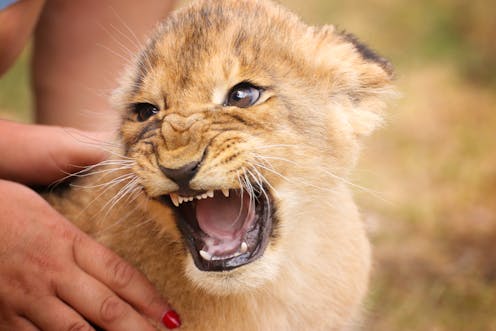
The world’s leading lion scientists argue that captive predator breeding has no conservation value. Successful reintroduction from captivity into the wild among large felids is extremely rare.
Nonetheless, the captive predator breeding industry in South Africa operates on the pretext that reintroduction to the wild is a viable strategy, and that it contributes to broader conservation.
The industry’s proponents also contend that it may serve as a buffer against wild lion poaching. The logic is that if captive-bred lions can supply the market for lion and tiger bones in East Asia, then wild lions will not be poached. South Africa’s Scientific Authority – a body that advises the Minister of Environmental Affairs on conservation issues – made this speculative argument last year.
But speculation is insufficient grounds on which to continue the practice. Growing evidence shows that wild lions in other parts of Africa are being poached, driven by East Asian demand for their parts. So, while the Scientific Authority is correct that South Africa’s wild lions are not imperiled by captive predator breeding, this does not mean that other lion populations are safe.
Despite these concerns, the latest development reveals a gaping hole in South Africa’s governance of the industry. The Department of Environmental Affairs – in its first quarterly report to parliament this year – revealed that the industry is still thriving.
Read more: South Africa’s role in the trade in lion bones: a neglected story
South Africa’s parliament has unequivocally condemned the captive breeding of predators for human interaction, canned hunting and the East Asian lion bone trade. It saw it as a blight on South Africa’s tourism and conservation reputation. A paper by the South African Institute of International Affairs estimates that the continued protection of the captive predator breeding industry may cost South Africa as much as R54 billion (about US$ 3.8 billion) in reputation damage over the next decade. South Africans themselves are overwhelmingly opposed to the practice and believe that it harms the country’s brand.
But the government appears to have kicked the can down the road. It does not appear to have taken on board parliament’s or South Africans’ strong views.
Policy instructions from parliament
The parliamentary portfolio committee for Environmental Affairs hosted a two-day workshop in August 2018 entitled: ‘Captive Lion Breeding for Hunting In South Africa: Harming or Promoting The Conservation Image of The Country’. The purpose was to review reports and presentations from conservation and hunting organisations on the topic.
The final report by the committee called for the Department of Environmental Affairs to urgently
initiate a policy and legislative review of Captive Breeding of Lions for hunting and lion bone trade with a view to putting an end to this practice…
It further called for an audit of captive lion breeding facilities throughout the country
to ascertain the conformity with the current threatened or protected species regulations and other applicable legislation in light of ongoing and increasing disquiet about the (captive lion breeding) industry.
A lucrative industry
The captive breeding industry is lucrative. Lion “encounter” operations buy or rent cubs from breeders. Some conduct questionable research on the cats. Unsuspecting tourists pet, feed, cuddle and walk with the big cats, mostly for the sake of a selfie. Some even pay for the privilege of volunteering at these facilities, falsely believing that they are contributing to conservation. The South African Institute of International Affairs paper estimates that the encounter element of the industry is worth roughly $ 180 million per year, the majority of which accrues to a handful of beneficiaries.
Once the cubs have exceeded their economic utility to encounter facilities, they are often sold into the canned hunting industry and thereafter into the Asian bone trade.
Given the recent controversy around canned hunting, some breeders sell directly into the bone trade, which has led to the creation of lion abattoirs. These abattoirs execute captive-bred lions for their skeletons. Under the Animal Protection Act of 1962, which prohibits the slaughter of wild animals, the Department of Agriculture, Forestry and Fisheries has the power to shut these down. It should do so.
The problem
The department’s defence of the industry in terms of fulfilling its mandate to conserve biodiversity, enforce international agreements and protect whole ecosystems, appears flimsy.
In 2016 the International Union for the Conservation of Nature issued a motion that urged the South African government to
terminate the practice of breeding lions in captivity for the purpose of canned shooting through a structured, time-bound process.
The motion also called for captive breeding to be limited to those facilities that were evidently conservation-orientated.
The Department of Environmental Affairs didn’t mention this. But it has at least proposed an amendment to regulations covering threatened or protected species that would see issuing authorities – the Provincial Environmental Departments – refusing to grant a permit for breeding listed large predators unless they could demonstrate conservation value. What’s unclear, though, is how such value will be identified or verified.
In respect of the audit it was instructed to carry out, the Department admitted that it still doesn’t know exactly how many breeding facilities there are, or how many big cats are being held in captivity. It inspected a total of 227 facilities between 2015 and 2018, 88 of which (38%) were found to have violated existing regulations.
But the department has re-issued permits for most of these facilities. It did not provide reasons for doing so.
What next
The department is in the process of establishing a high-level panel to conduct a more comprehensive legislative and policy review of the industry, though its operating terms have not yet been established. Most of the committee members (except for the main opposition party, the Democratic Alliance) seemed satisfied with the department’s feedback. This is difficult to understand given their vehement dislike of the industry and its negative impact on the country’s reputation.
The bottom line is that, increasingly, ethical tourism is gaining ground. South Africa can ill afford to become a pariah again. It therefore has to move faster against industries that threaten its tourism and conservation brand value.

Ross Harvey works for the South African Institute of International Affairs, which has – in the past – received research funding from the Humane Society and Stop Ivory.
Source: The Conversation – Articles (AFRICA)
Read more on The Conversation.
Join the fun: Add Your event | Submit a Press Release | Add your listing.


