South Africa: Ramaphosa administration lacks a long-term perspective:
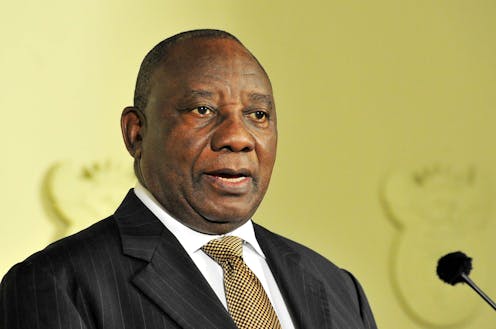
South African president Cyril Ramaphosa’s state of the nation address and the budget speech delivered by Finance Minister Malusi Gigaba – who was removed from the job less than a week later – had something in common: they both lacked an animating narrative. And they both looked backwards rather than forwards.
Ramaphosa pinned his hopes on the National Development Plan which was released six years ago, suggesting that he has not had much time to think about long-term economic recovery.
Gigaba’s budget speech was defined by the bad legacy of former president Jacob Zuma. The parlous state of governance and weak leadership of the economy has been costly to the economy. Essentially, South Africans are bearing the cost of poor leadership.
Both addresses didn’t leave a sense that there has been much reflection on the years ahead, the depth of the economic malaise gripping South Africa, and the storms that lie beyond the 2019 general elections.
The budget contained desperate increase in taxes, and some piecemeal allocations to various social causes. But citizens were left with no clarity on what the future will look like. This includes the new character of government, the structure of state-owned enterprises, and long-term development commitments of the current administration.
Trying to formulate a long-term strategy a year before the elections is a tough act, especially since the mind of a politician tends to be constrained by short-term considerations and desire for popularity. But if the administration under Ramaphosa is going to be successful, this is precisely what it has to do – craft a sensible and bold long-term strategy for economic recovery.
Tensions and interests
In the medium-term, the effects of the budget will be felt by public-sector workers, who are likely to be squeezed hard during wage negotiations. As Gigaba indicated, one of the cost containment measures that government will pursue is limits to public sector wage increase.
Negotiations for a three-year framework are currently underway . Depending on what the outcome is – and they are likely to last until June 2018 – they may very well complicate the proposed budgetary framework.
Some progress has been made in the negotiations between the government and the public-sector unions. But they are still at different positions on what the wage increase, over and above inflation, should be for the next three years. Unions are demanding consumer price index +3%, while government is offering consumer price index +1.5% for employees at lower levels.
This means that the public sector wage bill will increase. The only question is by how much.
On the positive side, major items in government spending remain those that matter to the poor. For example, R792bn has been allocated to basic education, R668bn to health and R528bn to social grants.
The budget has always included commitments that address issues of equity. This was true in Gigaba’s budget too. But, in the absence of a long-term plan for economic leadership, this too may come under threat once the general elections are out of the way.
There are other re-distributive measures targeted at constituencies that are important to the governing party. The R57bn allocation for free higher education may have been unplanned, but it helps government to stem any #Fees MustFall protests that might snowball into rolling mass protests on the eve of the elections.
The largesse extended to business start-ups to the tune of R2.1bn, and allocations to black producers in agriculture are all aimed at giving government a powerful platform to project its developmental credentials.
There are clearly tensions in the budget, with strong pressure to curtail public spending and to increase taxes on the one hand, while maintaining a pro-poor and developmental face on the other hand. This works in the short-term, but without a credible recovery plan the future looks foggy.
Further, what’s missing are clear plans to introduce greater efficiency in the public sector given that a lot of wastage happens across different spheres of government – as shown by various reports of the Auditor General –- as well as in state-owned enterprises.
Merely alluding to reform of these entities doesn’t help when there is no clear strategy on how government will shake things up – or by when. The statements by both Gigaba and Ramaphosa are too broad, and lacking a concrete plan on the reform of the public sector and state-owned entities.
Need for decisiveness
A major confidence-boosting action that should have been signalled in the budget speech is the need to reduce the bloated cabinet. Even though this is unlikely to generate significant savings, it would signal government’s commitment to lead by example in cutting fat. Indeed, Ramaphosa has alluded that he will cut the size of the government. What is important is how government is restructured to trim the fat while also positioning it for effective execution.
Some ministries under Zuma were created to accommodate various factional interests within the ANC rather than to enhance the delivery capacities of the state. Similarly, diplomatic missions were a trove for politically connected cronies. These need to be reduced drastically to send a clear message about the priorities of government.
A great deal of work awaits Ramaphosa to get the country moving beyond the budget vote. He has little time to solve some of the major challenges facing the country, ranging from governance to socio-economic challenges. He can ill-afford to spend an inordinate amount of time consulting and building a consensus. South Africa is in the middle of a storm, and that requires some decisive steps (and risk taking). He should not spend too much time in the boardroom. As the former US secretary of state Robert Gates put it,
A leader placed in charge of an organisation facing a firestorm should reach for a hose, not a PowerPoint.

Mzukisi Qobo does not work for, consult, own shares in or receive funding from any company or organisation that would benefit from this article, and has disclosed no relevant affiliations beyond their academic appointment.
Source: The Conversation – Articles (AFRICA)
Read more on The Conversation.
Join the fun: Add Your event | Submit a Press Release | Add your listing.


