South Africa still has a long way to go to settle traditional leadership challenges:
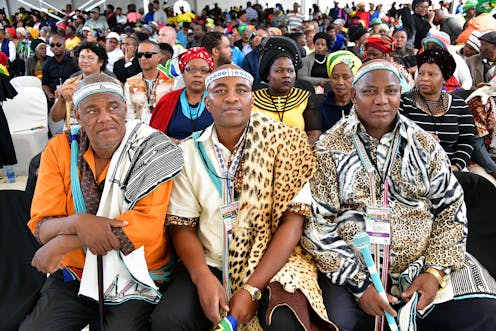
Twenty-five years after apartheid formally ended in South Africa, rural people are still fighting laws that entrench the former discriminatory system and limit their freedom.
Recently, rural activists marched to the government’s headquarters in Pretoria to protest against pending laws that they argue reduce their constitutional rights. The protesters are part of a campaign launched by the collaboration of civil rights organisations, the Alliance for Rural Democracy.
They were protesting against the Traditional and Khoi-San Leadership Bill awaiting signature by President Cyril Ramaphosa, and the Traditional Courts Bill which has been passed by the National Assembly and is now before the National Council of Provinces. (The Khoi-San are the first peoples of South Africa, formerly called “Bushmen”.)
The new laws deal with traditional leadership and traditional courts, but the protesters say they are based on a false understanding of those concepts. Their claim is important partly because the effect of the new laws is to deny people the right to choose whether to have their cases heard in customary or state courts.
Constitutional scholars argue that the customary and state courts do not offer the same protections and people should not be forced to use one kind rather than the other simply because they live in rural areas. This affects women in particular: they are not well represented in customary forums or in the new Bills.
It appears that the governing party, the African National Congress (ANC), is backing these laws because it believes the traditional leaders who pushed for them deliver rural voters. Yet it ignores rural voices that contest the new laws’ definition of what is “traditional”.
So, what is truly “traditional”?
Deciding what’s traditional
To understand the protesters, it is worth examining how the colonial fictions about traditional leadership and customary law have shaped rural people’s access to rights in South Africa.
The historical record, rather than the colonial depiction of it, shows that communities have typically determined how they are led. Customary law is lived and agreed by community members.
The historical and archaeological record also shows that communities did not have to have a senior traditional leader. The idea of a “chief”, beloved by colonialists, does not reflect the fact that societies in southern Africa were mostly governed by decisions made by groups of people.
This is why South Africa needs to balance the demands of traditional leaders with these collective decision-making processes and modern constitutional terms for governance. South Africa’s Constitutional Court has noted that “living customary law” requires respect – and that it must accord with the 1996 Constitution. But laws that keep using the idea of colonial and apartheid chiefdoms actually go against this precept.
Post-apartheid legislation insists on the existence of a “traditional leader” for a “traditional community” to be recognised by government. With recognition comes salaries for traditional leaders and land, among other government benefits. This is why traditional leaders support the laws. The new Traditional and Khoi-San Leadership Bill is based on the same hierarchy of leaders and authority as the Traditional Leadership and Governance Framework Act, which it replaces. And that, in turn, is based on colonial and apartheid-era definitions.
But it’s not the way communities define authority.
The law also delineates the jurisdiction of traditional leaders in terms of territory. But traditional community boundaries are actually set by fluid personal relationships. A community defines itself.
This mismatch of definitions is why people often don’t agree about who should inherit a title, who has certain status and where boundaries lie. The result is hundreds of disputes over leadership positions and community boundaries.
Definition of a community
One law that has recognised the historical reality is the Interim Protection of Informal Land Rights Act. This defines “community” as
any group or portion of a group … whose rights to land are derived from shared rules determining access to land held in common by such group.
Similarly, Section 1 of the Mineral And Petroleum Resources Development Act defines “community” as
a coherent, social group of persons with interests or rights in a particular area of land which the members have or exercise communally.
Unlike the Framework Act, these last two definitions attempt to capture the fact that communities end where agreements between their members end. The Informal Land Rights Act also sees that communities have flexible, nested and overlapping borders that depend on a purpose. This is especially important for decisions over land, where the relevant “community” may be the family, clan, subward, ward, village, or what is legally defined by the Framework Act as the “traditional community” (formerly, “tribe”).
New laws get it wrong
There are additional problems with the revised 2017 Traditional Courts Bill.
In the past, traditional courts were a part of the way that traditional communities functioned. They are not the same as state courts. They don’t judge. Rather, they are places where people manage disputes through processes combining negotiation, mediation and arbitration.
But the Traditional Courts Bill denies people living in “traditional communities” the right to choose whether to use customary or state courts. It also denies people the right to legal representation when accused of an offence – a right the Constitution wholly guarantees.
The Constitution says that the Bill of Rights underpins all laws. It qualifies the right to culture, which it considers an individual choice.
In a 2008 case, the Constitutional Court clarified its approach to customary law. Courts must first look at customary law as lived in and by communities and defer to the right of communities to observe and develop their own law. Courts must also balance this with their responsibility to ensure legal certainty and protect vested and constitutional rights, especially of vulnerable groups.
Who is vulnerable?
The relationship between women’s rights and customary law has been debated since South Africa’s Constitution was first negotiated. It continues to be raised in relation to all the legislation discussed above. Almost all traditional leaders in South Africa are male. And traditional courts are typically made up of men, excluding women from participation other than as parties to cases or witnesses.
This brings us back to why the Stop the Bantustan Bills campaign marched to Pretoria. They want a citizenship equal to that held by South Africans living in urban areas as promised under the Constitution.
It seems a straightforward request. But it may not be heard. After all, the ANC seemingly believes bending to the will of the traditional leader lobby will secure its rural support. This belief is arguably affirmed in the leader of the traditional leader lobby, Inkosi Patekile Holomisa, being declared one of two Deputy Ministers of Justice and Correctional Services in the new cabinet.
But President Ramaphosa still has an opportunity to show he is able to listen to rural people, even in the face of pressure from the traditional leader lobby. The President should therefore decline to sign the Traditional Leadership Bill and Traditional Courts Bill into law. He should rather honour the Constitution, whose drafting assembly he chaired during the new South Africa’s dawn.

Sindiso Mnisi Weeks is also adjunct associate professor in public law at the University of Cape Town. She is the author of Access to Justice and Human Security: Cultural Contradictions in Rural South Africa (Routledge, 2018).
Source: The Conversation – Articles (AFRICA)
Read more on The Conversation.
Join the fun: Add Your event | Submit a Press Release | Add your listing.


