South African diplomacy on Zimbabwe can remain quiet — but it must get tough:
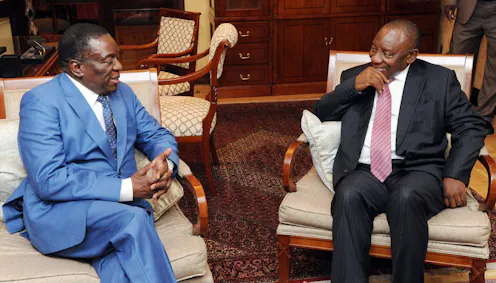
Cries of moral outrage have greeted the brutal crackdown by the Zimbabwean security forces on nationwide protests sparked by a sudden, massive, government-ordained hike in the price of fuel. Naturally enough, the demand is that “something must be done” to stop the brutality. Twelve people have already died, hundreds have been injured and there have been mass round ups.
In South Africa, demands that President Cyril Ramaphosa’s government should take firm action are fuelled by two factors. The presence of a large Zimbabwean migrant community within the country is one. The second is a widespread sense that Pretoria’s policy towards its errant neighbour has always been one of light wrist-tapping rather than a vigorous twisting of arms.
Inter-liberation movement solidarity is widely said to have strangled serious South African criticisms of Zimbabwean governments. This “quiet diplomacy” has been regularly dismissed as a strategy of doing nothing. If South Africa got serious, say the critics, President Emmerson Mnangagwa’s regime would have to comply with its demands. Democracy in Zimbabwe could be given a real chance.
Many South Africans are concerned by the position Ramaphosa has taken towards the present crisis. South Africa is reported to have turned down a request from Zimbabwe for a loan of US$ 1.2 billion to ease its desperate foreign currency shortage. Yet Ramaphosa was vocal at the recent meeting of global leaders at the World Economic Forum in Davos in calling for an end to sanctions. He argued that these were damaging Zimbabwe’s prospects of economic recovery.
Ramaphosa’s call for an end to sanctions clearly reflects his government’s view that it cannot afford a collapse of the Zimbabwean economy. Zimbabwe remains a site for South African investment and a significant market for South African goods. This is despite the huge difficulties South African firms have in getting profits out of Zimbabwe .
Meanwhile, best estimates suggest that South Africa already hosts up to two million Zimbabweans, though the exact number isn’t known. Any further decline of an already shattered Zimbabwean economy could send many more Zimbabwean migrants across the border, adding to the already huge pool of unemployed in South Africa.
There are thus very real reasons for the South African position, even if the motivation is self-interested. Yet would it help the cause of Zimbabwean democracy and human rights if the European Union and US were to now bring “sanctions” to an end?
In reality, the answer is extraordinarily complicated.
The thorny subject of sanctions
Successive Zimbabwean governments have long been dismissive of efforts from outside the country to effect political change. President Robert Mugabe routinely insisted that sanctions and other policies designed to isolate Zimbabwe were intended to bring about “regime change”.
These interventions included the round of sanctions first imposed by the European Union in 2002 and the passage by the US government of the Zimbabwe Democracy and Economic Recovery Act in 2001. The act encouraged the president to implement travel bans and financial restrictions against people conducting political violence.
The Zimbabwean African National Union-Patriotic Front (ZANU-PF) has equally consistently claimed that the collapse of the Zimbabwean economy is a result of the imposition of sanctions. Recently Mnangagwa claimed that the sanctions, which are still in place, are “illegal”.
Setting aside the Zimbabwe government’s reaction – which is to be expected – do sanctions work, which ones work and what conditions are necessary to make them work?
There is enormous controversy, politically and academically, around the issues. Furthermore, what impact do sanctions have, how do you measure this, and does impact measure up to the objectives notionally to be achieved?
In the Zimbabwean case, the US and EU insist that the measures they have taken are “targeted sanctions”. These are designed to hurt individuals identified as members of the repressive ZANU-PF regime rather than the ordinary people of Zimbabwe. For instance, the US Zimbabwe law led to the imposition of travel bans and financial restrictions on members of the ZANU-PF regime.
Yet reliable data on how effective such measures have been is lacking. Critics would argue that the present crackdown on protests demonstrates their manifest failure. There may well be a case for arguing that the imposition of targeted sanctions by both the US and EU are designed to demonstrate to domestic audiences that “they are doing something” as much as to bring about improved governance.
Yet does this mean they should be abandoned?
The case for keeping up the pressure
Immediate cancellation of such sanctions would clearly send out an extraordinarily dispiriting message to Zimbabweans who are on the receiving end of regime violence.
There is also a message here for the Ramaphosa government, and for other member governments of the southern African region.
By all means keep the borders with Zimbabwe open, the traffic flowing, and economic exchanges continuing. At the same time, there’s an urgent need to get serious with the Mnangagwa government. The time for diplomatic niceties is long past. South Africa needs to make life as uncomfortable as possible for members of the regime by adopting practical and measurable strategies: stop their travel to and through South Africa, freeze their bank accounts, stop them sending their children to private schools and South Africa’s top universities.
It may well be that if South Africa is to effect change for the better in Zimbabwe its diplomacy must remain “quiet”. If so, it must also be tough.

Roger Southall has received funding from the National Research Foundation..
Source: The Conversation – Articles (AFRICA)
Read more on The Conversation.
Join the fun: Add Your event | Submit a Press Release | Add your listing.


