South African President Cyril Ramaphosa can help resolve the Gaza crisis:
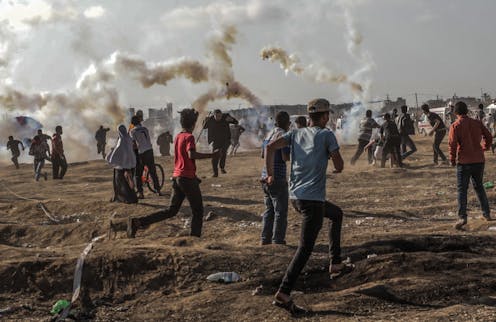
The gunning down by the Israeli army of protesting Palestinians at the Gaza border in May has drawn international condemnation. There’s also been global outrage about the recent killing of a young Palestinian medic near the same border.
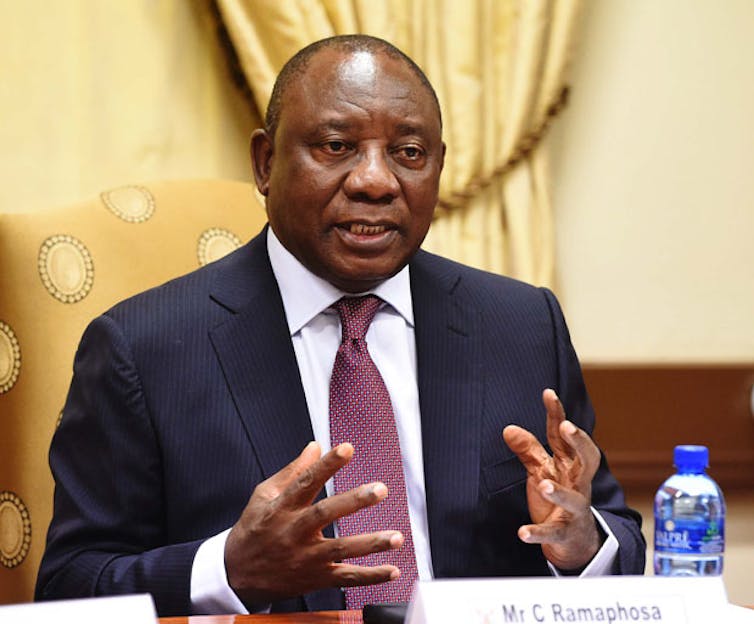
South Africa, led by President Cyril Ramaphosa, is among the states calling for an end to the ongoing and violent injustice in Gaza. The country has proposed an independent inquiry into the May killings. This proposal was endorsed by many other countries, and by UN Secretary-General Antonio Guterres.
But a resolution to this effect was quashed during a recent and reportedly bitter UN Security Council meeting.
The UN is stymied. However, Ramaphosa’s own history suggests that South Africa might yet play a valuable leadership role in bringing peace to Gaza.
Twenty years ago Ramaphosa was the only African representative on the International Commission on Intervention and State Sovereignty. This body formulated a new diplomatic framework for practical action to protect civilian victims of armed violence. The framework was initiated by Canada and called the “Responsibility to Protect,” or R2P.
A long overdue debate
The framework as a principle received unanimous endorsement at the UN’s 2005 extraordinary Summit of Heads of State and Government. It was intended to enable the UN to legitimately sanction collective action that could prevent severe suffering among civilian victims of armed violence.
The African Union became the first and still only multilateral body to entrench the principle in its governing instrument, the Constitutive Act. But, it remains untested.
The UN’s only attempt to apply the principle was in mandating a humanitarian armed intervention in the 2010/11 Libyan crisis. It was a controversial move. South Africa and others then on the Security Council faulted the US and NATO for violating the terms of the mandate to protect civilians. Instead, they charged, those intervening were intent on regime change, by deposing President Muammar Gaddafi.
The 2014 Gaza crisis, during which more than 2100 Palestinians and 66 Israeli soldiers were killed, offered another opportunity to test Responsibility to Protect framework. However, attempts to secure a binding UN resolution were stymied by a US veto.
The framework has a daunting diplomatic history. But it might finally find positive application in addressing Gaza’s humanitarian crisis. And South Africa could be the force that drives Responsibility to Protect from paper into action.
Protecting the people of Gaza
Ramaphosa and his foreign minister Lindiwe Sisulu might consider a diplomatic approach with at least three elements:
First, South Africa must be absolutely clear and transparent that an R2P intervention in Gaza would be strictly limited to protecting people. The three contending parties for control of Gaza’s people – Hamas, the Palestinian Authority based in the West Bank, and Israel – remain unable to find political compromise and appear locked into policies that only worsen suffering among the people trapped in Gaza.
South Africa can reasonably argue that none of these three parties to the Gaza conflict, or interested external powers, will benefit from an increasingly likely humanitarian catastrophe.
The country has plenty of compelling evidence to make its case. This includes the March 2018 report of the Office of the UN Special Coordinator for the Middle East Peace process on the perilous conditions in Gaza. Denying Gaza access to electricity has become a capricious political weapon recently wielded by Israel and the Palestinian Authority to weaken Hamas. This while Egypt dithers with allowing occasional supplies through its border with Gaza. This has brought essential human services to a humanitarian tipping point.
The UN report concludes that short term respite allowed between violent confrontations since the forced resettlement of Palestinians in Gaza 70 years ago will no longer suffice. Putting people first now must be paramount and predominate.
A second element could be to organise an ad hoc coalition of countries willing to apply Responsibility to Protect in Gaza, by essentially political not military means. South Africa could first approach the governments that actively supported the framework Commission on which Ramaphosa served. Gro Harlem Brundtland, then Prime Minister of Norway, once described this group to me as the “real international community”. She singled South Africa out as one of the most prominent and promising new members of this informal “club”.
Norway currently chairs a group seeking to coordinate donor assistance for the Palestinians. But, with cuts in US funding likely amid other setbacks, a new approach is needed. In March, UN Humanitarian Coordinator Jamie McGoldrick called for USD$ 539m in humanitarian relief for Gaza. This could be a useful starting point for a Responsibility to Protect intervention.
The third element is more challenging and political. Responsibility to Protect engagement in Gaza should have the informal backing of the UN Secretary-General and endorsement by the UN General Assembly. And if it doesn’t require a UN Security Council Resolution for a military intervention, as was the case with Libya, then it may be possible to avoid another US veto.
An invitation by the duly elected Hamas government in Gaza would be necessary. But, amid signs its internal support is dropping as people focus on their survival, a formula acceptable to them and to the Responsibility to Protect coalition might be feasible.
Opportunity for Ramaphosa
Since Israel claims Gaza is nominally an independent territory, its prime minister Benjamin Netanyahu might also be persuaded to come on board if R2P included pledges of restraint by Hamas.
US President Donald Trump is still a wild card amid mounting political resistance at home and isolation abroad. But he too might acquiesce to ad hoc humanitarian action by several of the US’s traditional democratic partners.
Ramaphosa could begin this process on the margins of this weekend’s G7 meeting in Canada, which he has been invited to attend. Depending on progress in the coming months, his government can continue to advance this case as South Africa rejoins the UN Security Council for the 2019/2020 sessions.

John J Stremlau was among the international group of scholars who contributed to the Supplementary Volume to the Report of the The International Commission on Intervention and State Sovereignty, "The Responsibility to Protect" published by the Commission in December 2001. .
Source: The Conversation – Articles (AFRICA)
Read more on The Conversation.
Join the fun: Add Your event | Submit a Press Release | Add your listing.


