South African teachers switch languages in class: why policy should follow:

If you step into a classroom in South Africa’s Limpopo province during a lesson, you’re very likely to hear the teacher speaking more than one language. She might begin a sentence in English, and then switch to Sepedi – the African language most commonly spoken as a mother tongue in the province.
This is a practice known as code switching or code mixing, which can form part of a translanguaging process. And it is not actually allowed in most South African classrooms. According to the country’s official language policies, schools must choose a language or languages of learning and teaching. Most choose English or Afrikaans and not the African language spoken in the area. African languages are then only taught as subjects and are rarely used as a medium of instruction.
But, as a recent study we conducted in Limpopo showed, the real daily language policy within classrooms differs significantly from the official language policy document of the school.
Teachers use code switching as well as a translanguaging process, alternating and blending languages to help pupils understand concepts. There is a reason for this: research has proved many times that pupils learn best in their own mother tongues.
This is, of course, not unique to South Africa – it happens in all multilingual societies to a certain degree. Some teachers who answered the questionnaire in Limpopo said they found value in code switching or translanguaging. They also felt that African languages were undervalued in their schools. This is not ideal in a country with 11 official languages that enjoy Constitutional protection.
A much more flexible and open teaching and language policy would help teachers and pupils to enable a meaningful learning environment in a multilingual and diverse classroom setting. Translanguaging should be embraced and supported as a teaching and learning technique.
Limpopo data analysis
The research was conducted among 1 094 teachers at about 110 schools across Limpopo. This large scale quantitative study covered public primary and secondary schools and the questionnaire focused on general teaching conditions, language attitudes and teachers’ language practices.
Only 16.5 % of all participating teachers reported never facing any language related challenges in their work. Others had all dealt with some issues related to language – either in terms of their school’s language policy or how they grappled with what languages to use in class. For some, these were strongly emotional issues. One told us:
I feel strongly that learners should not lose their home language in favour of other languages. Home languages are part of their identity.
Others thought code switching was a great idea and recognised its value:
I fully agree that it would be good for learners to be taught in their mother tongue or at least allow for code switching in the classroom to allow learners better understanding.
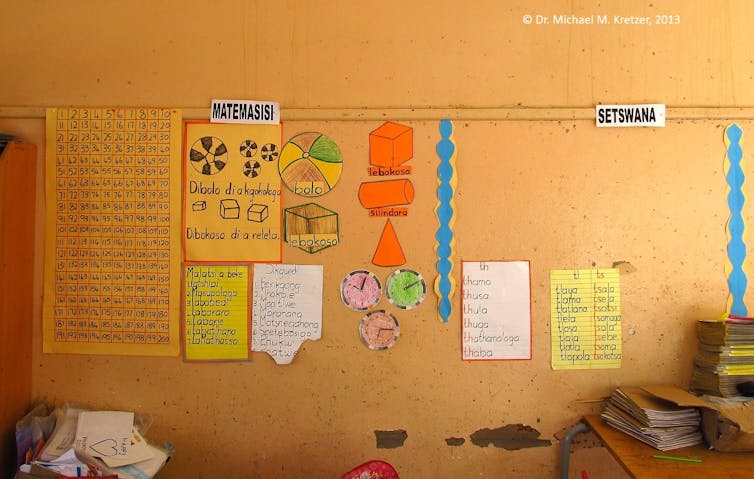
Other teachers viewed African languages as having limited use in teaching, especially in subjects like science. They believed these languages were better suited to social situations, and that their use should be limited to these situations. This indicates the importance and influence of language attitudes on language practices and policies.
Importantly, we found that code switching was used in all schools – even those that did not explicitly allow it in their school language policy documents. Teachers used it mainly in oral communication, in classroom situations. Others were afraid to code switch because of their schools’ language policy documents.
The role of School Governing Bodies
Individual schools’ language policies are formulated by the School Governing Body (SGB). This is in accordance with the South African legal framework to de-centralise education and also language policies. SGBs consist of the principal and elected members; elected members are the parents or legal guardians of enrolled pupils; teachers; pupils from grade 8 upwards or other school staff members.
Language policies must be set up within the country’s constitutional framework and in accordance with the Language in Education Policy, which came into effect in 1997. Its main aim was to increase multilingualism at schools and to consider the languages spoken in the surrounding area of a school to ensure these were central to language policy and teaching.
Parents or other members of the SGB often have a very biased language attitude that only favours English. They feel pupils should have maximum exposure to English – and this hinders a stronger inclusion of African languages at schools. Despite a large, comprehensive body of research that proves the value of mother tongues, such language attitudes seem to be very deeply rooted and persistent.
A much more flexible and open teaching and language policy would help teachers and pupils to enable a meaningful learning environment in a multilingual and heterogeneous classroom setting. Such an open language policy would and should include code switching or translanguaging to see the unused potentials of teaching in African languages as well as in English in classrooms.
Flexible language policies and teaching approaches should be utilised to put each and every individual pupil and his and her individual learning progress at the centre of classroom interactions.

Michael M. Kretzer receives funding from the NRF
Russell H. Kaschula receives funding from the NRF
Source: The Conversation – Articles (AFRICA)
Read more on The Conversation.
Join the fun: Add Your event | Submit a Press Release | Add your listing.


