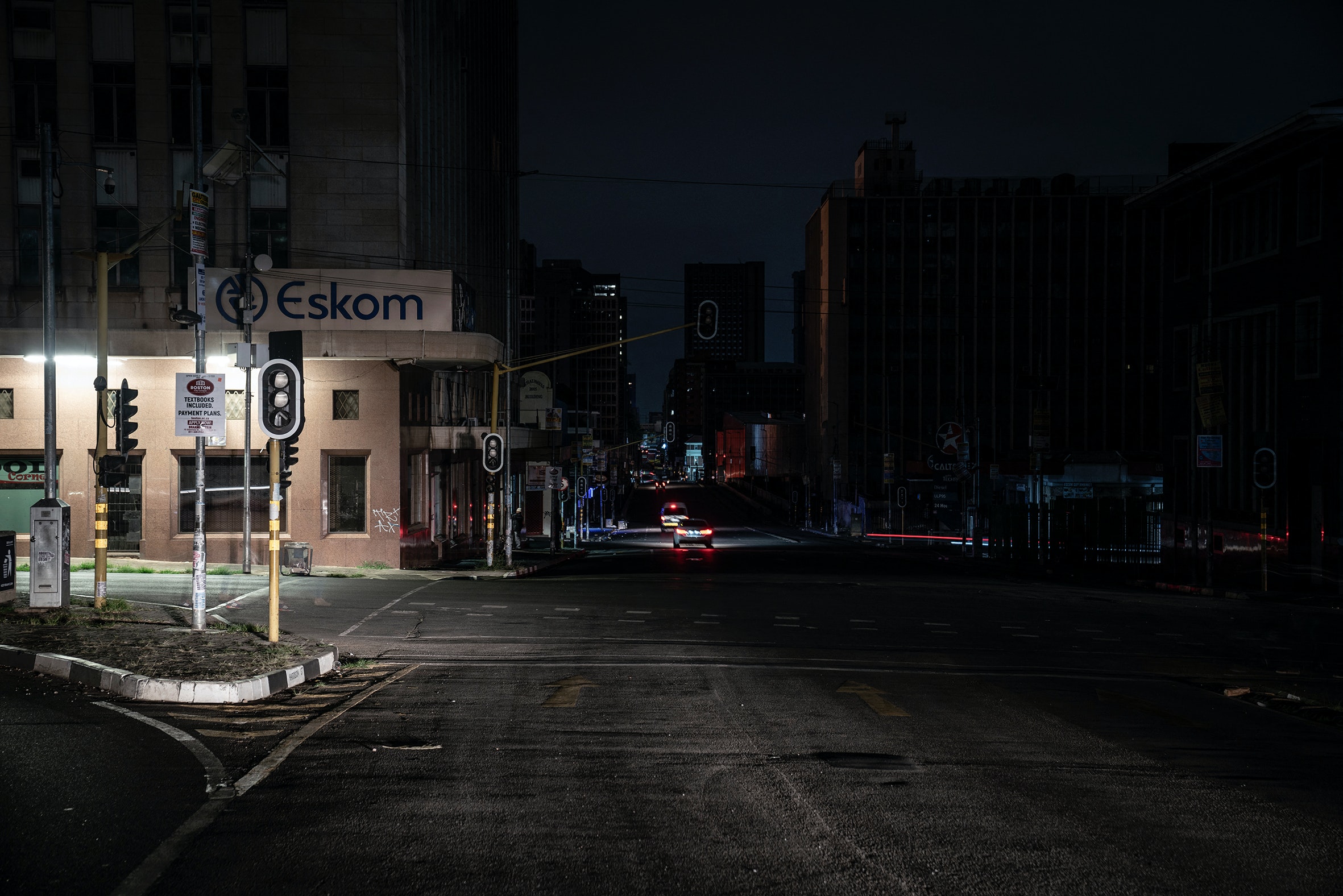
The announcement by the South African finance minister, Enoch Godongwana, of debt relief for the country’s troubled power utility, Eskom, is a step forward. It will fix one problem: Eskom has too much debt. But the plan won’t end power cuts which have worsened in recent years.
The international experience is that one way to end electricity shortages is to allow competitively-priced privately-funded generation at scale. This requires a reorganisation of South Africa’s electricity market along the lines announced by the Department of Public Enterprises nearly four years ago. The crux of the plan was to split Eskom into three separate units – generation, transmission and distribution, with transmission remaining state-owned.
With the announced conditions, which include the requirement that Eskom prioritise capital expenditure in transmission and distribution during the debt-relief period, the finance minister has missed an opportunity to finally achieve this.
What we can learn from other countries
Other countries that have had power cuts offer South Africa lessons. China, for example, faced rolling blackouts between 2003 and 2006 because of an unexpected growth spurt. In 2015, Greece was in the middle of a financial crisis and its people could not afford the electricity supply, some of which came through a complex deal with Russia. And in Colombia, a drought in 1992 caused the main source of electricity supply – which came from a hydroelectric plant – to literally dry up.
All these countries experienced power cuts. But South Africa is the only country to have had power shortages for 15 years. This is because the others moved quickly to rejig their electricity supply systems.
All three countries followed a similar route, as have many others. They untangled their single electricity companies, focusing on keeping parts of it under state control and opening up the rest to a mix of state and private companies.
Complex to manage
The electricity supply system has three parts. First is generation – generating electricity at a power plant. Second is transmission – moving it from the power plant to the municipality, usually on a high voltage line. Finally, distribution is about getting it the last few metres to a house or factory.
High-voltage transmission is what economists call a “natural monopoly”. It is more efficient if there is a single electricity grid for an area, rather than multiple grids. This part is best managed by a central body – in many countries a state-owned company. Because the transmission business can recover costs, it can use that income to increase transmission capacity, something that is urgently needed.
But China, Colombia and Greece all recognised that generation no longer needs to be a monopoly. Actually a monopoly in generation is bad for all the same reasons that all monopolies are bad. They typically charge more and produce less. You need a complicated regulatory system to get their prices right. Smaller generation companies are easier to manage.
Distribution is best left to a company as close to the end user as possible – in almost all countries, that is the municipality. In South Africa, it is a mix. For example, City Power distributes electricity to customers in older parts of Johannesburg. But Eskom distributes electricity direct in outlying parts of the metros.
This means that Eskom has to do everything: generate electricity, transmit it on large power lines to the cities and then distribute it to individual customers. It is a “vertical monopoly”. This makes it a fiendishly complex company to manage. Very few countries have such an arrangement – most prefer to allow specialist businesses in each part of the system.
Lessons for South Africa
Here’s what happened when generation was untangled from the rest of the state-owned monopoly in China. Between 2003 and 2006, new generation companies added over 237,500 MW to the Chinese grid. That’s the equivalent of delivering nearly 10 Eskoms in three years.
In 2019, the Department of Public Enterprises published a detailed and clear roadmap to follow this route, separating Eskom into generation, transmission and distribution. Internally, Eskom is already structured that way. On 17 December 2021, the legally binding merger agreement was executed to transfer transmission to the National Transmission Company South Africa SOC Limited.
But the very last step has not been taken, despite being government policy since 1998. Every time the proposed separation comes closer to happening, there has been fierce resistance from both unions and Eskom management. In 2018, it was because of loadshedding. During the years when there was no loadshedding and plants were being run too hard, it was because it was not urgent. And since the current electricity crisis, it is because there is loadshedding and Eskom is not financially viable. But it is precisely because Eskom is in financial distress that the separation needs to be accelerated.
In 2023, two things make it possible to do the separation very quickly.
The first is a new CEO. If the government is serious about the separation, as it has regularly said it is, it doesn’t make sense to appoint a single new CEO. Separate CEOs should be appointed for the National Transmission Company and for the other businesses. An independent board of directors for the transmission company should also be appointed.
The second is a technical issue related to Eskom’s debt. At the moment, Eskom as a whole is liable for the Eskom debt. The debt holders need to consent to any change in the legal structure.
The national treasury has announced that approximately R254 billion (about US$14 billion) of Eskom debt will be transferred to the national balance sheet in tranches over the next three years. Debt holders can be asked to approve the transfer of debt and the final piece of the restructuring at the same time. The legal and technical work has all been done – the National Transmission Company exists, and it just needs life and capital. It would have been far better to use the R254 billion (about US$14 billion) to help capitalise this critical new company.
Most debt holders will jump at the chance – certainty on the long promised new structure as it will go a long way to fix energy problems in the country. Also, it will improve the chances that debt holders will get their interest payments on the debt that isn’t transferred.
Unfortunately, the conditions that the national treasury has announced do not include the final unbundling. There is still an opportunity – the government’s conditions still have to be finalised. Eskom’s unbundling is one of the priorities of Operation Vulindlela, a joint initiative of the presidency and national treasury aimed at accelerating structural reforms and measures that can support economic recovery.
Hopefully the government will learn from the international experience and use the R254 billion (about US$14 billion) to fundamentally fix the problem of a vertically integrated, inefficient and ineffective monopoly. And with that, end power cuts.


