South Africa’s Cape Rockjumper numbers are falling and we’re not sure why:
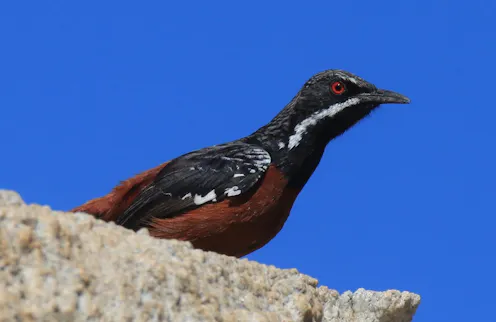
The Cape Rockjumper (Chaetops frenatus) is a bird found only high in the mountains of south-western South Africa – and its days may be numbered.
While initial population estimates were around 90 000 individuals this has recently changed to between 30 000 and 60 000. It’s listed as Near Threatened on the IUCN Red List of Threatened Species.
One reason may be that the bird’s preferred habitat, mountain fynbos, is dwindling as a result of a warming climate. Future climate scenarios say the Cape Rockjumper’s habitat may decrease by 62% by 2085.
But our ongoing research suggests the reasons for the decline might be more complex. Understanding this properly could be important for other species internationally too. It may be possible to slow or stop population declines.
Cape Rockjumpers live in small groups of two to five individuals defending large territories (up to 20 hectares), with only the dominant pair breeding. Both male and female in the dominant pair share parental duties.
Birders place a high value on spotting Rockjumpers, partly due to the challenge of finding them, but also because of their evident personality and entertaining social interactions. The attractiveness of the more brightly plumaged male adds to their flair.
Climate warning
Our initial research showed that Rockjumpers need a fair bit of water to cool down during hot weather, more so than your typical songbird living in warm environments. Although they seem well equipped to handle the odd summer heatwave in their mountain habitats, they may run the risk of dehydrating if they cannot find enough water-rich food such as insects or drinking water during the dry summers that persist over the Cape mountains.
But this alone seems unlikely to be the main reason why Rockjumpers are struggling in a warming world as extreme heat is still quite rare in the high mountain peaks. Warmer climates must be affecting some other aspect of Cape Rockjumper life.
Feeding behaviour could be one. This has been seen in other bird species. Warmer temperatures mean birds become less efficient at meeting their daily food needs, leading to mass loss in adult Southern Pied Babblers and nestling Southern Fiscals. These species live in hotter habitats than the Rockjumper.
Predation is another. It’s known that ground-nesting birds such as the Rockjumper face high rates of attack from ground predators. For example, we were shocked to find only one survivor from 20 nests during the 2017 breeding season. Given that Cape Rockjumpers lay two eggs per nest, this was a dismal 5% success rate. Previous data found Cape Rockjumpers fledged between 19% and 67% over a three-year study.
Nest predation came from Honey Badgers (Mellivora capensis), Cape Grey Mongoose (Galerella pulverulenta) and, on one occasion, ants. But Boomslang (Dispholidus typus), a venomous, bird-eating snake native to sub-Saharan Africa, was the biggest threat. If temperatures are warmer than usual early in the Cape Rockjumpers’ breeding season, snakes may become active earlier in the year, and attacks may become more common.
We are still in the process of monitoring other possible effects of warmer temperatures. For example, whether parents provide less food for their young in the surviving nests when temperatures are high.
Another relevant factor in population declines could be diminishing “sky islands”. Individual mountain ranges with Cape Rockjumper populations are separated by inhospitable valleys of semi-desert Karoo of up to 30 km. These valleys are likely to get wider due to warming temperatures which is leading to cooler Fynbos habitat retreating up the slopes of mountains.
Cape Rockjumpers are able to take short gliding flights, but seem reluctant to embark on sustained flight. This means they would have to “hop and skip” across these valleys. It’s not yet known whether Rockjumpers have the ability to trek across these valleys – which are often transformed by farms – in search of higher mountains.
The continued shrinking of suitable cool habitats for other alpine animals such as the Pika, a close relative of rabbits that lives in mountainous areas of North America and Asia, means that populations are becoming less able to reach each other to interbreed. Smaller populations are more at risk of inbreeding and extinction, irrespective of how they can cope directly with hotter temperatures.
Management strategy for the future
What can environmental managers do about the decline in Rockjumpers?
The main avenues for intervention are fire management and conserving possible routes the birds could use to move between mountain ranges.
For Rockjumpers, fire is a good thing, as they thrive on recently burned vegetation. The highest density of the birds at our main study site occurred three years after fire.
While most land-owners understand that fynbos requires frequent fire to maintain its health, there are still some areas where fires aren’t allowed.
In the longer term the future of Cape Rockjumpers depends on doing more research, and integrating it with decision making.

Ben Smit receives funding from National Research Foundation, Nelson Mandela University and Rhodes University.
Krista Natasha Oswald receives funding from Rhodes University, BirdLife South Africa, Tygerberg Bird Club, and the Animal Behavior Society. She is a PhD student at Rhodes University.
Source: The Conversation – Articles (AFRICA)
Read more on The Conversation.
Join the fun: Add Your event | Submit a Press Release | Add your listing.


