South Africa’s communist party strips the ANC of its multi-class ruling party status:
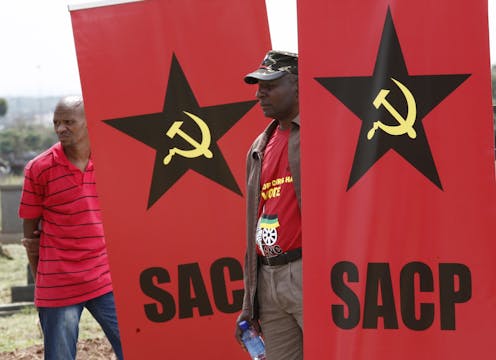
The South African Communist Party (SACP) has broken with history and challenged the governing African National Congress (ANC) in an election. The SACP’s decision to go it alone in the Metsimaholo municipality by-election marks a new low in relations within the tripartite alliance forged during the struggle against apartheid. The other alliance partner is the trade union federation Cosatu. The contest ended in a hung council, with the ANC taking 16 seats, the Democratic Alliance 11, the Economic Freedom Fighters eight and the SACP three. Politics and Society Editor Thabo Leshilo asked political scientist Professor Dirk Kotze about the development.
What is the significance of this development?
The decision to contest an election on its own clearly represents a watershed event for the SACP. It is the first tangible step towards implementation of a resolution taken by the SACP in 2007. Then, unhappy with the ANC’s policies in government, the communists raised the issue of contesting elections themselves. It proposed doing this either within a “reconfigured alliance” or having its own candidates contest elections, after which it would come to an agreement with the ANC on how to cooperate in government.
The SACP’s decision to go it alone is the culmination of a fallout dating back to 1996. Then, the ANC government under President Thabo Mbeki announced a macro economic framework, known as Growth, Employment and Redistribution (Gear), without substantial consultations with the SACP and Cosatu. Both slammed the policy as being anti-communist and serving the interests of business at the expense of the poor working class.
The SACP, and Cosatu, thought that their fortunes had turned when, with their support, Jacob Zuma was elected president of the ANC in Polokwane in 2007. But it wasn’t to be. Both groups have subsequently fallen out with Zuma. The relationship has deteriorated so badly that SACP members in KwaZulu-Natal are being assassinated over municipal council positions.
Why is this so unusual?
The Tripartite Alliance can be traced back to the late 1940s and the Communist Party’s subsequent underground involvement in the ANC-led Congress of the People in 1955. The Congress Alliance adopted the Freedom Charter as its blueprint for a democratic and prosperous South Africa.
In the 1960s the formation of Umkhonto we Sizwe, the armed wing formed by ANC and SACP members, was arguably the most concrete articulation of the ANC-SACP alliance.
In the decades that followed the SACP played a key role in facilitating the support of the Soviet Union and Eastern Bloc for the ANC and South African Congress of Trade Unions. The communists also shaped the ANC’s philosophy around national liberation as the “national democratic revolution” and view of apartheid as “colonialism of a special type”.
This influence on the ANC was personified by the likes of leading communists Moses Kotane, Moses Mabhida and Dr Yusuf Dadoo. The SACP viewed the alliance as a popular front uniting the working class and progressive forces in the struggle for freedom.
The SACP is unique in Africa because very few communist parties survived after independence. Most of them were either banned or integrated into nationalist liberation movement governments.
The party’s independent participation in the Metsimaholo by-election takes it back to the period before 1950 when communists such as Brian Bunting and Sam Kahn represented the then Communist Party of South Africa in Parliament.
But after that, and after the party was banned, the SACP’s revolutionary theory of armed struggle and insurrection excluded an electoral approach.
Once the first inclusive elections were planned in South Africa, the SACP deferred to the ANC as the leader of the national democratic revolution to pursue an electoral approach.
What is the significance for South Africa?
Firstly, no one can continue to argue that the Tripartite Alliance is still a coherent political front bringing together a working class union movement (Cosatu), working class party (SACP) and a multi-class governing party (ANC).
What this means is that the ANC’s social democratic character in terms of a partnership with working class organisations has come to an end. The ANC will now have to reconfigure its own identity as a social democratic party, similar to former UK Prime Minister Tony Blair’s reconfiguration of “New Labour”.
Secondly, the SACP’s decision serves as an official recording of the radical changes the ANC’s identity has undergone in terms of how it defines its own interests or constituencies. It’s finally stating that its core interests and those of the ANC’s are in the process of parting ways. In socialist parlance, the ANC’s and SACP’s class interests have reached a crossroads.
This follows on the earlier decision by Cosatu’s largest affiliate the National Union of Metalworkers of South Africa to part ways with the federation and to establish the United Front as its own political vehicle. It’s still unclear whether this this will result in a new left political movement. But, all the socio-economic conditions – such as high inequality, unemployment, poverty and social discontent – provide fertile ground for just such a movement.
What are the electoral prospects of the SACP?
The SACP is not in a position to mobilise substantial support in the near future. The left is contested terrain and prone to fragmentation. This is partly the result of personality clashes and ideological hair-splitting.
It could possibly join forces with the National Union of Metalworkers of South Africa which, for the last 30 years, has debated the ideal of a workers’ party. This would only be viable if the SACP combined its party programme with the social democratic (social welfare) needs of a rural, non-socialist populace. This would imply making ideological compromises, which is not uncommon for the SACP. It would also require it to establish a real party political infrastructure.

Dirk Kotze does not work for, consult, own shares in or receive funding from any company or organization that would benefit from this article, and has disclosed no relevant affiliations beyond their academic appointment.
Source: The Conversation – Articles (AFRICA)
Read more on The Conversation.
Join the fun: Add Your event | Submit a Press Release | Add your listing.


