South Africa’s new budget cushions the coronavirus blow – but only briefly:
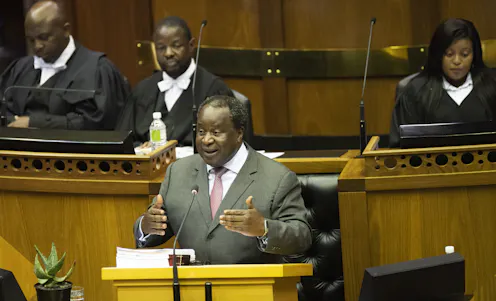
The adjustment budget tabled by South Africa’s finance minister, Tito Mboweni, this week is less an adjustment than a new budget. That was necessitated by three things: a collapse in economic activity, a large decline in tax revenue collection, and the need to increase the money allocated to departments and programmes linked to the government’s COVID-19 response.
The adjustments to the 2020 budget partly cushion the initial blow of the COVID-19 pandemic and the government’s lockdown. But the relief is only temporary and measures to contain the growth in debt will bite hard in years to come. Some cried wolf about austerity budgets in South Africa after the global financial crisis in 2008 before they were actually a reality. In 2021, the wolf will likely be at the door.
The treasury predicts that revenue will be R1.1 trillion instead of R1.4 trillion – R300 billion less than projected in February this year. Proposed spending is now R40 billion more than in the February budget, although R7 billion of this is debt-service costs. The headline result is that the main budget deficit – the gap between government’s income and spending – will balloon to be 14.46% of gross domestic product instead of the planned 6.8%.
The government intends to cover part of that by borrowing about US$ 7 billion from multilateral institutions like the New Development Bank and the International Monetary Fund. But that will finance less than half of the R344 billion increase in the borrowing requirements. This means more conventional borrowing at a time when the costs of doing so, after recent credit downgrades, are high.
The scale of the changes renders the country’s annual budget tabled in February redundant by normal standards, along with much of parliament’s interrogation of those proposals in subsequent months. From the onset of the lockdown it was clear that this would be the case. So parliament could, and should, have played a more proactive role by, for example, facilitating public engagement with the treasury on fiscal options for responding to the effects of the pandemic and lockdown.
The legislature’s lacklustre approach will mean that, as has been the case in non-crisis periods, the minister’s proposals will almost certainly be rubber-stamped with no substantive public consultation or influence. And that is particularly egregious given the serious implications for all South Africans of the dramatic worsening of the country’s finances since February.
Lockdown froze economic activity
The collapse in economic activity at the root of this is the result of both the pandemic itself and the government’s response. Fear of the virus and basic measures such as social distancing, travel restrictions and limits on gatherings would have had a significant impact on economic activity anyway. But the lockdown is arguably the larger factor. It stopped most economic activity by decree. And that is also why the government is now moving hastily to ease it, even as the rate of new infections increases.
The budget indicates that R142 billion has been allocated to COVID-19 measures – approximately 9% of total spending. That includes a R41 billion increase in social grants, which is lower than the originally announced R50 billion. As indicated by the bigger picture, most of this is not new spending. About R110 billion comes from various forms of reallocation from other, previously planned government expenditure areas. The full details of how such re-allocations happen, and the possible consequences for public service delivery of the associated trade-offs, will likely only be available after the fact.
Reduced economic activity has meant reduced tax collection. The fall in revenue is worsened by tax relief measures to cushion businesses and employees from the effect of the lockdown restrictions and broader economic downturn. The bigger consequence of this is that the ratio of national debt to GDP, which was already unprecedentedly high and repeatedly above targets, will increase to 81.8% instead of 65.6%. The treasury states its intention to get this under control through a series of measures that will be announced in the medium-term budget policy statement in October and the 2021 budget.
One dimension of those proposals will seek to raise an extra R40 billion of tax revenue. Strangely, however, the adjusted budget includes no proposals to increase taxes on the minority of individuals who will maintain high, stable incomes in the current year.
So despite rhetoric that sacrifices will need to be made, there appears to be little appetite to increase the contributions to government’s efforts from the most well-off in society during the pandemic. This group includes the politicians and officials making these decisions.
Debt crisis looms
The budget proposals seek to emphasise the need for future, drastic action with projections showing that national debt under a scenario of “public finance as usual” will increase to 106% of GDP over the next few years.
Historical precedent suggests that the chances of a developing country avoiding a debt crisis at that level of debt for any sustained period of time are very low.
However, there were already few substantive ideas for changing the pre-pandemic outlook. It’s therefore doubtful that the treasury has the ability to come up with ideas in the face of an even more dire situation. There has been a great deal of talk about the need for “structural reforms”. But those that have been placed on the table don’t hold up to close scrutiny. Instead, they are simply the most recent manifestation of a view that privatisation of various kinds is some kind of panacea for state failure.
Read more: Budget shows treasury is desperately short of ideas to fix South Africa’s economic woes
In reality, the kinds of sweeping governmental, social and economic changes required to change the country’s trajectory have for some time been outside the scope of what a treasury should, or is capable of, determining. South Africa has not come to terms with that and so there is little ability to conceive of alternative approaches, never mind adopt them.

Seán Mfundza Muller receives funding from a European Union-funded project, "Putting People back in Parliament", led by the Dullah Omar Institute (University of the Western Cape), in collaboration with the Parliamentary Monitoring Group, Public Service Accountability Monitor (Rhodes) and Heinrich Boell Foundation (South Africa). He also receives funding from the Council on Higher Education for research into the effects of recent higher education policy decisions. He is affiliated to the Johannesburg Institute for Advanced Study and the Public and Environmental Economics Research Centre (University of Johannesburg), regularly making inputs to Parliament oversight of the national budget, advising civil society groups on public finance matters and consulting for private sector organisations on an ad hoc basis. The views expressed are his own.
Source: The Conversation – Articles (AFRICA)
Read more on The Conversation.
Join the fun: Add Your event | Submit a Press Release | Add your listing.


