South Africa’s new higher education disability policy is important, but flawed:
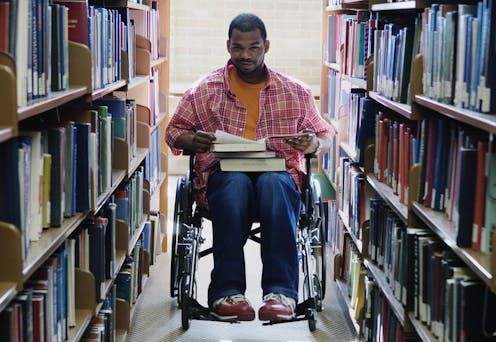
South Africa finally has a disability policy that’s specific to the higher education sector. The new policy framework should be celebrated as an achievement. Its value is that, because it’s specific to the sector, it gives institutions (such as universities) a common vision. It also enables monitoring and evaluation of progress that is context specific.
Australia is one country that’s taken this approach with its 2005 Disability Standards for Education. Most countries, though, favour more general policies; Sweden and Norway are two examples of this approach.
We have been critical about the absence of any policy in South Africa and welcome the development. But can a policy document lead to positive change? This is something that South Africans with disabilities will be wondering. Currently, about 7.5% of the country’s population have disabilities; about 20% of that number are enrolled in higher education institutions.
It’s obviously too early to answer this question. But a critical examination of the policy framework – which has been gazetted into law and cannot easily be changed – reveals some concerns. Some of these include funding, the approaches taken to understand disability, how it will be integrated with existing national policies and what support is available to universities trying to implement it.
The gaps
The policy framework is intended to help higher education institutions provide sufficient services to students and staff with disabilities. It spells out the challenges around disability issues in South African higher education and the ways the government plans to respond to them.
But there are problems with the document.
For instance, there’s still enough room in the policy for universities to abdicate their responsibility when it comes to things like decent and properly equipped accommodation for students with disabilities.
For example, the framework states that all institutions should make adjustments to enable people with disabilities to be on par with everyone else. But there’s a contradiction. Institutions are not supposed to incur significant expenses when making these adjustments. The reality is that some alterations – like making lecture halls and residences accessible particularly to people in wheelchairs – will cost money.
This will be particularly challenging for South Africa’s poorer, less resourced and rural institutions. The national government will to need to source the bulk of funds for what’s proposed in the policy. Innovative funding mechanisms will be necessary.
And that leads to another issue. The department of education and training is responsible for carrying out most of the initiatives proposed in the framework, including implementation. But a single government department can only do so much. Explicit reference ought to be made to other departments that will help with things like planning, building and sourcing funding.
There’s also no mention of the private sector. That’s an oversight, since industry and businesses should be involved. They could fund some of the work, offer technological innovations to improve the lives of students with disabilities and even offer employment to graduates with disabilities.
Finally, there’s a particularly strange exclusion. There’s no mention of getting students and staff with disabilities involved in implementing the policy. Yet they are the experts on disability, and on how best the policy could be brought to life. They can also be powerful advocates for an end to stigma and discrimination, which is crucial if the policy to really work.
Another issue is that the policy framework views all disabilities as the same. But students with disabilities have varied and unique needs. They require individually tailored services based on what each person requires to be successful.
The risk with the framework is that some students may not get enough tailor made support for their specific disabilities.
Going forward
The first big win would be if this policy could be amended to cover some of its shortcomings. It needs to be adjusted if it’s going to improve the lives of students with disabilities and introduce a culture of inclusion and diversity at national, institutional, and individual level.
One change that’s imperative is that it should introduce a minimum threshold of support for each type of impairment. For example, students with visual impairments will be provided with accommodation on campus; those who use guide dogs will be accommodated in a dog-friendly space. They will be provided with study materials on time and in accessible formats like Braille or audio books. Assessments will be fair, offering alternative test methods such as oral exams.
The second area that needs special attention is implementation. It remains to be seen how the policy framework will be implemented, and whether it will bring real change for students with disabilities.
But, in the meantime, universities can take the initiative by looking at smaller systemic changes to improve these students’ lives. Providing reading materials in accessible formats doesn’t cost much money and neither does introducing a culture of inclusion through engaging students and staff with disabilities at the institutional and departmental levels.
The reality is that policy papers alone aren’t enough to engender change. Genuine political will and commitment is required to address disability challenges.

Oliver Mutanga currently receives funding from the European Commission’s Horizon 2020 under the Marie Skłodowska-Curie grant number 609020. Previously, Oliver received funding from the SARChl of the DST & Technology and NRF of South Africa grant number 86540.
I have received a Thuthuka Research Grant from the National Research Foundation in South Africa. I am currently holding an Open Distance Learning Research Support Programme grant from the University of South Africa Research Directorate.
Bothwell Manyonga does not work for, consult, own shares in or receive funding from any company or organisation that would benefit from this article, and has disclosed no relevant affiliations beyond their academic appointment.
Source: The Conversation – Articles (AFRICA)
Read more on The Conversation.
Join the fun: Add Your event | Submit a Press Release | Add your listing.


