South Africa’s current electricity crisis has been described as “a perfect storm”. A number of factors have converged to reach this point: an ageing and inadequately maintained fleet of coal power stations, delays in upgrading the Koeberg nuclear power station and significant failures at the recently built Medupi and Kusile coal power stations.
Since the beginning of 2022, power utility Eskom’s inability to meet the country’s electricity demand has resulted in unprecedented loadshedding (scheduled power cuts). In 2022, electricity interruptions totalled 3,775 hours over 205 days. The situation almost certainly will not improve any time soon.
At the same time, Gauteng – South Africa’s most populous province and its economic hub – has experienced critical water supply issues. In late 2022 and early 2023, the combined impact of heat waves, intermittent pumping of water because of electricity interruptions and infrastructure failure has led to demand outstripping water supply. Residents of Gauteng’s biggest municipalities have experienced near-daily low water pressure or water cuts.
Read more: Power cuts in South Africa are playing havoc with the country’s water system
Many private individuals and businesses are investing in alternative electricity and water sources. The exact number is uncertain – most systems are not registered. Alternative investments include water tanks, boreholes, solar panels and diesel generators. These solutions cost anywhere from R4,000 (about US$220) for rainwater tanks and up to R180,000 (almost US$10,000) for a borehole.
The cost of installing residential solar panels is anywhere from R8,000 (about US$440) to R10,000 (around US$550) per kWp (a measure of how high the panels’ power output is). Inverters and batteries are also pricey. Even with financing options, most households can’t afford alternatives.
These investments are generally efforts to maintain a level of normality and to survive through unreliable water and electricity supply. But the cumulative effect of these individual actions could have significant consequences for inequality and service provision for the poor. South Africa is already one of the most unequal countries in the world.
Poor people are less able to afford alternatives for power and water. There’s also the risk that municipalities will gradually be unable to cross-subsidise services to the poor as they lose revenue from wealthy consumers.
Social justice considerations have been at the forefront of South Africa’s just transition from coal-based to renewable electricity generation. But this has largely focused on the labour force and affected communities. Less attention has been paid to the justice implications of electricity distribution.
There is hope. Private investments in off-grid water and electricity could be mobilised to help address the current crises. However, this requires rei-magining the role of the state and citizens, reworking municipal funding models, and encouraging private investors to support the grid in various ways.
What do the Quality of Life data tell us?
In early February 2023 we used survey data from 2013 to 2021 to show how Gauteng households were investing in alternative electricity and water provision. We examined who was accessing these alternative sources and who was not.
The data for this project was drawn from the Gauteng City-Region Observatory (GCRO)‘s regular Quality of Life survey, which is designed to gather a representative sample of Gauteng residents. It includes questions about demographics, living conditions and socio-economic circumstances. All the datasets are freely available to download through the University of Cape Town’s DataFirst platform.
The data reveal that access to alternative electricity and water sources has increased over time. In 2013/14, only 0.8% of residents reported having access to solar or wind energy, while 0.3% had a generator.

By 2020/21, these figures had jumped to 5% and 4%, respectively. Despite this increase, only a small minority of Gauteng residents (about 1 in 20) have access to alternative water and electricity.
Affluent households are proportionately more likely to invest in alternative electricity and water sources than poorer households. In 2020/21, 2% of respondents with a monthly household income below R3,201 (around US$177) had a rainwater tank. Some 4% of this income group had a borehole or well. In contrast, 9% of the respondents in the higher income groups – a monthly household income over R25,600 (about US$1,415) – had access to a rainwater tank or borehole.

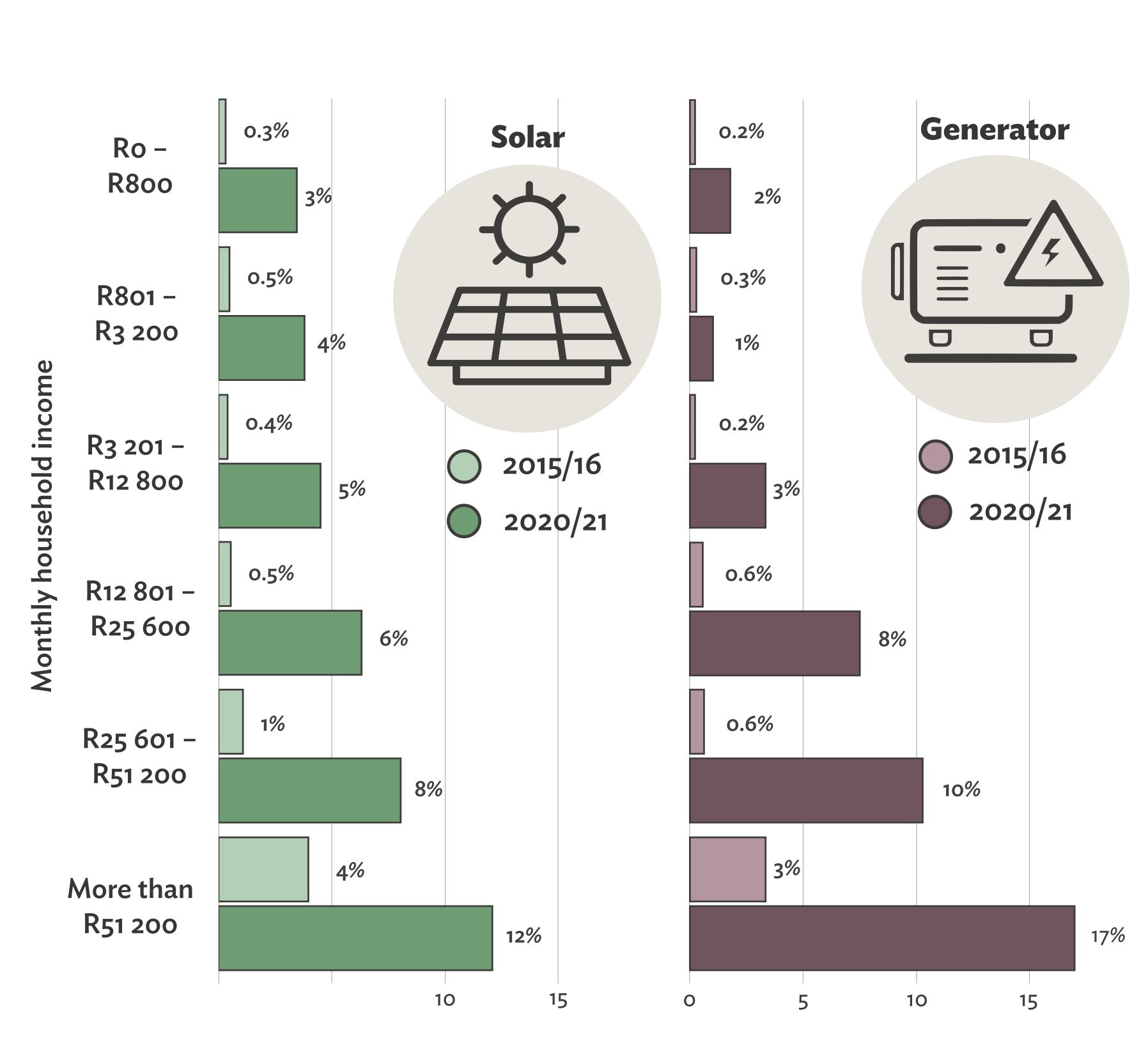
The uneven increase in access to alternative electricity is particularly notable. Access to solar power grew from 0.3% in 2015/16 to 3% in 2020/21 for households earning less than R800/month. For the highest income group (monthly household income more than R51,200), access to solar increased from 4% to 12% over the same period.
Implications for a just transition
The gap is clearly widening between affluent households who can shield themselves from electricity and water interruptions, and poorer households who cannot afford to do so.
And this gap could widen further because of how municipal services are financed. Under the current funding model, municipalities depend on revenue from basic service provision (electricity, water and refuse) to fund their mandated activities. They use the revenue from industries, businesses and wealthy consumers to cross-subsidise services for the poor.
This model has been critiqued for being unsustainable and creating perverse incentives for municipalities to elevate tariffs and encourage high users to keep consuming electricity. But it at least ensures access to services for poor households.
The current move by residents and businesses towards self-generated electricity has potentially dire consequences for municipalities’ ability to ensure fiscal stability and equitable access to services.
It also has some technical drawbacks. Private investments have the potential to add strain and complexity to the grid. Grid-charged battery systems increase electricity consumption and post-loadshedding peaks. Solar photovoltaic installations reduce pressure on the grid during the day. But, they leave the evening peak unchanged. Power plants must continue producing electricity in excess during the daytime demand to ensure they can meet the evening peak.
Private borehole installations could cause uneven depletion of aquifers. They could also negatively affect groundwater management and undermine the availability of these water resources for broader society.
Mobilising private investments
However, there are opportunities to harness private investments to cope with the current electricity and potential future water crises.
Municipalities are beginning to give households and businesses incentives to sell their excess power back to the grid. This could reduce the cost of electricity for municipalities, maximising their ability to cross-subsidise service delivery for the poor.
Where households and businesses have invested in batteries, they could store solar energy and sell it back to the grid during the evening peak.
In addition to the authors, the Off-grid Cities project team members include: Fiona Anciano, Charlotte Lemanski, Margot Rubin, Laurence Piper, SJ Cooper-Knock, Temba Middelmann, Brian Murahwa, Joanna Watterson, Eyong Tarh, Miguel Isaac and Zackeen Thomas.


