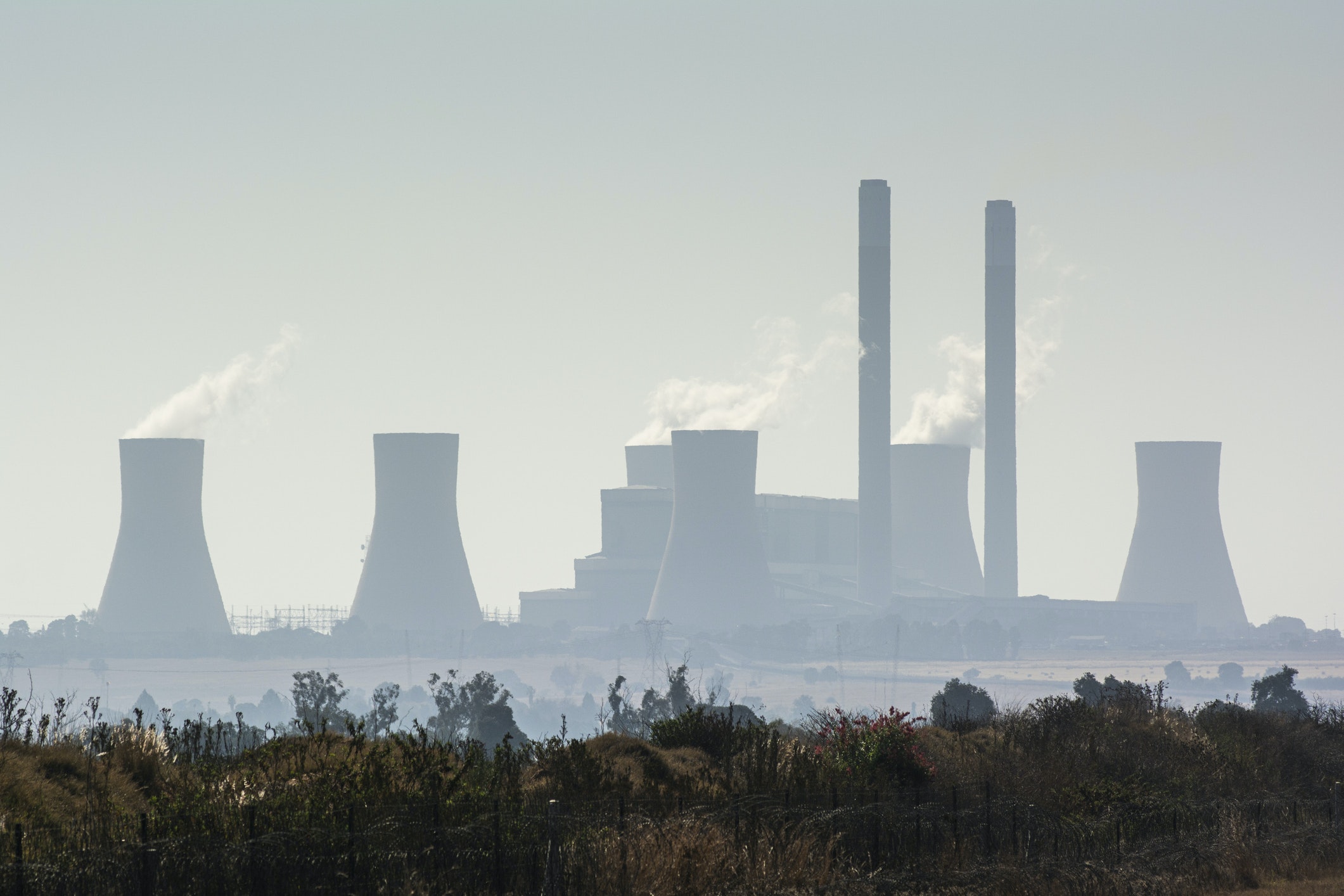
Eskom, South Africa’s state-owned energy utility, has been called the world’s worst polluting power company and Mpumalanga province, where a majority of the Eskom stations are located, the world’s largest air pollution hotspot. But are emissions from Eskom really so high, and if so, why? Should South Africans be worried about these emissions?
Eskom is by far the largest emitter of the pollutants sulphur dioxide and nitrogen oxides and the greenhouse gas carbon dioxide in South Africa due to its reliance on coal. Emissions of these gases from Eskom’s coal-fired power stations have dropped slightly over the last decade. South Africa hasn’t, like other countries, markedly decreased air pollutant emissions from the electricity sector even though there are technologies to do this.
Eskom’s emissions are detected over most of the north-eastern region of South Africa through satellites. The large hotspot seen is due in part to the close proximity of the majority of the country’s power stations in Mpumalanga. However, Eskom emissions are not the only source of pollution in this region. Ultimately, if South Africa wants to improve air quality and meet climate change goals, it needs to move away from coal.
What’s released
Air pollution from coal-fired power stations is a byproduct of the burning of coal. They are known as combustion by-products.
The main constituent of the exhaust gases (called flue gases) emitted from coal-fired power stations is nitrogen (N₂, 73%-76%), an inert gas that naturally makes up 78% of the atmosphere. Other major components are oxygen (O₂, 6%) and water vapour (H₂O, 5%-8%). All three are normal constituents of the earth’s atmosphere and are not toxic.
Carbon dioxide (CO₂) makes up around 13% of flue gas. Carbon dioxide is a greenhouse gas and is changing the climate.
Air pollutants make up a small percentage of the total flue gas: sulphur dioxide, 0.1%; oxides of nitrogen, 0.05%; mercury and fly ash in trace amounts.
Eskom reports its emissions publicly. According to Eskom’s most recent figures, around 1.6 million tons of sulphur dioxide, 804 000 tons of oxides of nitrogen, 71 tons of particulates (ash) and 206.8 million tons of carbon dioxide are released annually in total from all its power stations.
Eskom’s sulphur dioxide emissions are now higher than those from the power sector in the US, China and the European Union, but around 60% lower than the power sector in India. China, in particular, has achieved dramatic reductions in sulphur dioxide emissions over the last two decades.
In terms of carbon dioxide emissions, South Africa is the 15th highest emitting country, but has the highest carbon emission intensity of the G20 countries.
Emissions don’t equal what we breathe
Greenhouse gases stay in the atmosphere for a long time, so the amount that is emitted is very closely related to the concentrations in the atmosphere. However, when discussing the impact of any source on air pollution, it’s important to distinguish between emissions and ambient (outdoor) concentrations of pollution.
Emissions are the release of pollutants from a source. Some, like from power stations, are released higher in the atmosphere and are diluted before they reach the ground. Others, like emissions from vehicles and veld fires, are emitted where we breathe.
The negative health impacts from air pollution are related to the amount that we breathe – the ambient concentrations of pollution. In many areas, this is dominated by local sources that emit closer to the ground, while those that emit higher in the atmosphere contribute a smaller amount of pollution to a larger area.
The impact of what’s released
The combustion by-products from Eskom power stations are emitted from tall, thin stacks. There are usually two, and shouldn’t be confused with the steam emitted from the shorter, squatter cooling towers. These stacks are high (ranging from 152 metres to 300 metres) so that the plumes are diluted before they come to the ground, where the pollutants can be inhaled and affect ecosystems.
But that only limits some of the harm. As carbon dioxide remains in the atmosphere for 300 years to 1,000 years, the impact on climate change is not impacted by the height of the stacks. Carbon dioxide from South Africa’s coal-fired power stations accounts for around 43% of South Africa’s greenhouse emissions and around 25% of sub-Saharan Africa’s greenhouse emissions.
Increasing carbon dioxide levels warm the atmosphere, resulting in an increase in average temperature, an increase in the frequency and severity of heatwaves, and a change in rainfall patterns.
The emitted sulphur dioxide and oxides of nitrogen can undergo chemical reactions in the atmosphere to form particulate matter and ozone. These pollutants can stay in the atmosphere for days to weeks, and thus can travel far before they are removed from the air by rain or they deposit on surfaces (such as buildings, the ground, trees).
Exposure to air pollutants increases the incidence of diabetes, lung cancer, respiratory, cardiovascular and cardiopulmonary diseases and contributes to premature deaths. To protect health, the ambient concentrations of sulphur dioxide, nitrogen dioxide, particulate matter and ozone are regulated in South Africa through the National Ambient Air Quality Standards. However, these levels are exceeded in many areas of South Africa, which means people’s health is at risk. The emissions from Eskom contribute to these high concentrations, but are not the only source of pollution.
Technology can play a part
Mature technologies can extract most of the pollution from the flue gas stream before it is released to the atmosphere. These are used widely around the world.
Historically, Eskom’s focus has been on reducing particulate (ash) emissions. More than 99% of all the ash is removed at all its power stations and disposed of on large ashing facilities. These need to be carefully managed, usually by planting vegetation, to prevent the generation of windblown dust.
But Eskom has a long way to go in reducing the other pollutants. Few of its power stations have the technology to reduce emissions of sulphur dioxide and oxides of nitrogen. Technology that extracts carbon dioxide from the flue gas and stores it underground is not commercially available yet.
Minimum emission standards were introduced in South Africa in 2010. These gave power stations 10 years to comply with stringent limits for sulphur dioxide, nitrogen oxides and particulates.
But this required new technology to be installed and by 2020 only one coal-fired power station was in full compliance.
Lack of funds is the main reason Eskom has given for not retrofitting the power stations as required. The long planning and installation timelines, long unit outage times and additional water requirements are secondary considerations.
The large capital outlays for emission reduction upgrades were required at the same time as Eskom was borrowing large sums of money to fund the construction of Medupi, Kusile and Ingula power stations. And national demand for electricity stagnated, limiting Eskom’s revenue growth.
The way forward
Better air quality in South Africa can be achieved by reducing emissions in all sectors and decarbonising the energy system. While the Eskom power stations have the highest total emissions, there are many sources of air pollution in South Africa, most of which are from the burning of fossil fuels.
Diversifying the energy mix to cleaner fuels will have positive effects on air quality and help South Africa meet the climate goals currently under discussion at COP26.


