Southern Africa’s liberation movements: can they abandon old bad habits?:
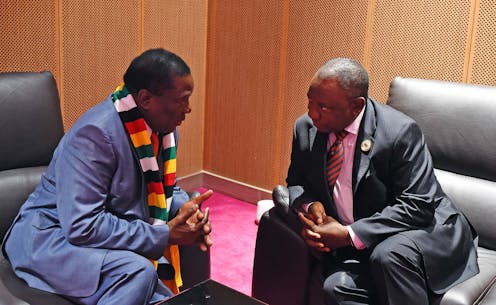
Until recently, southern Africa’s political and economic outlook seemed to be moving in a promising direction. The highlights were provided by Zimbabwe and South Africa with the displacement of Robert Mugabe by Emmerson Mnangagwa in November 2017 and Jacob Zuma by Cyril Ramaphosa earlier this year. Both were to pronounce the inauguration of new eras for their countries, and to promise political and economic reform.
Prior to this, there were presidential changes in the three other countries ruled by the region’s liberation movements. Hage Geingob succeeded Hifekepunye Pohamba in Namibia in March 2015; Filipe Nyusi succeeded Armando Guebeza in Mozambique in January 2017; and Joao Lourenco succeeded Eduardo Dos Santos as Angola’s state President after legislative elections last year.
All five new leaders were younger than their predecessors, three of them (Ramaphosa, Nyusi and Lourenco) by ten years or more. This diluted – but far from dissipated – the tendency towards gerontocracy.
And there was more. While Mugabe was ousted by virtue of a “military assisted transition” the other four incumbent presidents were constrained to stand down because their terms in office were expiring.
Taken together, the changes in leadership, combined with initiatives of economic reform, seemed to bode well for the region as a whole. And to bring new hope to the 100 million people who live in their countries.
These events may yet result in outcomes that are progressive politically and economically. But, for all the commitment to renewal, doubts are beginning to accumulate that the region’s liberation movements are capable of turning away from the bad habits and practices of the past.
This has been brought home in dramatic fashion by the controversies surrounding the Zimbabwean election.
Signs of renewal
The region’s national liberation movements became increasingly aware that after decades in power they were losing popularity. They were confronting a crisis of legitimacy. Signs that commitments to reform and renewal were meaningful were most apparent in Angola, Zimbabwe and South Africa.
In Angola, Lourenco was quick to move against the political and financial empire constructed by Dos Santos. He sacked Isabel Dos Santos, daughter of the former president and widely known as the richest woman in Africa, as head of Sonangol, the state oil company. The large corporation is a fulcrum of the economy, responsible for about a third of GDP and 95% of exports.
Citing misappropriation of funds, he followed this up by dismissing Jose Filemento, Dos Santos’ son, as head of the nation’s $ 5 billion sovereign wealth fund. He also had brushed aside restrictions on his ability to appoint new chiefs of the military, police and intelligence services by appointing his own security chiefs.
In Zimbabwe, the popular enthusiasm which greeted Mugabe’s ousting and Mnangagwa’s elevation was to be somewhat dimmed by the choice of his cabinet. The mix of military coup-makers, Mugabe left-overs and ZANU-PF re-treads rather than reaching out to the opposition to form a transitional coalition government did not go down well.
Nonetheless, Mnangagwa’s early initiatives offered promise of more rational economic policies. Above all, he indicated that he was bent on entering negotiations with the international financial agencies and other creditors to re-schedule payments due on Zimbabwe’s massive debt.
This was combined with a three-month amnesty to allow individuals and companies who were reckoned to have illegally exported some US$ 1.8 billion to bring it back into the country. Third, Mnangagwa announced a series of measures to boost agriculture and mining.
All such measures were designed to encourage an inflow of foreign investment, that had slowed to a trickle because of the arbitrariness of Mugabe’s rule.
Opposition parties felt that Mnangagwa’s initiatives fell far short of what was required. Nonetheless, they were buoyed by his recognition that if Zimbabwe was to be restored to something approximating economic health, he would have to call an early election whose result would be accepted internationally as legitimate.
This, as it turns out, was too tall an order.
Round about the same time Ramaphosa was embarking upon his own programme of reform in South Africa. His triumph in the battle for the party leadership, achieved at the African National Congress’s (ANC) five yearly national congress in Johannesburg in December, had been narrowly won.
During his years in power, Zuma transformed the ANC, the state and state-owned companies into a massive patronage machine for looting the fiscus. This was to become known as “state capture”. Much of it was engineered by or in league with the immigrant Indian Gupta family.
Accordingly, Ramaphosa’s mission was to “re-capture” the state. War was declared on corruption, commitments made to cleaning up the state owned enterprises, to re-configuring state departments and restoring collaborative relations with business (which had been severely undermined under Zuma).
Ramaphosa’s efforts continue to be impressive. They have included appointing respected technocrats to key government positions as well as dismissing, prosecuting or sidelining a slew of Zuma acolytes.
He also cleared the way for an extensive judicial review of the state-capture project (which Zuma had done his best to obstruct). And he initiated extensive re-structuring of failing state owned enterprises and state agencies, notably the South African Revenue Service.
Doubts are mounting
However, it has not been plain sailing.
The Zimbabwean election went into meltdown with accusations of a rigged election. The military is seen as being in firm alliance with Zanu-PF, ready to step in if its rule is threatened.
Meanwhile in South Africa Ramaphosa has increasingly run up against the constraints imposed by the continuing political weight of the Zuma faction in an ANC which has remained deeply factionalised. He has struggled to forge party unity to prepare for the 2019 election. And he is most particularly challenged by the strength of the Zuma faction in KwaZulu-Natal.
A poor election result for the ANC in 2019 will severely undermine his political authority, and hobble his attempts to restructure the state and economy.
Elsewhere, cynicism is gaining ground. Many doubt Lourenco’s capacity to systematically deconstruct the powerful network which has supported and defended the Dos Santos family for decades. The view among some is that it will only re-engineer the political dominance of the ruling MPLA.
In both Namibia and Mozambique, critics suggest that changes in the presidency have led to little more than business as usual – and that in both countries the ruling party elites remain deeply enmeshed in corruption.
Parties of liberation no more?
The rule of liberation movements in southern Africa rule has been increasingly challenged by economic failure, rising popular discontent, the alienation of young people and yawning internal divisions. This has led to multiple suggestions that their time span is limited, and that their rule will give way as a result of internal division, electoral defeat or other unforeseen events.
They have responded with promises that they will embark on “renewal”.
But, so far the evidence is mixed. They may well retain their capacity to hang on to state power. But their capacity for significant and far-reaching reform remains severely constrained.

Roger Southall receives funding from the National Research Foundation
Source: The Conversation – Articles (AFRICA)
Read more on The Conversation.
Join the fun: Add Your event | Submit a Press Release | Add your listing.


