Spat over toll roads in South Africa shows poor people don’t count:
Most South Africans are poor. But this does not prevent politicians treating them as though they don’t exist.
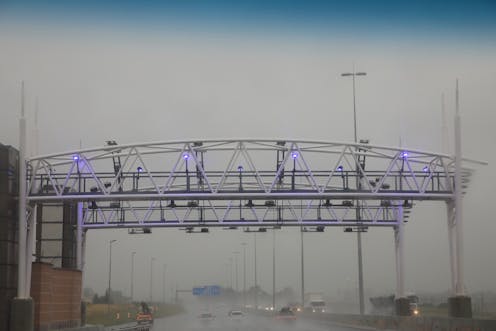
The invisibility of poor people in the country, who are estimated to make up 55,5% of the population was on display recently as David Makhura, Premier of Gauteng Province, the country’s economic heartland, and the Minister of Finance, Tito Mboweni, aired their differences on Twitter. The topic was the electronic tolling (known locally as e-tolls) of freeways in Gauteng.
The Gauteng African National Congress (ANC), which Makhura leads, has responded to a backlash against the tolls by urging that they be removed . The national government in which Mboweni serves, and is also led by the ANC, imposed the tolls and continues to support them, at least in principle. So, while the spat transfixed people who believe that interesting human activity happens only on Twitter, the fact they were arguing was of no great moment: both were expressing the position of their sphere of government.
Nevertheless, the exchange was revealing –- but not for the reasons which fascinated the Twitter-struck media. It showed once again how invisible poor people are in South Africa’s politics.
Opposition to e-tolls
The battle against electronic tolls in Gauteng is usually portrayed as the fight of “the people” against an unjust government. In reality, it is a revolt by car owners who don’t want to pay for the freeways on which they drive. Buses and minibus taxis, the transport used by the poor, are exempt from the tolls. So, people who can afford to own a vehicle pay to use the freeways on which everyone drives.
This is a textbook example of progressive taxation -– those who have more pay for services so that they are available to the poor too.
Owners rebel against paying for public goods around the world and so it is not surprising that car owners have mobilised against the tolls. Nor is the fact that Makhura and the Gauteng ANC want the tolls gone -– people who can afford cars are plentiful in Gauteng, and so the tolls have dented the ANC’s voter support in the province. It’s also not surprising that the Congress of South African Trade Unions, which is in a governing alliance with the ANC, is a strong opponent of tolls: many union members own cars.
What is surprising is that opposition to e-tolls is an article of faith among organisations and people who claim to want a fairer distribution of society’s wealth: it is odd when people who claim to be fighting for the poor condemn anyone who suggests that car owners should be tolled so that poor people can use freeways without paying. If they take the side of the car owners, who speaks for the poor?
The obvious answer would surely be the government which has introduced the tolls. We should expect to hear national government explaining that e-tolls are a boon to the poor and so help to build a fairer economy. We might also expect that, when car owners are campaigning for the tolls to be scrapped, government politicians would be mobilising support among the poor, explaining that their right to ride on the highways for free is under threat.
But, as Mboweni’s response to Makhura shows, government representatives never defend the tolls as a pro-poor tax. The minister’s argument is an energetic defence of the “user pay” principle -– the idea that public infrastructure should be paid for by those who use it. This is not necessarily pro-poor because it could mean that poor people who use it should pay the same as well-off users. Not once during the exchange does Mboweni suggest that e-tolls are a good idea because they help the poor.
Pro-poor by default
Mboweni’s lack of interest in pointing out that the tolls help the poor is standard -– there is no record of any government politician defending tolls because they help poor people. And so, it comes as no great surprise that the decision to exempt buses and minibus taxis was taken some time after the government decided to introduce the tolls. It was a response to lobbying and was not the government’s idea. Nor is it surprising to hear complaints that minibus taxi drivers have difficulties in receiving exemptions to which they are entitled.
E-tolls help the poor not because the government wanted this but because this deflected pressure. They are pro-poor not because of the government but despite it.
So, the poor are ignored by those who claim to speak for them and by the government which seemed to care about them but doesn’t.
This reality is not restricted to the e-toll debate. It is common for debates about poverty to exclude poor people. The only group who have been ignored in the debate over land expropriation are landless people. A few were taken to public hearings on the issue because the people who arranged for them to attend knew they would support their position. But no-one made a serious attempt to listen to what the landless had to say about land.
It is also common for measures which would hurt the poor -– like scrapping e-tolls – to be portrayed as pro-poor. A well-known example is free higher education which would allow the rich to study for free. Another is the revival of the demand a couple of decades ago that township residents – who are mostly poor – pay a flat rate for services. This means that those who have more pay the same as those who have almost nothing.
Why is it so common for activists and politicians to pass off measures which help the better off as boons for the poor? One possibility is that this is a legacy of the fight against apartheid.
Apartheid legacy
A key apartheid strategy was to divide people – and black people in particular. And so, it became a key goal of the movements trying to free people from white minority rule to stress the unity of black people. They knew that some had more than others, but mentioning this would undermine the unity which the movements prized. Those who worried out loud that important differences were being ignored were told that they would be addressed after the system was defeated.
But old ways of thinking and acting become ingrained and so, ignoring the difference between the well-off and the poor survives, whatever slogans people use.
As long as this continues, poor people will remain unheard –- and will be forced to endure plans to better their lives which do nothing for them and a great deal for those who don’t need help.

Steven Friedman does not work for, consult, own shares in or receive funding from any company or organization that would benefit from this article, and has disclosed no relevant affiliations beyond their academic appointment.
Source: The Conversation – Articles (AFRICA)
Read more on The Conversation.
Join the fun: Add Your event | Submit a Press Release | Add your listing.


