Steps new government must take to get the DRC onto a sounder footing:
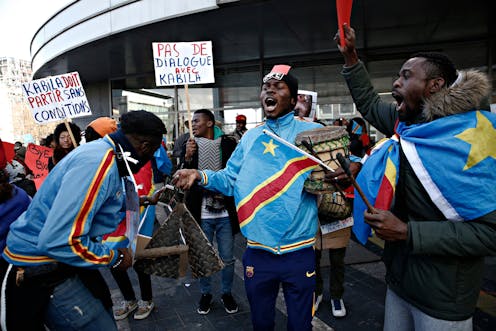
The Democratic Republic of Congo (DRC) has been consumed by conflict and instability over the past two decades. The state is weak while unemployment is rife and good health care and education are inaccessible for most people. The Conversation Africa asked Marta Iñiguez about the country’s troubles, and what can be done to turn the situation around.
Does the DRC have a functioning state?
The DRC has a functioning state for some sectors of the population and to undertake certain prerogatives – like the repression of dissent. But it isn’t carrying out some key roles. These include the provision of security, good health and education services, building infrastructure or defending the interests of small businesses to boost the economy.
In the past few years the security situation has deteriorated, and the state (government as well as sectors of the police, army and judiciary) has been complicit. The North-Eastern territories of Beni and Ituri, as well as the province of Kasai, have witnessed several massacres. These have led to a rise in the number of displaced people which has reached figures unseen for two decades, and a general lowering of living standards. That said, in order to fully understand conflict in the DRC, we need to take account of regional, historical and structural dynamics.
What are the signs that the government is unable to run the country?
I would not say that Joseph Kabila is unable to run the country. In fact, he’s been praised by donors and investors for his good management of the economy. For many years the country achieved an average 7% growth, though this has now slowed to just over 2%.
But he hasn’t provided dignified living standards for the majority of the population.
According to the latest human security indicators, 90.5% of the DRC’s citizens live on under $ 3.10 per day. And, on average, girls only attend about 5.3 years in school, and boys 8.4.
The DRC’s main source of revenue comes from extractive industries. But its mineral riches have proved to be a double-edged sword. The money has been used to finance conflict – though minerals have not been the conflict’s main financing source nor have minerals been the main source of conflict.
In addition, most of the minerals are processed entirely elsewhere.
While this may not be surprising in the context of a post-colonial African state, which continues to be caught up in political and economic structures that come from colonisation, Kabila’s government continues to be party to conflict by engaging in proxy wars and downplaying the army. He also manages the economy for the benefit of Kabila’s own entourage, his family and particular elites.
This prevents Kabila from engaging in sustained and sincere political dialogue to solve the different layers of conflict at the regional and local levels. It also prevents him from attending to historical demands of the country’s rural poorest people and releasing his grip on power – even if this means he risks taking the country back to the verge of a full and extended conflict.
What implications does this have for elections?
The general view is that the elections won’t be free and fair. Kabila will try to make sure that his successor, Emmanuel Ramazani Shadary, is the winner. The likelihood is that he will be.
Based on my own research, and insights from people in the country, the main international donors know that this is a likely scenario. But they would prefer to have elections than not. Also, they actually favour a Kabila successor than any of the unknowns of the opposition.
But the general sense and the indication from polls is that the population doesn’t want either Kabila or any of his successors. This sets the scene for yet another round of contested elections. Violence is already present and is likely to continue.
In the run up to elections, Kabila has got rid of his main contenders, Jean Pierre Bemba and Moise Katumbi, and has harshly repressed dissent. Many members of pro-democracy groups are now in jail, in exile or dead.
Elections will also take place with new voting machines, which are believed to have been rigged to alter results. In this climate, it’s not surprising that a main depot of the Commission Electorale Nationale Indépendante, the organ responsible for organising elections and where 29,000 machines were being kept, was set on fire. Neither is it surprising that Kinshasa’s governor suspended campaigning in city four days before elections for security reasons, blocking one of the main opposition candidates, Martin Fayulu, and leaving both the campaign and elections in limbo.
But in the DRC everything is possible and despite this, elections might still go ahead, with or withour delay. Nevertheless, the climate is not conducive to a peaceful or free electoral journey.
What would be the top four priorities to get a functioning government?
The question is: functioning for whom? To get a functioning government for the majority of the population, the government must organise a national dialogue. This would need to establish a route map to address the basic needs of people in different regions of the country, including roots of conflict, as well as to organise free, fair and credible elections.
The government should work with donors to redirect investment to areas that would ensure dignified employment opportunities were created.
And the government’s collection of revenues should be completely overhauled to make it serve the DRC public, not private interests.
Finally, the judiciary should also be reformed and given the means to prosecute crimes at all levels – from those committed in war, to violence against women as well as those related to corruption.

Marta Iñiguez received a Marie Sklodowska Curie grant. Marie Sklodowska-Curie fellowship PARADOXGREATLAKES 660933.
Source: The Conversation – Articles (AFRICA)
Read more on The Conversation.
Join the fun: Add Your event | Submit a Press Release | Add your listing.


