Study in Ethiopia links healthy soils to more nutritious cereals:
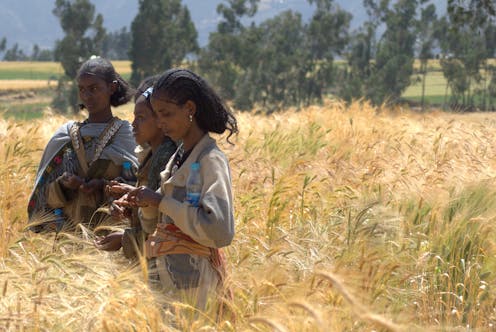
Large fields, predictable rainfall and favourable temperatures have meant that farmers in Arsi Negele, a town in southeastern Ethiopia, have benefited from good crop yields. Their production of wheat and maize, two of the main food staples in Ethiopia, have also increased over time.
But there are worrying indicators that the increased yield and calories haven’t translated into sufficient vitamins and minerals. This deficiency is known as “hidden hunger” and Ethiopia is classed as having “severe” levels.
Less than 20% of children in the area have a diet that’s diverse enough to meet their nutritional needs. This is much lower than the 40-70% typically found in other developing countries, like Tanzania. Protein and zinc deficiencies are of particular concern and contribute to a variety of health issues like stunted growth in early years and poor immunity.
One of the causes of this is that, because there’s a need to feed more people, global trends prioritise high yielding cereal species and varieties as the paper refers mainly to different species over lower-yielding – but more nutritious – crops and animal products.
While it’s known that soils can contribute to nutrients in crops, the studies are very few and mostly look at horticultural crops – like vegetables, fruits and flowers. Little has been done to quantify the links between soil organic matter – plant and animal residue – and crop nutrient content, particularly in cereals.
Our study is one of the first to reveal the link between soil organic matter and crop nutrient content for a staple crop in a developing country. We found that wheat grown around Arsi Negele had more nutrients, like zinc and protein, when grown on soils rich in organic matter.
Increasing organic matter by 1% was associated with an increase in zinc equivalent to meet the daily needs of 0.2 additional people per hectare and an increase in protein equivalent to meeting the daily needs of 0.1 additional people per hectare. These modest increases in soil organic matter contribute a small, but important, increase in nutrients found in wheat.
Although these nutrient increases are not enough to address hidden hunger on their own, they reveal how healthy soils are an additional tool – alongside diet diversity and the biofortification of food – for fighting malnutrition.
Nutrient levels
Twenty seven farms, of varying distances from the forest, were selected. We measured; soil organic matter content, wheat yield, and wheat nutrient composition.
We found that wheat grown in areas closer to the forest, which are especially high in organic matter (about 1% higher) due to decomposing trees and plants and enriched with manure of livestock grazed in the forest, had higher levels of nutrients – like zinc and protein.
This is good news for Ethiopia, where low-cost soil management approaches may be more accessible to farmers than expensive mineral fertilisers which I’ve found to cost about $ 30 USD per bag – about 4 bags are needed per hectare. As a result, less than 30kg of mineral nitrogen fertiliser are used per hectare of wheat in our study area – when it should be at least twice that amount.
Some of the techniques that improve soil organic matter include:
-
Planting trees on farms
-
Minimise plowing to conserve and support the accumulation of organic matter
-
Planting legume crops – like such as faba beans, haricot beans and field peas – which fix nitrogen from the air into the soil, thus increasing fertility.
Farmers in inland Africa are known to pay more than twice as much for fertiliser as farmers in Europe. These soil techniques are more accessible and have already led to successful outcomes in different African farming systems.
Growing malnutrition
The consequences of poor soils for wheat nutrition are significant, not only for people in Ethiopia, but around the world. The finding offers a new solution in addressing growing malnutrition.
It can help increase the nutritional content of food, which has decreased due to large-scale intensive farming systems. Wheat is one of the world’s main crops, with global production of over 749 million metric tons, but studies show that the amount of essential dietary nutrients in these crops have eroded over time. Ethiopia saw a decline in nutrients despite increased crop yields in part due to the Green Revolution – a global push to increase agricultural production.
Another major threat is climate change. A recent study found that crops grown in an atmosphere of increased carbon dioxide (CO2) contain lower levels of protein, zinc and iron, and estimated that “hundreds of millions of people” could become more nutrient deficient as the climate changes. By increasing the organic matter of soils we could grow food that adds a buffer to these reductions.
Way forward
More projects need to include actions that increase soil organic matter for the sake of improved nutrition.
While big climate change initiatives exist to protect and store carbon in soils, we must look at the bigger picture and consider how soils and forests contribute to improved nutrition as well. By planting more trees on farms, storing more carbon in soils, and improving crop-livestock interactions, we not only fight climate change but also wage a stronger battle against malnutrition.

Frédéric Baudron receives funding from ACIAR, IFAD, USAID, NDF, GIZ.
Source: The Conversation – Articles (AFRICA)
Read more on The Conversation.
Join the fun: Add Your event | Submit a Press Release | Add your listing.


