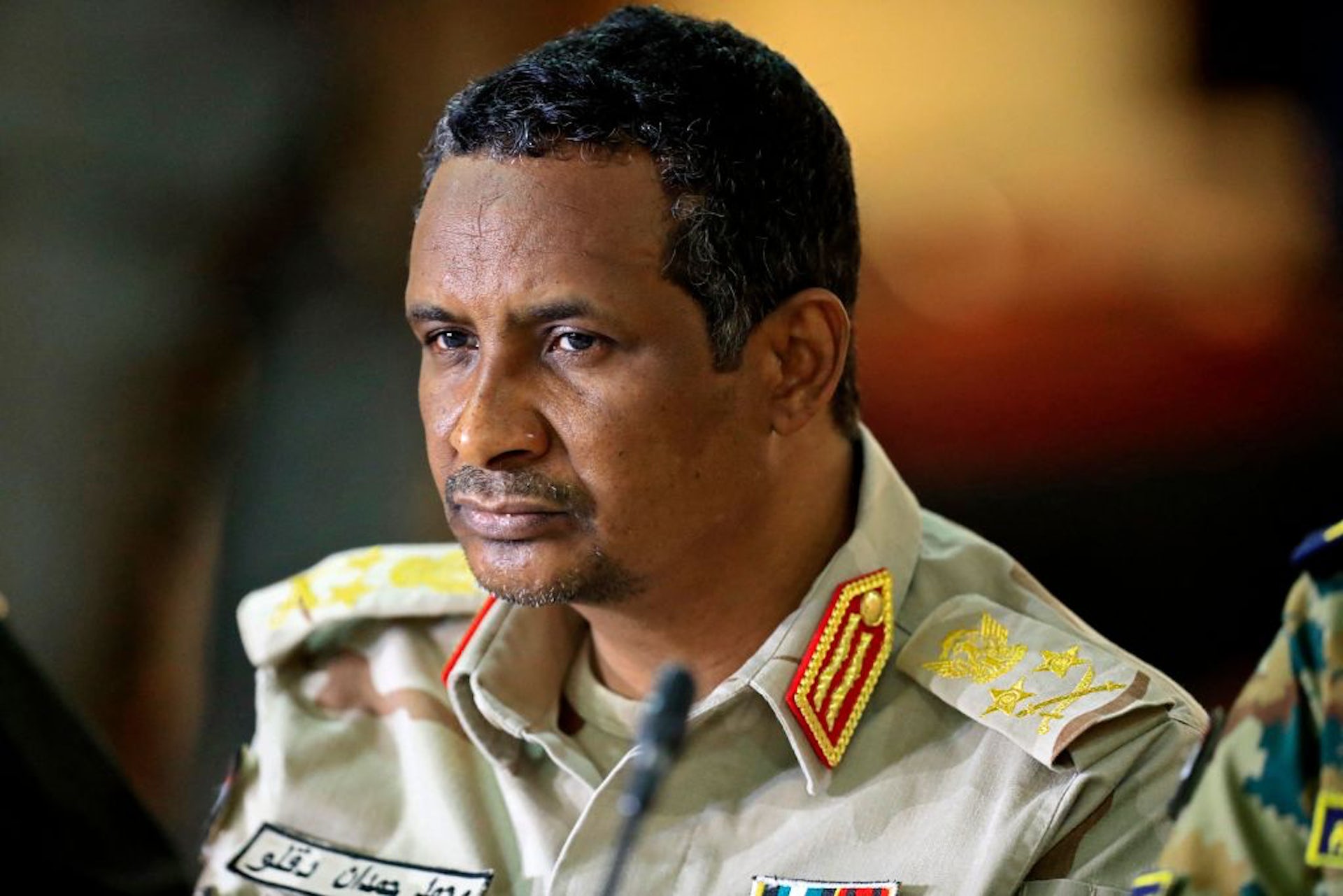
Dozens have been killed in armed clashes in the Sudanese capital Khartoum following months of tension between the military and the powerful paramilitary group Rapid Support Forces (RSF). Behind the tensions is a disagreement over the integration of the paramilitary group into the armed forces – a key condition of a transition agreement that’s never been signed but has been adhered to by both sides since 2021.
General Mohamed Hamdan Dagolo, better known as Hemedti, is the leader of the RSF. He is a key mover in the fast-escalating civil war, as he has been in other key moments in Sudan’s recent history.
Hemedti’s Rapid Support Forces is led by Darfurian Arabs known as Janjaweed. The term refers to the armed groups of Arabs from Darfur and Kordofan in western Sudan. Drawn from the far west of the country’s periphery, they have – in a mere decade – become the dominant power in Khartoum. And Hemedti has become the face of Sudan’s violent, political marketplace.
I have been a scholar of Sudan for decades. During 2005-06, I was seconded to the African Union mediation team for Darfur and from 2009-11 served as senior adviser to the African Union High-Level Implementation Panel for Sudan, in the lead-up to the independence of South Sudan. My most recent book, co-authored with Justin Lynch, examines Sudan’s unfinished democracy.
Hemedti’s career is an object lesson in political entrepreneurship by a specialist in violence. His conduct and (as of now) impunity are the surest indicator that politics of the mercenary kind that have long defined the Sudanese periphery, have been brought home to the capital city.
Coming in from the periphery
Hemedti is from Sudan’s furthest peripheries, an outsider to the Khartoum political establishment. His grandfather, Dagolo, was leader of a subclan that roamed across the pastures of Chad and Darfur. Young men from these camel-herding, landless and marginalised group became a core element of the Arab militia that led Khartoum’s counterinsurgency in Darfur from 2003.
A school dropout turned trader, Hemedti has no formal education. The title ‘General’ was awarded on account of his proficiency as a commander in the Janjaweed brigade in Southern Darfur at the height of the 2003-05 war. A few years later, he joined a mutiny against the government, negotiated an alliance with the Darfurian rebels, and threatened to storm the the government-held city of Nyala.
Soon Hemedti cut a deal with the government. Khartoum would settle his troops’ unpaid salaries and compensation for the wounded and killed. He got promotion to general and a handsome cash payment.
After returning to the Khartoum payroll, Hemedti proved his loyalty. President Omar al-Bashir who ruled Sudan from 1993 to April 2019 when he was deposed became fond of him, sometimes appearing to treat him like the son he had never had.
But, in the days after Bashir was overthrown, some of the young democracy protesters camped in the streets around the Ministry of Defence embraced him as the army’s new look.
A country in his pocket
Back in the fold, Hemedti ably used his commercial acumen and military prowess to build his militia into a force more powerful than the waning Sudanese state.
Al-Bashir constituted the Rapid Support Forces as a separate unit in 2013, initially to fight the rebels of the Sudan People’s Liberation Army-North in the Nuba Mountains. The new force came off second best. But, with a fleet of new pickup trucks with heavy machine guns, it soon became a force to be reckoned with, fighting a key battle against Darfurian rebels in April 2015.
Following the March 2015 Saudi-Emirati military intervention in Yemen, Sudan cut a deal with Riyadh to deploy Sudanese troops in Yemen. One of the commanders of the operation was General Abdel Fattah al-Burhan who has chaired the Transitional Military Council since 2019. But most of the fighters were Hemedti’s RSF. This brought hard cash direct into Hemedti’s pocket.
And in November 2017, Hemedti’s forces took control of the artisanal gold mines in Jebel Amer in Darfur — Sudan’s single largest source of export revenues. This followed the defeat and capture of his arch-rival Musa Hilal, who rebelled against Al-Bashir.
Suddenly, Hemedti had his hands on the country’s two most lucrative sources of hard currency.
Hemedti is adopting a model of state mercenarism familiar to those who follow the politics of the Sahara. The late President Idriss Déby of Chad rented out his special forces for counter-insurgencies on the French or U.S. payroll in much the same manner. One can expect to see RSF troops deployed to Libya some day.
On the other hand, with the routine deployment of paramilitaries to do the actual fighting in Sudan’s wars at home and abroad, the Sudanese army has become akin to a vanity project. It is the proud owner of extravagant real estate in Khartoum, with impressive tanks, artillery and aircraft. But it has few battle-hardened infantry units. Other forces have stepped into this security arena, including the operational units of the National Intelligence and Security Services, and paramilitaries such as special police units — and the RSF.
Reaping the whirlwind
But there’s also a twist to the story. Every ruler in Sudan, with one notable exception, has hailed from the the heartlands of Khartoum and the neighboring towns on the Nile. The exception is the Khalifa Abdullahi “al-Ta’aishi” who was a Darfurian Arab. His armies provided the majority of the force that conquered Khartoum in 1885. The riverian elites remember the Khalifa’s rule (1885-98) as a tyranny. They are terrified it may return.
Hemedti is the face of that nightmare, the first non-establishment ruler in Sudan for 120 years. Despite the grievances against Hemedti’s paramilitaries, he is still recognised as a Darfurian and an outsider to the Sudanese establishment.
When the Sudanese regime sowed the wind of the Janjaweed in Darfur in 2003, they least expected to reap the whirlwind in their own capital city. In fact the seeds had been sown much earlier. Previous governments adopted the war strategy in southern Sudan and southern Kordofan of setting local people against one another. This was preferred to sending units of the regular army -— manned by the sons of the riverain establishment — into peril.
Hemedti is that whirlwind. But his ascendancy is also, indirectly, the revenge of the historically marginalised. The tragedy of the Sudanese marginalised is that the man who is posing as their champion is the ruthless leader of a band of vagabonds, who has been supremely skillful in playing the transnational military marketplace.
_A version of this article was first published by the World Peace Foundation.


