Security forces in Sudan have repeatedly attacked or otherwise used excessive unnecessary force, including lethal force, against peaceful demonstrators in Khartoum, Human Rights Watch said today. On January 17, 2022, alone, doctors’ groups recorded seven killings of protesters by live ammunition, three of which Human Rights Watch documented.
Following the October 25 military coup, numerous protests have taken place across Sudan, particularly in the capital, Khartoum. According to the Central Committee of Sudanese Doctors, security forces have killed 79 people, including a woman and nine children. January 17 was the second deadliest day since the coup.
“For over three months, Sudan’s security forces have caused serious bodily, often lethal, harm to suppress the protests,” said Mohamed Osman, Sudan researcher at Human Rights Watch. “And yet, emboldened by years of impunity, and a meek international response to their coup, Sudan’s military leaders have been committing grave crimes against civilians without consequences.”
Human Rights Watch remotely interviewed eight witnesses to the January 17 events, including witnesses to three of the seven protester killings, and a doctor in Khartoum, and analyzed six videos and eight photographs from January 17 posted to Facebook. Human Rights Watch has not been able to investigate or assess independently the evidence surrounding the four additional reported killings, although the doctors’ groups have recorded the names and details of those killed.
Witnesses said the anti-riot police and Central Reserve Police (CRP), a militarized police unit, led the lethal response on January 17. Six witnesses said that the CRP used live ammunition against unarmed protesters at multiple locations throughout the day. Regular police beat and arrested peaceful protesters.
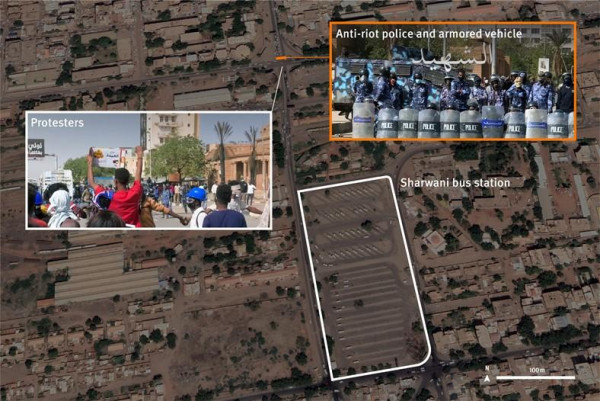
Around 1 p.m., protesters arrived at the Sharwani bus station, two kilometers south of the Presidential Palace. Three witnesses said that anti-riot police, identifiable by their blue camouflage uniforms, positioned themselves in large numbers not far away. Witnesses said the protesters stopped about 20 meters from the police forces and started chanting.
“Out of nowhere, the anti-riot police started firing teargas at us,” said a 23-year-old protester, who was at the front of the protest. “There was no warning nor provocation from our side.”
Another protester, 26, said anti-riot police fired teargas canisters directly at protesters at the front of the march: “As we retreated to find cover from the teargas, I was hit in the back by a canister. I also saw two other protesters being hit in the head and chest.
Three witnesses confirmed that the police gave no verbal warnings or instructions to disperse before firing the teargas. One protester said that he and others started throwing rocks and teargas canisters back at the police.
A video posted to Facebook corroborates the witness accounts. The video shows a four-wheel armored vehicle and two lines of approximately 45 anti-riot police by an intersection close to the Faculty of Medicine of Khartoum University, about 250 meters north of the bus station. In the video, they are blocking entry to the road that ultimately leads to the Presidential Palace.
Protesters are gathered 15 to 20 meters away, on the other side of the intersection, chanting and holding signs. Four protesters at the front of the crowd are holding hands to create a chain with their backs to the police. A cloud of gas is seen, and the protesters run away from the police.
Firing teargas canisters directly at people can cause severe injury, especially from such close proximity, and violates international standards. The UN Office of the High Commissioner for Human Rights reported in mid-January that more than a quarter of those injured since the coup were hit directly by teargas canisters.
By matching landmarks visible in the video with satellite imagery, Human Rights Watch identified the location to be outside the University of Khartoum’s Faculty of Medicine. Screenshots from the video show the positions of the protesters and the police.
Two witnesses said that, about 30 minutes later, Central Reserve forces appeared from the east. A 27-year-old protester said he saw between 20 and 30 CRP officers, some fired live ammunition at protesters. While this protester could not identify their weapons, Human Rights Watch identified a CRP officer by his khaki camouflage uniform in a video posted on Facebook, holding a folding-stock Kalashnikov-pattern assault rifle.
Another witness who was at a makeshift barricade on the eastern side of the bus station said he saw the first fusillade of bullets but that he and others at the barricade remained there. He saw two vehicles approaching: a khaki CRP vehicle and a white pickup truck with no license plate and agents in civilian clothes in the back.
Between 2 and 2:30 p.m., the witness said, he heard a gunshot as the protesters threw rocks at armed CRP officers approaching them. He saw one protester hit and bleeding. He later learned this was Osman al-Sheraif, 40, who died. A doctor’s report said he had gunshot wounds to the pelvis and right thigh.
Shortly afterward, another 26-year-old protester said, he and other protesters scattered around the bus station, while anti-riot police, CRP, and regular police chased them, arresting, and beating some with batons and gun butts.
Four protesters said that the security forces’ response intensified around 3 p.m., when protesters retreated down the street and gathered to prevent security forces from reaching al-Jawda hospital, where the injured protestors were being taken. Security forces have on several occasions raided health facilities and harassed medical staff and patients.
Between 3:30 and 4:30 p.m., three witnesses said they saw two protesters – Hassan Ibrahim al-Bashir, 29, and al-Haj Malik, 21 – fatally shot on the street near al-Jawda hospital, and others injured.
“The main force attacking was the anti-riot police, composed of a number of soldiers on foot and a couple of trucks,” said a friend who had been with al-Bashir. “I heard a couple of gunshots. Suddenly, I felt a bullet hitting my arm. I looked at Hassan to tell him I was shot. At that exact moment, Hassan shouted to me that he had been shot in the eye and I saw blood covering his head. I grabbed his hand and asked others to help me carry him away. All the way to the hospital I didn’t care about my own injury and hoped he would be fine. He wasn’t. He died later.”
A medical source confirmed that al-Bashir was shot in the head and died at the hospital.
Two witnesses to al-Haj’s killing said CRP soldiers shot at them behind their barricade with assault rifles, 300 meters from al-Jawda hospital. They said they also saw anti-riot police firing teargas gas and stun grenades.
A 26-year-old protester saw a CRP officer aiming his assault rifle at the protesters from behind a cover. Another officer approached, pointing at some protesters at the front, as if he was giving the officer aiming the rifle instructions. “A few seconds after, he [the CRP officer] fired,” the protester said, “a protester fell to the ground. Later I found out this was al-Haj. His shirt was covered in blood. He was shot while he was behind a cardboard shield.
A doctor’s report said that al-Haj had a bullet wound to the chest.
Human Rights Watch analyzed a video of this event posted to Facebook. On an intersection 1.5 kilometers south of the bus station and near al-Jawda hospital, three groups of protesters crouch behind sheets of cardboard as others throw stones and projectiles back at the police and the four-wheel armored vehicle. A protester behind a cardboard barrier falls to the ground and a group of protesters gather around and carry him away from the police.
Minutes earlier, a CRP in khaki camouflage is seen aiming a folding-stock Kalashnikov-pattern assault rifle at the protesters.
At around 5:30 p.m., protesters around the gas station and the hospital dispersed, but two witnesses saw the three police groups arresting and beating protesters and bystanders in residential parts of al-Daim until around 7 p.m. A 23-year-old protester saw police pursuing protesters into houses in multiple places in the area.
Calls from regional and international actors for the military to halt the crackdown have had no impact, Human Rights Watch said. Security forces have denied using live ammunition and claimed that they only use an “appropriate amount of force.” Human Rights Watch documented Central Reserve Police using excessive and lethal force in Khartoum’s Bahri city, on November 17, when 12 protesters were killed. Military units from the Sudan Armed Forces (SAF) and Rapid Support Forces (RSF) and unidentified agents in civilian clothes, have also been involved in abuses against protesters since the coup.
Police are under the direct command of the general director of police, who reports to the interior minister. The military, including SAF and RSF, answer to the Sovereign Council, the collective presidency.
Following the January 17 events, about 150 prosecutors, judges, and legal advisers from the Justice Ministry called for credible and meaningful investigations and prosecutorial supervision over detention and crowd control.
A prosecutor in Khartoum told Human Rights Watch on January 22 that the participation of multiple forces, including military units, complicates the prosecutors’ efforts to identify a clear command chain and ensure that all forces responsible for abuses are held to account.
“The military has repeatedly responded to popular civilian opposition with summary killings, arbitrary arrests, and other abuses, and yet the Sudanese people continue to press for change,” said Osman. “The international community should not passively observe the protesters, but actively engage with their calls for a fairer Sudan.”
Distributed by APO Group on behalf of Human Rights Watch (HRW).


