Sudan stands on the brink of yet another civil war sparked by the deadly confrontation between the Sudan Armed Forces of General Abdelfatah El-Burhan and the Rapid Support Forces of Mohamed Hamdan Dagalo (“Hemedti”).
Much of the international news coverage has focused on the clashing ambitions of the two generals. Specifically, that differences over the integration of the paramilitary Rapid Support Forces into the regular army triggered the current conflict on April 15, 2023.
I am a professor teaching at Columbia University and my research focuses on the political economy of the Horn of Africa. A forthcoming paper of mine in the Journal of Modern African Studies details the strategic calculus of the Sudan Armed Forces in managing revolution and democratisation efforts, today as well as in past transitions. Drawing on this expertise, it is important to underline that three decades of contentious energy politics among rival elites forms a crucial background to today’s conflict.
The current conflict comes after a decade-long recession which has drastically lowered the living standards of Sudanese citizens as the state teetered on the brink of insolvency.
How energy has shaped Sudan’s violent political economy
Long gone are the heady days when Sudan emerged as one of Africa’s top oil producers. Close to 500,000 barrels were pumped every day by 2008. Average daily production in the last year has hovered around 70,000 barrels.
In the late 1990s, amid a devastating civil war, President Omar Al-Bashir’s military-Islamist regime announced that energy would help birth a new economy. It had already paved the way for this reality, ethnically cleansing the areas where oil would be extracted. The regime struck partnerships with Chinese, Indian and Malaysian national oil companies. Growing Asian demand was met with Sudanese crude.
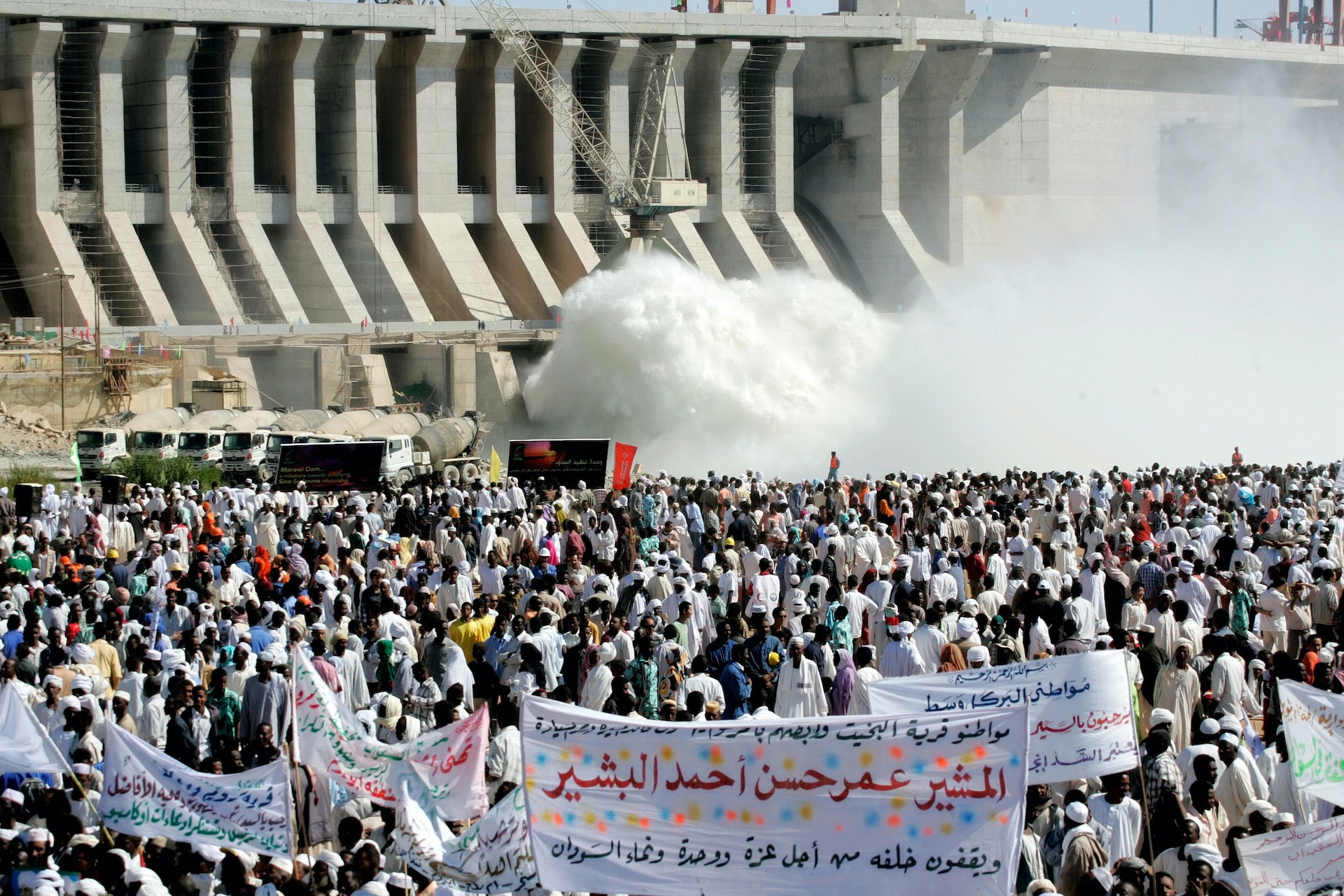
Petrodollars poured in. The regime in power between 1989 and 2019 oversaw a boom. This enabled it to weather internal political crises, increase the budgets of its security agencies and to spend lavishly on infrastructure. Billions of dollars were channelled to the construction and expansion of several hydro-electric dams on the Nile and its tributaries.
These investments intended to enable the irrigation of hundreds of thousands of hectares. Food crops and animal fodder were to be grown for Middle Eastern importers. Electricity consumption in urban centres was transformed; production in Sudan was boosted by thousands of megawatts. The regime spent more than US$10 billion on its dam programme. That’s a phenomenal sum and testament to its belief that the dams would become the centrepiece of Sudan’s modernised political economy.
South Sudan secedes
Then, in 2011, South Sudan seceded – along with three-quarters of Sudan’s oil reserves. This exposed the illusions on which these dreams of hydro-agricultural transformation rested. The regime lost
half of its fiscal revenues, and about two-thirds of its international payment capacity.
The economy shrank by 10%. Sudan was also plagued by power cuts as the dams proved very costly and produced much less than promised. Lavish fuel subsidies were maintained but as evidence shows, these disproportionately benefited select constituencies in Khartoum and failed to protect the poor.
As the regime sank ever deeper into economic crisis, its security agencies concentrated on accumulating the means they deemed essential to survive, and to compete with each other. Both the Sudan Armed Forces and Rapid Support Forces deepened their involvement in Sudan’s political economy. They took control of key commercial activities. These included meat processing, information and communication technology and gold smuggling.
Soaring fuel, food and fertiliser prices
This economic crisis fuelled a popular uprising which led to the overthrow of Al-Bashir. After the 2018-2019 revolution, the international community oversaw a power-sharing arrangement. This brought together Sudan Armed Forces, Rapid Support Forces and a civilian cabinet. Reforms were tabled to reduce spending on fuel imports and address the desperate economic situation.
However, the proposals for economic reform competed for government and international attention with calls to fast-track the “de-Islamisation” of Sudan, and to purge collaborators of the ousted regime from civil service ranks.
Inflationary pressures worsened as food and energy prices rose. It also strengthened a growing regional black market in which fuel, wheat, sesame and much else was illicitly traded across borders. At the same time, divisions grew in Sudan’s political establishment and among protesters in its streets.
The government’s efforts to push back against growing control of economic activities by the Sudan Armed Forces and Rapid Support Forces ultimately contributed to the October 2021 coup against Prime Minister Abdallah Hamdok.
Overlapping crises
The coup only deepened the crisis. So too did global supply shocks, such as those caused by the COVID-19 pandemic and the Russia-Ukraine conflict, which sent the prices of fuel, food and fertiliser skyrocketing globally, including in Sudan. Fertiliser prices increased by more than 400%. The state’s retreat from subsidising essential inputs for agricultural production, such as diesel and fertiliser, led farmers to drastically reduce their planting, further exacerbating the food production and affordability crunch.
Amid these overlapping energy, food and political crises, Sudan’s Armed Forces and Rapid Support Forces have been violently competing for control of the political economy’s remaining lucrative niches, such as key import-export channels. Both believe the survival of their respective institutions is essential to preventing the country from descending into total disintegration.
In view of such contradictions and complexity, there are no easy solutions to Sudan’s multiple crises. The political, economic and humanitarian situation is likely to worsen further.
A version of this article was first published by the Center on Global Energy Policy.


