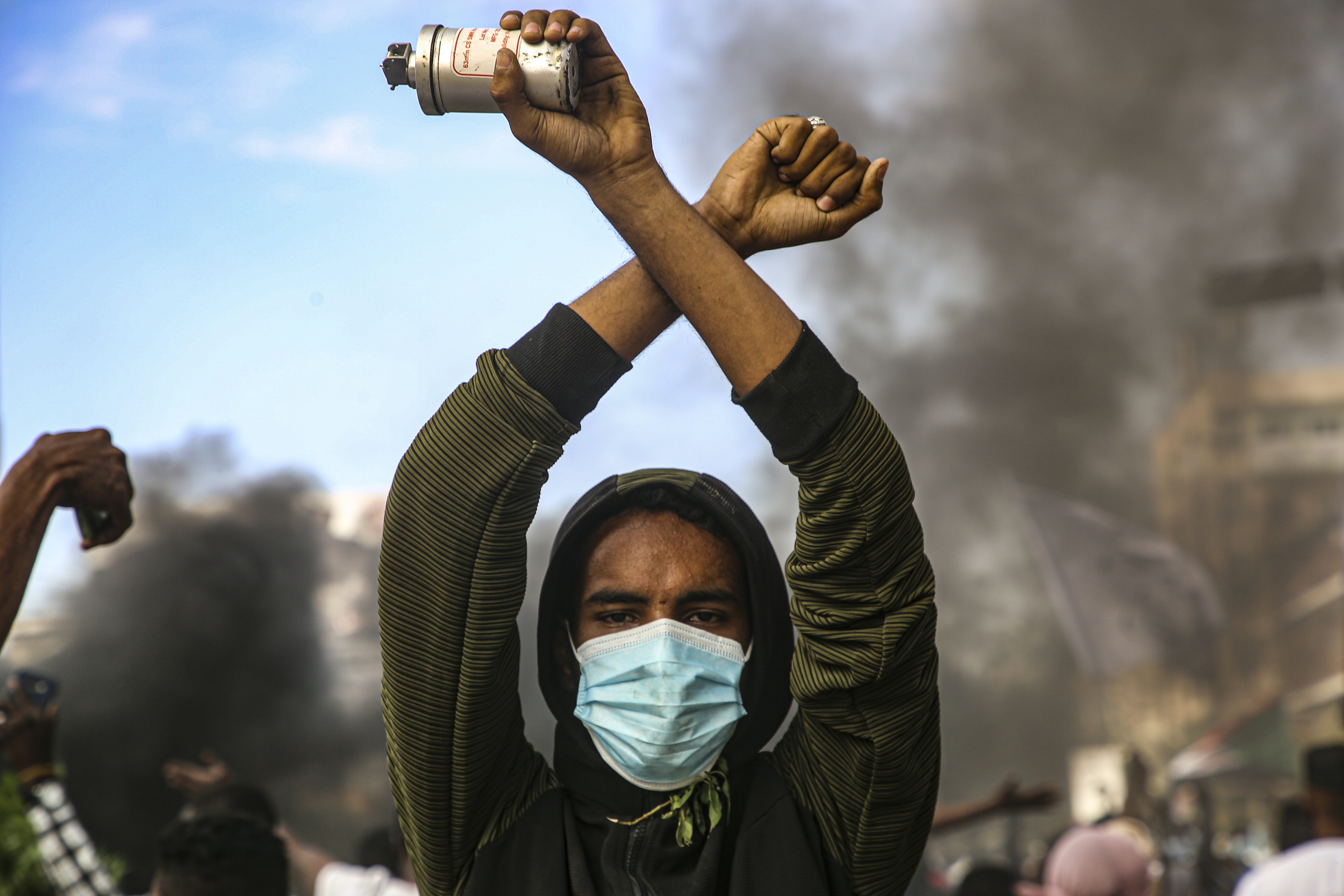
Sudanese have been going out on the streets for non-violent, peaceful protests for more than three months since the military coup on October 25, 2021.
Thousands of demonstrators have been defying a ban on protests and have marched in Khartoum and other cities denouncing the military takeover. They are calling for a fully civilian government to lead the country’s now-stalled transition to democracy.
Since the October coup, at least 79 people have been killed. The internet has been blocked for long periods, preventing the protesters from telling the world about what goes on.
But the main protest organisers – the neighbourhood resistance committees and the Sudanese Professionals Association – say that they will not leave the streets until the fall of the coup regime, and until the military leaders are held to account for the atrocities they have committed.
The protests have remained peaceful, and people have not stopped coming, despite the military’s use of excessive force. When the military leaders have responded so harshly and have not given in on any demands, why do the protests still continue?
We’ve carried out research into youth activism in Sudan and have insights into what drives people to continue protesting.
We believe that the reasons for continued protests are a combination of; historical proof that demonstrations can bring change, previous experience in organising protests and because they’re driven by young people who have the tools and energy to keep pushing and who have little faith in others to make the change happen.
The drivers
The first is the success that ordinary Sudanese had in toppling former president Omar al-Bashir. Resilient demonstrations from 2018 to 2019 against Bashir contributed to the fall of a president that had been in power for three decades.
These events showed Sudanese people that they could bring about change. Marching in the street, day after day, is seen as something worthwhile, something rewarding, that will bring an outcome.
The main protest organisers are the neighbourhood or resistance committees and the Sudanese Professionals Association.
Initially established in 2012, the neighbourhood committees were run by young volunteers to ensure essentials – such as bread, sugar and cooking gas – were distributed. They developed into underground resistance committees and, together with the Sudan Professional Association (an association of health workers, doctors and lawyers), organised people into marches throughout Khartoum and in other towns.
Young people – Sudanese youth – were the backbone of the protests against Bashir. And continue to be today.
The generation of people, between the ages of 15 and 30, were all raised under the authoritarian rule of the Islamist party National Congress Party which ran the country from 1989 to 2019. Political activism was harshly repressed, making voluntary charity work one of the few arenas where young people could engage. As opposition to the regime increased, youth engagement gradually turned from charity to political protests, seen in Khartoum and other cities from 2013.
The lessons learnt by young people from voluntary work and previous resistance and repression under Bashir became instrumental for the success of the uprising in 2019.
The volunteers had learnt how to organise supplies, and the politically experienced taught the others how to mobilise, and both groups knew how to crowdfund. Underground organisation and the use of social media were key.
It’s allowed demonstrators to maintain stamina and continue to mobilise protests over and over again, regardless of the challenges.
The second driver is that young people are drawn to demonstrate out of a feeling of responsibility to change the situation. This is written based on observation and interviews from our ongoing research project which started in 2018.
These emotions are a key aspect of the Sudanese revolution and may explain why the protests continue even in the face of brutal violence from the military. This was also seen in Tunisia and Egypt.
The act of going over and over again to the Mawkib is an act of resilience but also is part of encouragement that the fight is not over.
A third reason for the endurance of the protests is disappointment with formal political participation and channels. Previous protests proved that informal and clandestine organisation through neighbourhood committees worked. In addition, activists are also deeply disappointed with the Forces for Freedom and Change, a coalition of civilian political forces which accepted a power sharing with the military in the transitional government from 2019, thereby allowing the army to get back in power.
The demonstrators also have little faith in the influence of the international community. This is due to the experience with the international community during Bashir’s regime. The economic sanctions for example, that were imposed on Sudan in the early 1990s, did not directly affect the regime. But they had a heavy impact on the life of the citizens.
A call for support
The protesters recognise that the change has to come from within. In our interviews with activists, they also underline that it can be aided by well thought out support from the international community.
It could, for example, take direct action against the military itself, such as individuals, rather than the country as a whole.
It could also take the form of pressure on states in the region to withdraw their support for the coup makers. And it could involve finding ways to support civil society and activists instead of withdrawing aid.


