Surviving genocide: a voice from colonial Namibia at the turn of the last century:
Germany committed genocide in Africa 40 years before the Holocaust of the European Jews. In 1904 and 1905 the Ovaherero and Nama people of central and southern Namibia rose up against colonial rule and dispossession in what was then called German South West Africa. The revolt was brutally crushed. By 1908, 80% of the Ovaherero and 50% of the Nama had died of starvation and thirst, overwork and exposure to harsh climates.
The army drove survivors into the waterless Omaheke desert. Thousands more died in concentration camps.
For many historians this first genocide committed by Germany provided the template for the horrors that were to come 40 years later during the Holocaust of the European Jews. The philosopher Hannah Arendt, herself a Holocaust refugee from Germany, explained in 1951 that European imperialism played a crucial role in the development of Nazi totalitarianism and associated genocides.
We know very little about the experience of those who lived through this first systematic mass extinction of the 20th century. Forty-seven testimonies were recorded and published in 1918 in a scathing official British report about German colonial rule in Namibia, known as the Blue Book. One eyewitness remarked:
Words cannot be found to relate what happened; it was too terrible.
Following on an earlier Norwegian edition, a new book, Mama Penee: Transcending the Genocide, by Uazuvara Ewald Kapombo Katjivena, to be published by UNAM Press in Windhoek in February, makes an extraordinary attempt to present the lived experience of the genocide.
Surviving a genocide
Based on oral and family history, Katjivena, a former exiled liberation Namibian fighter until the country’s independence from South Africa in 1990, tells his grandmother’s story in a biography deeply infused with family and oral history. His grandmother, Jahohora, survived the genocide as an 11-year-old girl.
In the book’s opening scene young Jahohora witnesses her parents’ murder at the hands of German colonial troops in 1904. Following this traumatic experience, she wanders into the veld. The young girl survives on her own, using skills that her mother had imparted to her, to scavenge from the environment. She traps rabbits and birds, eats berries and wild honey, and occasionally feasts on an ostrich egg.
The remaining connection with her parents is cruelly cut after she is caught and forced to work for a German farmer. During the “civilising” washing and changing of her attire, her ceremonial Ovaherero headgear is cut into pieces and burnt by the farmer’s wife.
The headgear was her mother’s significant gift for the growing daughter just before the start of the hostilities in early 1904. Jahohora suffers deeply humiliating experiences.
Katjivena’s grandmother was a remarkable woman of deep thought, insight, and immense resolve. Her parents and grandparents belonged to a section of the Ovaherero called the Ovatjurure. They played a significant role in their communities by helping to maintain peace among families in the nearby homesteads and in the neighbouring villages.
Their daughter passed on this remarkable tradition to the children and grandchildren she brought up during Namibia’s colonial era under Germany and South Africa.
Regaining agency
Katjivena intersperses Jahohora’s personal perspective with historical facts. We read a detailed, chilling account of General Lothar von Trotha’s extermination order of 2 October 1904. The oral history telling, however, also indicates instances of humanity during an entirely inhumane era.
Who were these white people, the survivor wondered. Why had some German soldiers saved her from certain death and given her a chance of life while their fellows had mercilessly killed her parents? As Jahohora meets other survivors and hears their stories, she begins to understand the genocide and especially the role of Von Trotha, who is locally known as omuzepe (the killer).
Katjivena’s story looks simple, yet it exudes deep meaning. It turns the gaze onto the oppressors. The resisting gaze of the colonised, the cultural theorist Elizabeth Baer writes, is an act of self-creation. It “begins to recognize and restore agency to the victims of imperialism”.
Transcending the genocide
The subtitle of Katjivena’s book is Transcending the Genocide. It adds a tremendous living voice to the symbolic commemorations of Germany’s African genocide that have taken place over the past few years.
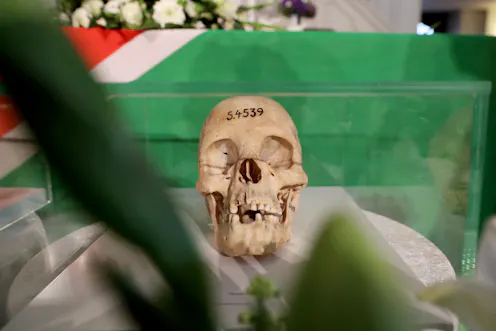
Importantly, human remains of genocide victims were repatriated from Germany to Namibia in 2011, 2014 and 2018. These had been shipped to academic and medical institutions in Germany, and had remained there until recently.
In 2019 some significant items of cultural memory, which had been stolen during colonial conquest, were returned to Namibia from the Linden Museum in Stuttgart. These included the slain Nama leader Hendrik Witbooi’s Bible and his riding whip.
In Windhoek a Genocide Memorial, built in 2014, signifies a noteworthy shift in post-colonial Namibian memory politics. The statue’s North Korean aesthetics and symbolism remain controversial. That aside, the new monument shows that the genocide of the Ovaherero and Nama has belatedly entered the public history narrative of Namibian nationhood. This would have been impossible a few years earlier.
Reconciliation and reparations
On the political level, the German government finally acknowledged the colonial genocide in 2015. Ever since, Namibian and German envoys have been talking about an official apology by Germany.
Most controversial have been negotiations about reparations. Also controversial has been the role of the Ovaherero and Nama communities that were directly affected by the genocide. But in January 2020 Germany’s new ambassador to Namibia, Herbert Beck, hinted that important political developments might be about to happen.
It is not clear yet where the complicated process of post-colonial reconciliation is going. Yet, with stories such as Katjivena’s remarkable biography of his grandmother, the dead and the survivors of the colonial genocide are finally given a face.

Heike Becker does not work for, consult, own shares in or receive funding from any company or organisation that would benefit from this article, and has disclosed no relevant affiliations beyond their academic appointment.
Source: The Conversation – Articles (AFRICA)
Read more on The Conversation.
Join the fun: Add Your event | Submit a Press Release | Add your listing.


