Taking Africa’s democratic temperature as a dozen countries prepare for polls:
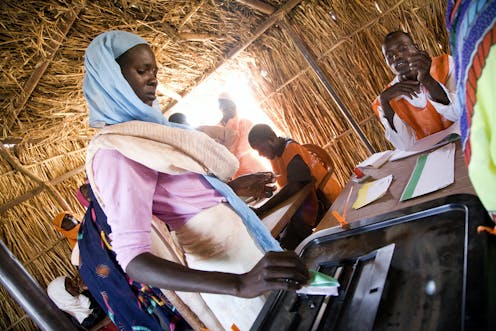
More than a dozen national elections will be held across Africa next year. All 55 members of the African Union (AU) are obligated to hold regular and ostensibly democratic elections. They must also invite teams of AU election observers to publicly monitor, assess and report the results.
Is all this electoral activity helping to entrench democracy as the foundation for national and regional security, development and integration? Or have elections become the means for demagogues to grab power – or, more typically, for powerful elites and authoritarian rulers to entrench themselves?
Democratic theory prescribes credible elections as a necessary, but insufficient means, to consolidate real democracy. Real democracy typically abets peace and security. National circumstances vary. But three additional conditions are also vital. They are freedom of expression, the right of assembly, and an independent nonpartisan judiciary to resolve disputes and ensure the rule of law predominates.
Most deadly conflicts in Africa occur within – not between – sovereign states. Recognising this, the AU has made observing and assessing democratic elections an integral part of its operations. This often happens alongside observers from regional economic communities.
As observations improve, so do opportunities to gauge whether electoral violence and other severe human rights abuses threaten regional peace and security.
In mid-November, there were three important developments at the AU headquarters in Addis Ababa. These promise to improve Africa’s long-term prospects for collective self-reliance and democratic peace. And this will happen regionally, nationally and locally.
The first was a streamlining of the continental body’s operations. The second was a move to strengthen the monitoring and evaluation of member countries. The third was a renewed commitment to improve the depth, duration, and diligence of African election observation missions.
Three Changes
President Paul Kagame of Rwanda has been the chair of the AU this year. He has driven a set of administrative and financial reforms to improve its efficiency and effectiveness.
Headline reforms include:
-
Reducing the number of AU Commission portfolios,
-
Introducing merit-based hiring and promotion procedures, and
-
Reducing dependence on foreign donors. This has been achieved by revising the scale of member state contributions and penalties for nonpayment.
The key structural reform will be combining the portfolios of Political Affairs and Peace and Security. This makes sense strategically. It will ensure that the lion’s share of AU resources supports both urgent peacemaking needs and creates conditions conducive to developing politically capable states. Failures on either front could jeopardise the AU’s strategic plan for the socio-economic transformation of the continent.
Two other developments complement these shifts.
One is the Assembly’s decision to strengthen the monitoring and evaluation of key governance areas on the continent. This promises substantial improvements in the role and functioning of the African Peer Review Mechanism. The mechanism was established in 2003. It aims to encourage member states to critically and regularly assess their progress in governance and socio-economic development.
After much initial excitement, the mechanism devolved into a largely technical and widely ignored exercise. Its governing Forum of Heads of State sought to infuse it with greater political clout and relevance in 2016. It mandated its new director, Professor Eddy Maloka, to produce an Africa-wide comparative assessment of governance challenges facing AU member states.
This will be presented to the next regular AU Assembly of Heads of State and Government in February 2019.
The final change involves beefing up election monitoring. Ten years ago the AU entered into a formal partnership with the Electoral Institute for Sustainable Democracy in Africa. The parties agreed on 16 November to seek ways to extend and improve the partnership.
The institute is based in Johannesburg. It boasts an all-African staff from more than a dozen nations. It has helped AU missions on several fronts. This has included the training and application of:
-
a common set of observation principles and democratic election standards, and
-
more comprehensive, rapid and technologically advanced tools and training of AU observers.
The partnership has also helped the AU to acquire a leadership role among domestic and international election observer groups pursuing greater electoral transparency and accountability. This is true even within Africa’s most troubled states.
Is democracy dying?
These efforts would seem to run counter to the question “Is Democracy Dying?”, which has become a preoccupation in the era of US President Donald Trump. African politics, too, are vulnerable to demagoguery, debauchery and divisiveness. More notable is the proliferation of progressive forces at all levels of African politics. They are exposing and combating corruption and other egregious abuses of power.
Progress is slow, erratic, and dangerous for democracy advocates and activists to pursue. Yet in a year when Freedom House’s latest global survey concludes democracy is in decline, Africa may well be bucking the trend.
The Mo Ibrahim Foundation’s 2018 Index of African Governance found that
…governance on our continent, on average, is slowly improving … approximately three out of four African citizens live in a country where governance has improved over the last ten years.
Despite Africa’s many problems, it continues to sustain a wide variety of democratic experiments. Extensive surveys by Afrobarometer, the non-partisan research network, show the majority of Africa’s citizens still prefer democracy to the alternative. This is a reality the African Union increasingly recognises and is attempting to support.

John J Stremlau serves on the EISA Board without compensation and in that capacity was a member of the team that met with AU officials on 16 November 2018.
Source: The Conversation – Articles (AFRICA)
Read more on The Conversation.
Join the fun: Add Your event | Submit a Press Release | Add your listing.


