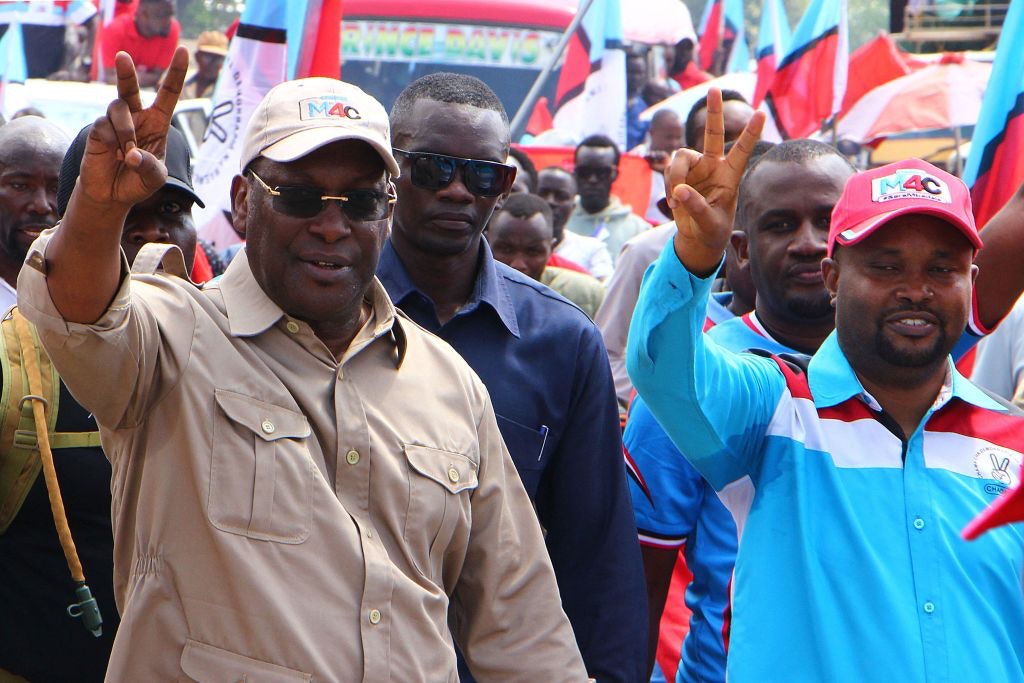
Tanzania’s president issued a statement in June 2016 announcing a ban on political rallies outside campaign periods. The ban was unconstitutional.
Article 20 (1) of the constitution of Tanzania allows for public assembly. Other laws, such as the Political Parties Act and the Parliamentary Immunities, Powers and Privilege Act, give political parties and politicians the right to conduct rallies.
Despite these laws, it took another presidential statement in January 2023 to unban rallies. This illustrates the power of the president – even over the constitution.
Opposition parties and activists have noted that this great presidential power is a constitutional loophole. The Tanzanian constitution has proved to be weak in protecting itself.
A constitution can protect itself if it has clear checks and balances. With imperial presidential powers, the constitution gives the executive branch of government the upper hand over the two other branches of government: the judiciary and legislature.
Such powers – and their abuse – have led opposition parties and activists to call for constitutional reviews.
There are four reasons driving the agitation for constitutional change in Tanzania: unfree and unfair elections; unchecked presidential powers; political impunity; and the skewed political arrangement between Tanzania and Zanzibar.
Entrenching dominance
Recent calls for constitutional change in Tanzania began in 2010. A constitutional review commission was set up in 2012, headed by former prime minister Joseph Warioba. The commission drafted a report, and a constitutional review assembly was set up to debate it.
The review assembly was dominated by members of the ruling party, Chama cha Mapinduzi. They altered the Warioba report and proposed a draft constitution similar to the existing one. A coalition of opposition parties boycotted the process and it stalled.
Maintaining the same constitution has been the ruling party’s strategy. The current constitution facilitates one-party dominance by entrenching the party’s and president’s power.
Further review was stopped by president John Pombe Magufuli, who came into power in 2015. Magufuli rejected any calls for constitutional reforms – and acted in a way that disregarded the existing law.
Read more: Tanzania’s John Magufuli: a brilliant start but an ignominious end
Chasing change
The four triggers for constitutional reform in Tanzania are related.
1. Repeated unfree and unfair elections
In Tanzania, unfree and unfair elections began after the constitution was amended in 1992 to allow for multi-party elections. Since then, there have been six general elections. Each has been marred by accusations of an unlevel playing field, rigging and violence. The 2020 general election was especially violent.
Constitutional reform is crucial to realise free and fair elections. This is because the composition of the electoral commission as provided for by the constitution is bound to be biased. The president, who is often the incumbent candidate and the chairperson of the ruling party, is responsible for appointing the executive director and commissioners of the commission. All election returning officers at the constituency level are also presidential appointees.
The consequence is that electoral officials are likely to be loyal to their appointing authority rather than to the ideals of free and fair elections.
Additionally, once the presidential vote has been announced, the constitution doesn’t allow for it to be challenged in court.
2. Unchecked presidential powers
Under the current constitution, the president of Tanzania has enormous power. He or she appoints senior officials in other branches of government and all heads of public institutions. This includes the chief justice, all other judges and the inspector general of police. The president also appoints the controller audit general, who audits government accounts.
Through loyalty, these appointees are likely to enforce the president’s statements even if they are unconstitutional.
Further, the president cannot be prosecuted as per Article 46 of the constitution. The president is protected during and after their tenure in office. Such provisions promote impunity.
3. Impunity
Impunity in Tanzania plays out where one group of people can do what they like politically, while another group – in particular opposition politicians – faces excessive exposure to an unjust system.
Trumped up charges against opposition leaders, activists and business people deemed critical of the president are popular tools for keeping critics silent. Such charges, facilitated by undemocratic laws, were used during Magufuli’s regime. Magufuli died in March 2021 and was succeeded by Samia Suluhu Hassan.
In the early days of Hassan’s administration, in July 2021, Freeman Mbowe, the leader of the opposition party Chadema, was arrested and charged with terrorism offences. Due to political pressure – and a failure to find evidence – the charges were dropped. Mbowe spent eight months in jail.
After his release in March 2022, Hassan expressed her determination to boost the country’s democracy. She has also expressed her resentment of the unjust political system and called out corruption at the office of public prosecutions.
But presidential sentiments like these are not adequate as they don’t lead to institutional changes in political structures or norms.
4. The Tanzania-Zanzibar agreement
This is arguably the most contentious trigger for calls for constitutional reform.
The political relationship between the island of Zanzibar and the mainland, Tanzania, has raised calls for Zanzibari autonomy. The government of the United Republic of Tanzania deals with union matters, as well as all mainland issues. The Revolutionary Government of Zanzibar deals with the matters of Zanzibar only.
Opposition leaders have argued that the constitution and this current structure increase the ruling party’s influence in Zanzibari politics. Constitutional debate on this issue is often around four proposed structures: one joint government, two governments, three governments (with the union being the third tier), or a confederation with a central authority.
What next?
The underlying call for constitutional reform seeks to uproot the one-party state system to allow for accountability and democratic progress in Tanzania. Under the current constitution, any pronouncements of change are cosmetic, with no sustainable effects.
For Tanzania to realise real and sustainable democracy, a new constitution is necessary.


