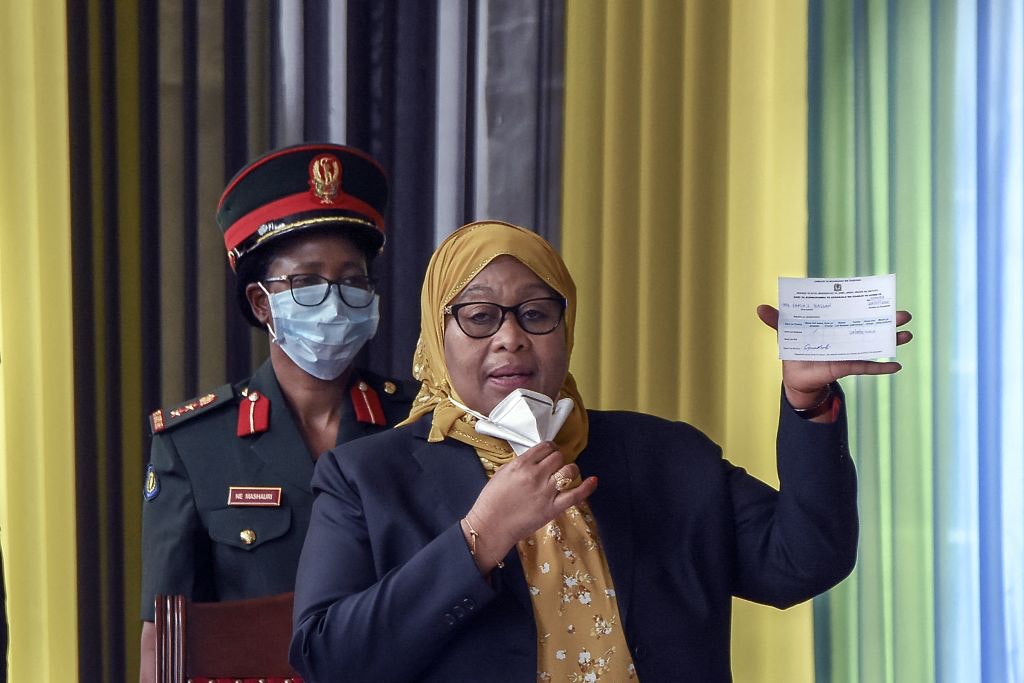
After the death of President John Magufuli on 17 March 2021, Vice-President Samia Suluhu Hassan became Tanzania’s sixth president, and the first woman in the office.
She may have been an “accidental president” but she seems to have set Tanzania on a change of course compared to the approach taken by her predecessor. Her government has enhanced diplomatic relations, approached the COVID-19 pandemic differently and increased the number of women in high political office.
The extent to which this will bring institutional rather than merely rhetorical change is unclear. Detractors will point to her lack of commitment to broader constitutional change as evidence of the latter.
Given that Hassan has marked her first year in office, it is fair to consider some of her government’s achievements and what these indicate about her main priorities for the remainder of her term. Tanzania’s next election is in 2025.
Within six months of taking office, Hassan had reshuffled her cabinet. This was viewed as an attempt to increase her grip on power within the ruling party, Chama cha Mapinduzi. Soon after, she announced her intention to run for a second term.
She also publicly received a COVID-19 vaccination in a marked divergence from the attitudes of her predecessor.
Hassan also made headlines by calling out gross global vaccine inequities at the UN General Assembly. Her government has additionally steered the country out of an economic crisis that was in large part caused by the COVID-19 pandemic.
Economic gains
As a result of taking a more measured and less bombastic approach than her predecessor, Hassan’s government has had notable successes in improving diplomatic and economic ties.
Her government has also set about improving continental and regional economic relations. It ratified the African Continental Free Trade Area and has overseen increased trade with neighbouring Kenya. Hassan also signed Tanzania on to a trade deal between the East African Community and the European Union in February 2022 that had been blocked by her predecessor.
Read more: Tanzania is getting a political remake as President Hassan eyes the 2025 polls
While this may see the re-emergence of reservations at such agreements, not least from former presidents, they mark a clear change of tone under Hassan. They signal a move away from the outspoken rhetoric of economic nationalism under Magufuli, even if that softened through his first term in office.
It has even been suggested that Tanzania’s improved ties with investment partners means that the country is well positioned to enhance global gas exports in light of the Russian invasion of Ukraine. This is a position that Hassan has acknowledged. Significant progress has already been made in rolling out plans for a liquefied natural gas plant since the change of government. The facility is expected to be complete by 2028.
Action on women
Many were rightly critical of Hassan’s clumsy comments in 2021 when she described Tanzania’s women footballers as having “flat chests”. This chimed more with her predecessor’s well-documented misogynistic attitudes.
But her actions have spoken louder than her words. This is evidenced in her progressive move to lift a long-standing ban on teenage mothers returning to school to complete their studies.
She has also overseen an increase in the number of women in the cabinet – they are now nine out of 25 – and in more prominent positions. Speaker Tulia Ackson replaced Job Ndugai, one of a number of Magufuli loyalists to lose his position. Stergomena Tax became the country’s first female defence minister.
These appointments have sparked important discussions on the role of women in Tanzanian politics, especially on social media. It may also demonstrate a more progressive and even feminist foreign policy moving forward.
Addressing the one-party spiral
Under Magufuli, it had been argued that Tanzania was returning to a system closer to the days of the one-party state. This seems to be changing under Hassan, at least rhetorically. She has highlighted the need for changes to political conduct and clean politics.
Read more: Tanzania must face up to calls for reform if it wants to keep the peace
She has met with Tundu Lissu, an exiled political opponent who fled to Belgium after a near fatal shooting in 2017. Additionally, terrorism charges against Freeman Mbowe, the chairman of the opposition party Chadema, were dropped. The ban on four Swahili language newspapers, instituted under the previous regime, was also lifted.
Cautious optimism
The signs so far appear encouraging. According to the 2021 Afrobarometer survey, Tanzanian’s top four priorities for the government are: health (top priority for 23.2% of respondents), water supply (16.3%), infrastructure and roads (15.1%), and electricity (6.3%).
Hassan’s recently outlined priorities seem to reflect this list.
Citizens expect good schools where their children can go to learn. They are waiting for health centres to be built, water supply, and rural electrification. This constitutional exercise is very costly.
However, the lack of commitment she has expressed on restarting constitutional changes – which stalled under former president Jakaya Kikwete in 2014 – has led some to question if structural change is on her agenda.
Leading opposition figures argue that without constitutional amendments, the unchecked power of the president and the ruling party, Chama cha Mapinduzi, will make mounting a credible electoral challenge in 2025 difficult.
Deeper structural and constitutional transformation in Tanzania may fail to materialise in Hassan’s first term in office. Whether it will happen under her leadership will become clearer with time, but change is needed to reunite a still fractured country. We could look to proximate examples from Kenya and South Africa where constitutional reforms helped foster a deeper sense of national unity.


