Sierra Leone is prone to climate-related disasters like fires, water shortages, floods and mudslides. It has also seen serious disease outbreaks like Ebola and COVID-19.
On the World Risk Index 2021, Sierra Leone rates 47th among 181 nations, recording high scores for vulnerability, susceptibility and lack of coping capacities.
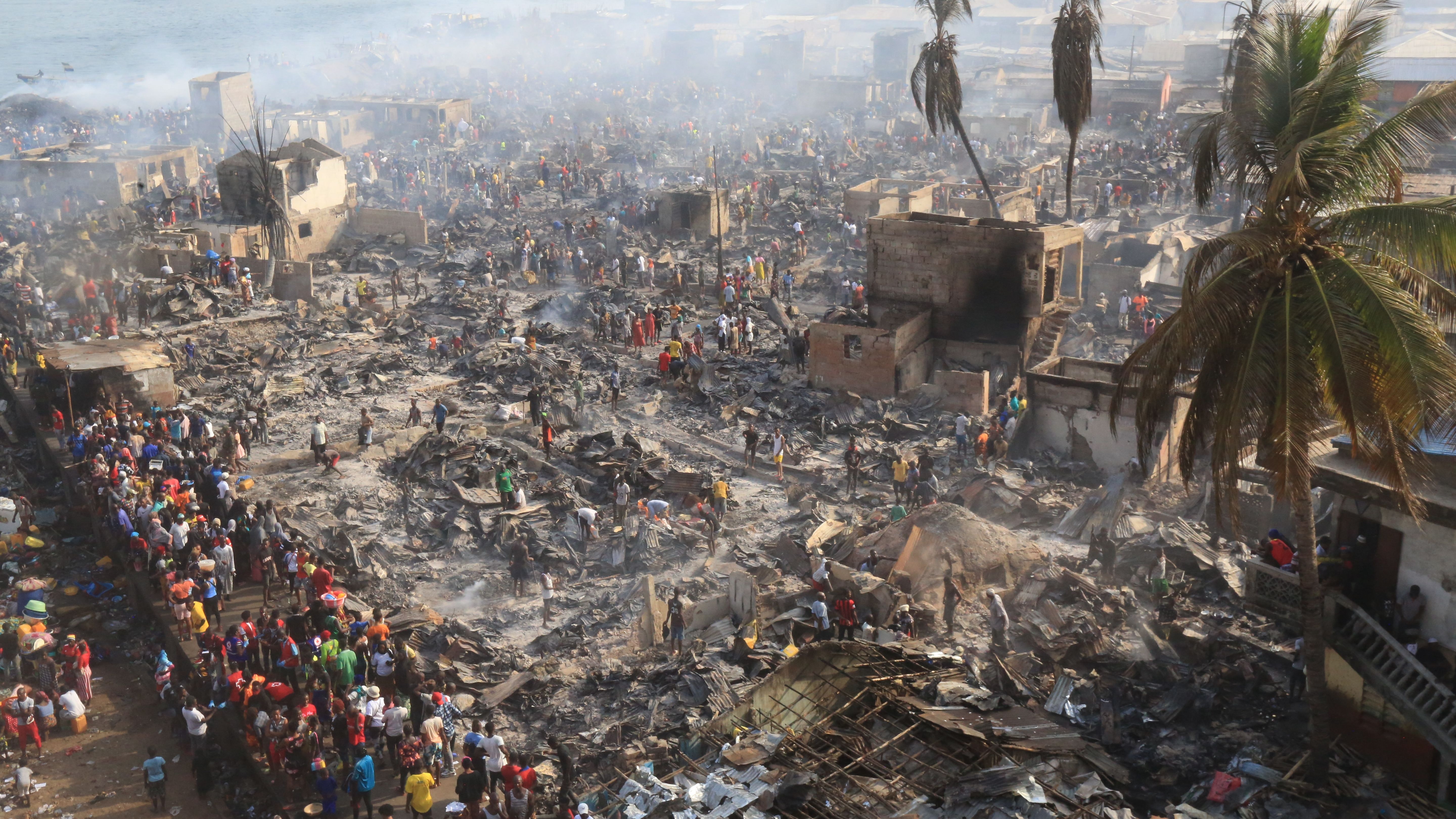
The situation seems to be worsening. For example, Freetown, the country’s capital, has experienced over 25 major urban fires since February 2021. This included the Susan’s Bay fire disaster that resulted in 7,000 people losing their homes in one night in March 2021. The city has large numbers of informal settlements and slums which are very vulnerable to disasters.
The solution often propagated by international institutions like the United Nations Office of Disaster Risk Reduction or the World Bank has been to develop formal disaster risk management programmes.
Sierra Leone also has a new National Disaster Management Agency, launched in November 2020.
While promoting better risk reduction is always sensible, it leads to a tendency for disaster management systems to lean heavily on experience and systems designs of other countries. These often require high levels of human, technical and financial resources which are not available at present in countries like Sierra Leone. Learning entirely from examples from abroad does not always mean “building back better”.
Shiny new systems on paper may sometimes remain divorced from the realities on the ground. As I have argued previously, local disaster management should also be built from the bottom up.
Read more: Sierra Leone faces coronavirus as rainy season hits – local disaster planning will be key
In places like Sierra Leone, disaster management is often conducted by volunteers and with limited funding. There may not be sustained attention or other resources to turn plans into regularly exercised practice.
The ‘air gaps’ between the formal building of disaster risk management systems and practical challenges mean that entire systems will be prone to failures and breakdowns.
But this is not to say that these gaps cannot be filled. There are many fixes that lie within the hands of disaster managers and officials. What is needed –- alongside formal capacity building -– is more concerted attention on those often small, rather specific and manageable challenges that have big consequences for the operation of disaster management.
We call these “single points of failure”. These single points of failure could be deficiencies in working infrastructure, like inoperable communication systems or broken equipment for firefighters. They could be human resources where say over-reliance on or lack of appropriate training of key individuals can lead to overstretch or errors or a lack of awareness of key procedures by local volunteers.
Diagnosing and addressing them is essential in building effective disaster risk management systems. Starting with the specific things that can be resolved, and understanding control measures needed to fix them, is the most effective and direct route to enhancing disaster response where resources are scarce.
Our research project, Driving African Capacity – Building in Disaster Management, was conducted in cooperation with Sierra Leone’s Office of National Security and National Disaster Management Agency as well as local partners, like Freetown City Council. It focused on finding these key points where disaster risk reduction and response can be improved, realistically and affordably.
Agreed areas for action
The project’s final report presents eight thematic areas and 27 immediate action points. The themes are:
- technical
- coordination
- communication
- capacity-building
- procedural
- human
- physical
- economic.
To arrive at these, we drew on the experiences of 559 participants over three years of research across Sierra Leone. We also incorporated viewpoints during COVID-19 and the Susan’s Bay fire. Among the participants were national policymakers, workers from international institutions and non-governmental organisations, local authorities, responders, community leaders and disaster management volunteers countrywide, including informal settlements.
The report represents perhaps the first comprehensive study of Sierra Leone’s existing disaster management arrangements and practice using this approach in detail. It identifies areas where national and local stakeholders agree that there are resolvable points.
They also agree that if these points are not addressed quickly, they are very likely to have severe consequences across the disaster management system of Sierra Leone.
Most (94%) of the national and local actors expressed concerns in relation to the numbers, provision, availability and training of human resources. And 88% identified missing or weak procedural implementation of plans and standard operating procedures in practice.
Comparable figures (88%) were also recorded for deficiencies in relations between the national agencies and the provinces and districts. Many (69%) of those interviewed also mentioned ineffective coordination between government ministries, departments and agencies as a hindrance to disaster risk reduction and response.
Basis for action
Nevertheless, 80% of national and local actors rated comparable single points of failure as resolvable in their ‘top five’ listings. The power to deliver solutions lies in the hands of the existing disaster managers who fundamentally agree on the same things. This provides a strong basis for concerted action in the future.
The report shows that solutions to delivering effective disaster risk management are not entirely about building formal systems. In many ways, formal systems are easiest to create, though expensive in Africa. The challenge lies in integrating and targeting these efforts with informal measures that can address the most pressing points that African disaster managers know from experience.
By endorsing the final report, the government of Sierra Leone acknowledges that there is an urgent need to give national and local actors ongoing support to address these single points of failure. Only by resolving the informal points can the formal – expensive – disaster risk management systems be strengthened.


