Technology transfer: how universities can harness research for real life:
All over the world, universities produce vast quantities of research. A great deal of this has the potential to make a difference in people’s lives: through the creation of new businesses and jobs, for instance, or in the form of technology that brings innovations to health and wellness.
But this potential isn’t automatically unlocked. This is where a process known as technology transfer comes in. Many universities, have offices dedicated to technology transfer. Their job is to oversee technologies mature from a concept, to a prototype, then a pilot demonstration and finally a commercial product or service.
South Africa’s universities are doing well when it comes to technology transfer. But the rest of the continent seems to be lagging behind. There are several reasons for this, including a lack of resources and capacity. But the biggest issue is a lack of access to funding. Technology transfer is expensive, and universities don’t make significant profit out of it. The value is largely derived by the licensee, who has the right to exploit the technology commercially.
The biggest value of technology transfer, though, is to society at large. The more enterprises that emerge out of research projects, the more jobs that will be created and a bigger boost to a country’s GDP.
Technology transfer requires a cultural shift in academia. Academics usually concentrate on doing research for the sake of publication. Technology transfer asks them to do more: to develop their ideas into commercial products or businesses. There are tremendous benefits and rewards if they do, including additional income and more money in their personal research funds.
African countries could benefit enormously from a focus on technology transfer, especially in terms of economic growth and job creation. It’s imperative for governments to get involved in driving technology transfer by equipping people with the necessary skills, driving a mindset change in academia and providing resources.
My own institution, the Cape Peninsula University of Technology, has established several successful technology transfer projects. We’ve done this by identifying gaps in the market, understanding what people want and harnessing our institutional skills. The lessons we’ve learned in the process may offer useful insights to others who want to forge this path.
Attrition rates
The amount of funding directed at research and development in the developed world is significantly greater than in developing countries. So, if you think of technology coming out of research as a pipeline, developing countries’ pipeline is much smaller.
The trick is to get a higher percentage of researchers focusing on research that can go through the technology transfer process.
Countries in Africa also need to focus on decreasing the attrition rate of technologies through the development cycle. It’s a long process, and it’s not always successful. The attrition rate is correlated with the type of technology being developed and the development duration. Technologies such as pharmaceuticals are a good example of a long development cycle with high development costs.
Academic peer review, as applied to journal articles, has a lower threshold than the market. Often the inadequacies of a researcher’s work are highlighted during the technology transfer process. For instance, the drug candidate could be shown to be toxic.
Another possible reason for technology attrition is that funding may dry up. Finally and very importantly, technologies are developed by people. Often these individuals are soft funded, meaning their salary is not paid for by an institution but rather from grant funds. The loss of key individuals in a development team can hamper or prevent the project from continuing.
One way to lessen this attrition rate is by localising technologies. In this model, technologies patented in other countries and proven commercially can be re-developed or engineered for an African country’s context. This is perfectly legal because patent protection is country specific. A good example of localisation is Baidu, which is essentially the Chinese version of Google. A good strategy for a researcher in Africa is to have a mix of projects focusing on unique research as well as localisation.
Success stories
There have been some successful technology transfers at African universities in recent years.
At my own institution, Cape Peninsula University of Technology, technology transfer has allowed us to make great strides in two important areas: outer space (specifically, nanosatellites) and food.
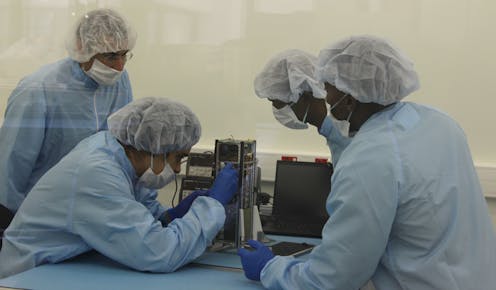
Amaya Space is one of our spin-off companies, which works to commercialise all of the space related technologies emerging from the university. It’s been successful partly because we identified a gap in the market. We noticed that more countries and private companies globally were investing in nanosatellite subsystems. And we understood that South Africa’s space sector needed more expertise, products and services.
Read more: Cool cubes are changing the way we play in space
The solution was simple: we had the technology, the expertise and the will to enter the space sector. Amaya Space was born, and today the institution has eight separate intellectual property rights. These are protected as confidential information (know-how) because we are continuously developing the technology. We also recently launched the most advanced nanosatellite developed in Africa.
The Bambara technology portfolio is another success story. The Bambara Groundnut is widespread in Africa and is known by various names. It has potential as a cash crop because of its nutritional composition, functional properties and antioxidant potential.

Again, our institution identified a gap. We’ve used the Bambara Groundnut as a raw material to create several products, like dairy substitutes, baked goods, meat substitutes, and beverages. These products are gluten-, lactose- and cholesterol-free. This taps into the country’s growing consciousness of and demand for healthier diets. It also recognises that African climates are changing: the groundnut can grow under drought conditions.
In these examples, part of the secret to success has been in spotting gaps in the market and identifying areas of need in the country.
This is an important lesson for others who want to get involved in technology transfer.

Revel Iyer receives funding from the National Intellectual Property Management Office (NIPMO).
Source: The Conversation – Articles (AFRICA)
Read more on The Conversation.
Join the fun: Add Your event | Submit a Press Release | Add your listing.


